Singing
Made with ♥ by Maristella Povellato
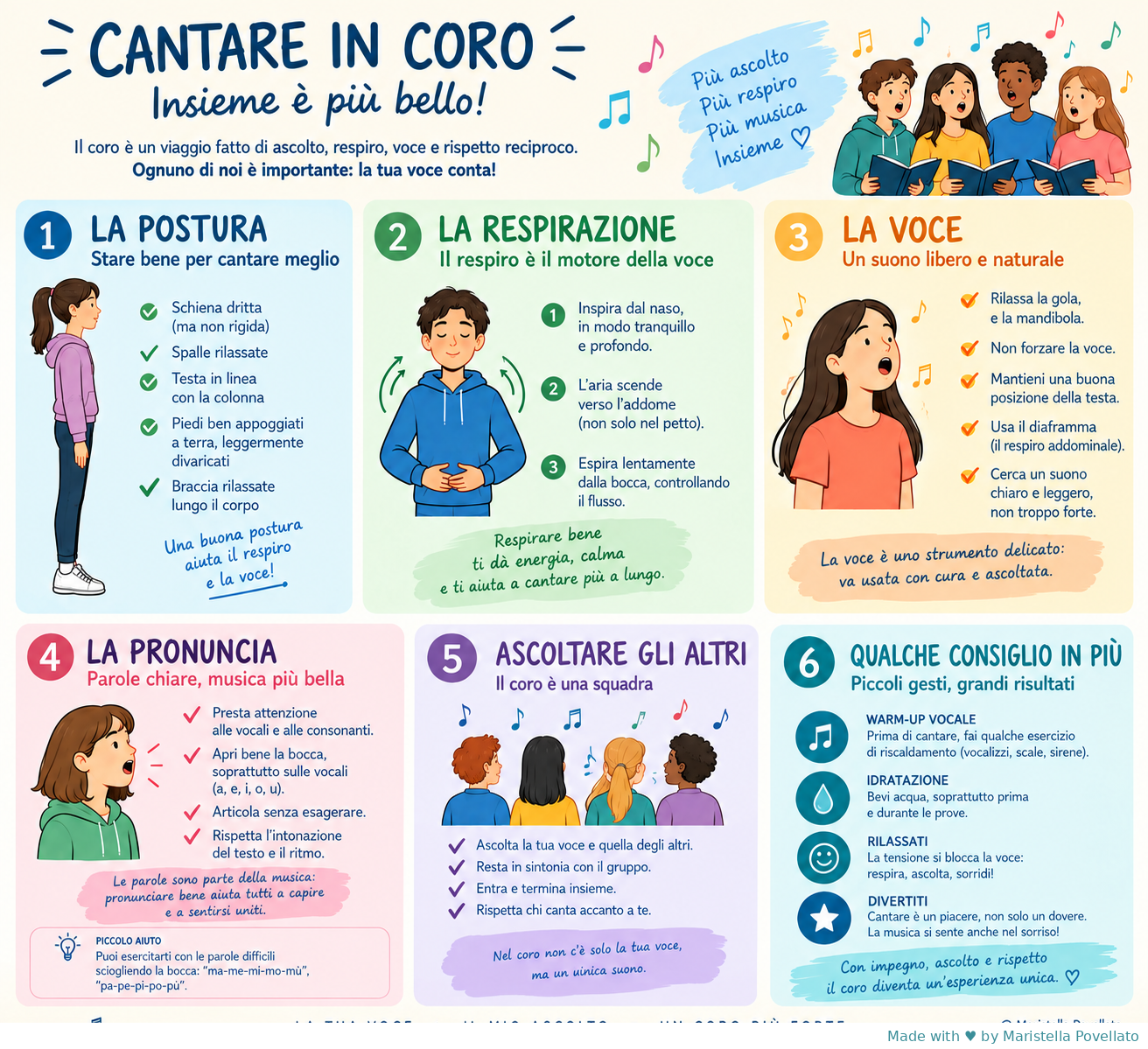
Singing is the most natural instrument we have: with your own voice, you can explore different melodies, rhythms and styles, warming up your voice and singing together with skill and enjoyment.
Vocal Warm-Up
Breathing, articulation and pitching exercises to prepare your voice safely.
Reading and Syllables
From the rhythm syllables TA, TI, RI to reading melodies, to help you sing accurately.
Technique and Phrasing
Learning about the vocal system, articulating the words and paying attention to musical phrasing.
Class Repertoire
Songs, scores and pieces from different musical genres for everyone to sing together.
Singing course
In our voice practice, we work on breathing, pronunciation, voice production, listening and rhythm. The exercises are short, repeatable and designed for everyone to do together without being judged. We will also learn many songs from a wide range of repertoires.
Diaphragmatic Breathing
Place your hands on your tummy and breathe in slowly through your nose, feeling your abdomen expand. Breathe out through your mouth as if you were blowing on hot soup. Repeat 5 times before singing.
Vocal Exercises on Syllables
Sing the major scale on "la-la-la", "mi-mi-mi" and "no-no-no", starting on a comfortable note. Gradually widen your range without straining your voice.
Articulating the Words
Slowly say "Ta-Ti-Ti Ta", "Pe-Pi-Pe-Po" and "Mi-Ma-Mu-Mo", moving your lips and tongue carefully. Clear articulation makes the words understandable to everyone.
Singing in Tune as a Group
One pupil gives the others an A using a tuning fork or an app; the class repeats the same note, trying to match it. Then move on to short two-note melodies.
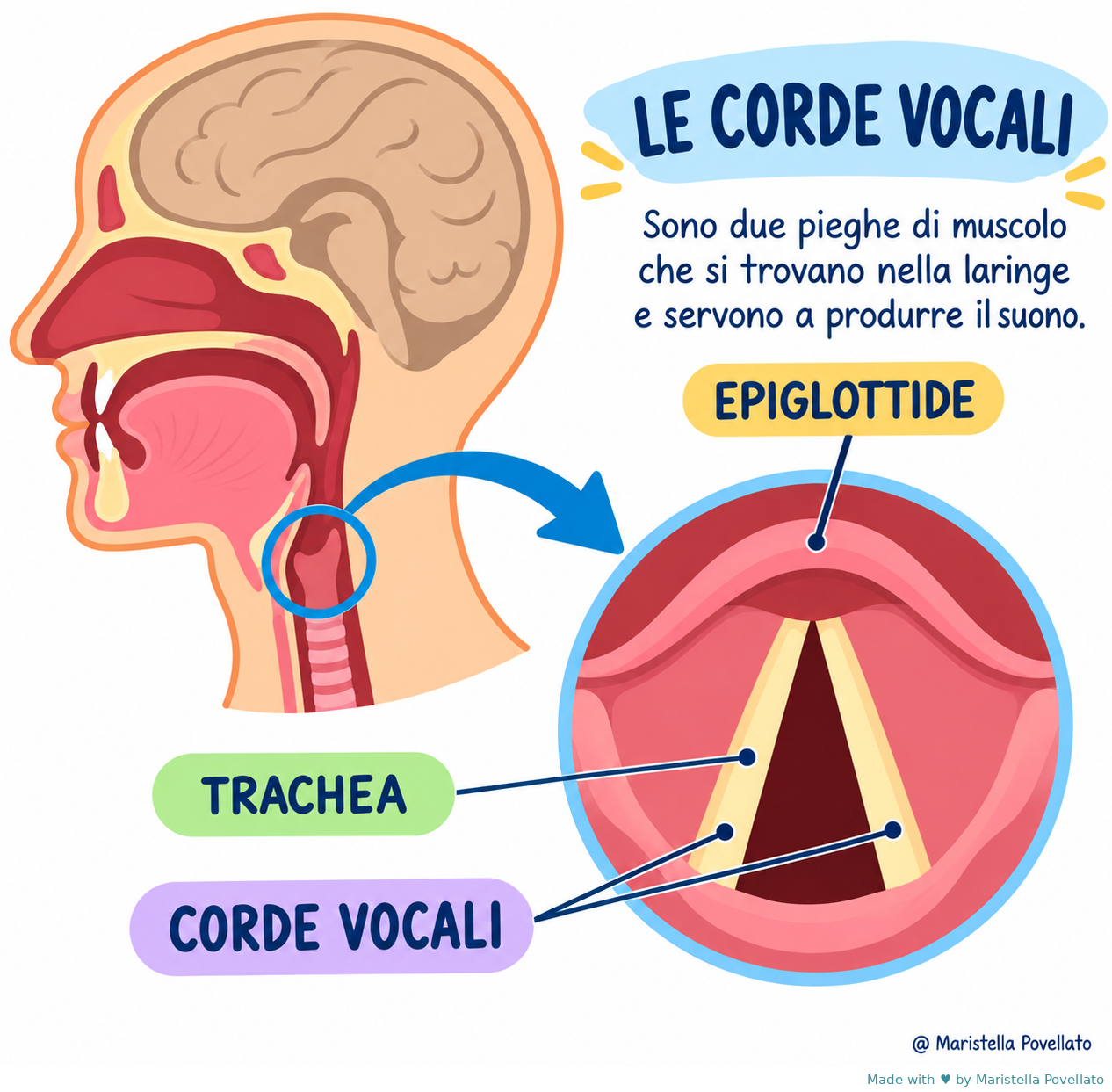
Anatomy
Knowing how the voice works helps you sing naturally, safely and effectively.
Made with ♥ by Maristella Povellato
The resonating chambers
Depending on the pitch, the sound enters different cavities. From lowest to highest:
- U — the lowest, in the mouth/lips.
- O — a little higher, in the pharynx/larynx.
- A — a middle pitch, in the centre of the larynx.
- E — in the mouth, near the sinuses.
- I — the highest sound, with its resonating chamber in the centre of the forehead.
Vocal cord problems
Speaking or shouting at an excessively high pitch rubs the vocal cords together and can cause small calluses (nodes or nodules), lowering the voice. Singing without control dries them out and makes them stiff, causing pain. This is why people who use their voices a lot need to drink plenty of water.
The right way to breathe for singing
There are three types of breathing:
- Costal: the chest and sometimes the shoulders rise — this is not the right way to breathe for singing.
- Abdominal: the lungs inflate too much, the abdomen is pressed too hard and the diaphragm works too much — useful after physical effort, but not for singing.
- Mixed or costo-diaphragmatic: this is the right way. Start relaxed and breathe in as if smelling a flower, without raising your shoulders; the ribs and diaphragm expand forwards to let the air through. Air enters through the nose, passes through the larynx and trachea, and reaches the lungs, which expand as the diaphragm moves down.
Before singing
You can train your voice with vocal exercises: short patterns of 4-5 notes repeated going up and down, using vowel sounds. Before each exercise, breathe deeply and correctly; produce the sound in a relaxed, natural way, paying attention to singing exactly in tune.
Phonetics
Phonetics studies what speech sounds are like and how they are produced. In singing, it helps you pronounce words clearly: knowing where each sound is formed allows you to open it up, shape its tone and keep it steady on the note.
Made with ♥ by Maristella Povellato
The seven Italian vowels
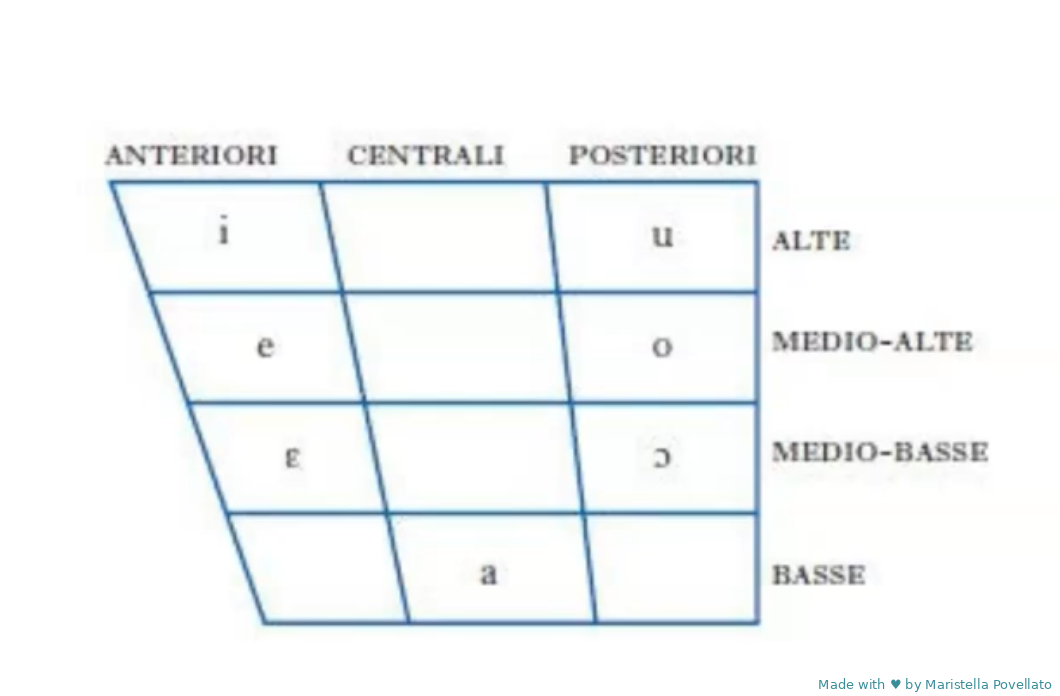
The alphabet has 5 vowel letters, but Italian uses 7 vowel sounds: e and o have both a close and an open version. In the International Phonetic Alphabet (IPA), each sound has just one symbol, so pronunciation can be read without ambiguity.
| IPA | Type | Tongue | Example |
|---|---|---|---|
| i | chiusa | front, high | vita, fine |
| e | chiusa | front, mid-high | melo, bacio |
| ɛ | aperta | front, mid-low | bello, tetto |
| a | aperta | central, low | casa, mare |
| ɔ | aperta | back, mid-low | solo, bocca |
| o | chiusa | back, mid-high | moto, canto |
| u | chiusa | back, high | luna, cuore |
How to read the vowel chart
The chart is a map of the mouth seen from the side. The columns show how far the tongue is towards the front (front vowels) or back (back vowels); the levels show how high o low. The vowel i is at the top and front, with the tongue raised high; u is at the top and back, with rounded lips; a is at the bottom and centre, with the mouth open and the tongue low.
When you sing, the position of your tongue changes the tone colour: this is why an «a» sung on a high note is not the same as an «a» spoken on the phone, and an «i» that is too tight becomes thin and piercing.
Vowels in singing
- The vowel carries the sound: stay on the same vowel for the full length of the note, without sliding towards another one.
- Italian vowels are pure: do not add a glide at the end (the English «go» sounds like «gou-ou», while the Italian «solo» stays «sɔlo»).
- On high notes, close vowels (i, e, u, o) tend to open, and open vowels (ɛ, ɔ, a) tend to close: aim for a focused sound, not a strained one.
- Do not add a vowel at the end of shortened words: sing «cantar», not «cantar-a».
Made with ♥ by Maristella Povellato
Consonants: how they are formed
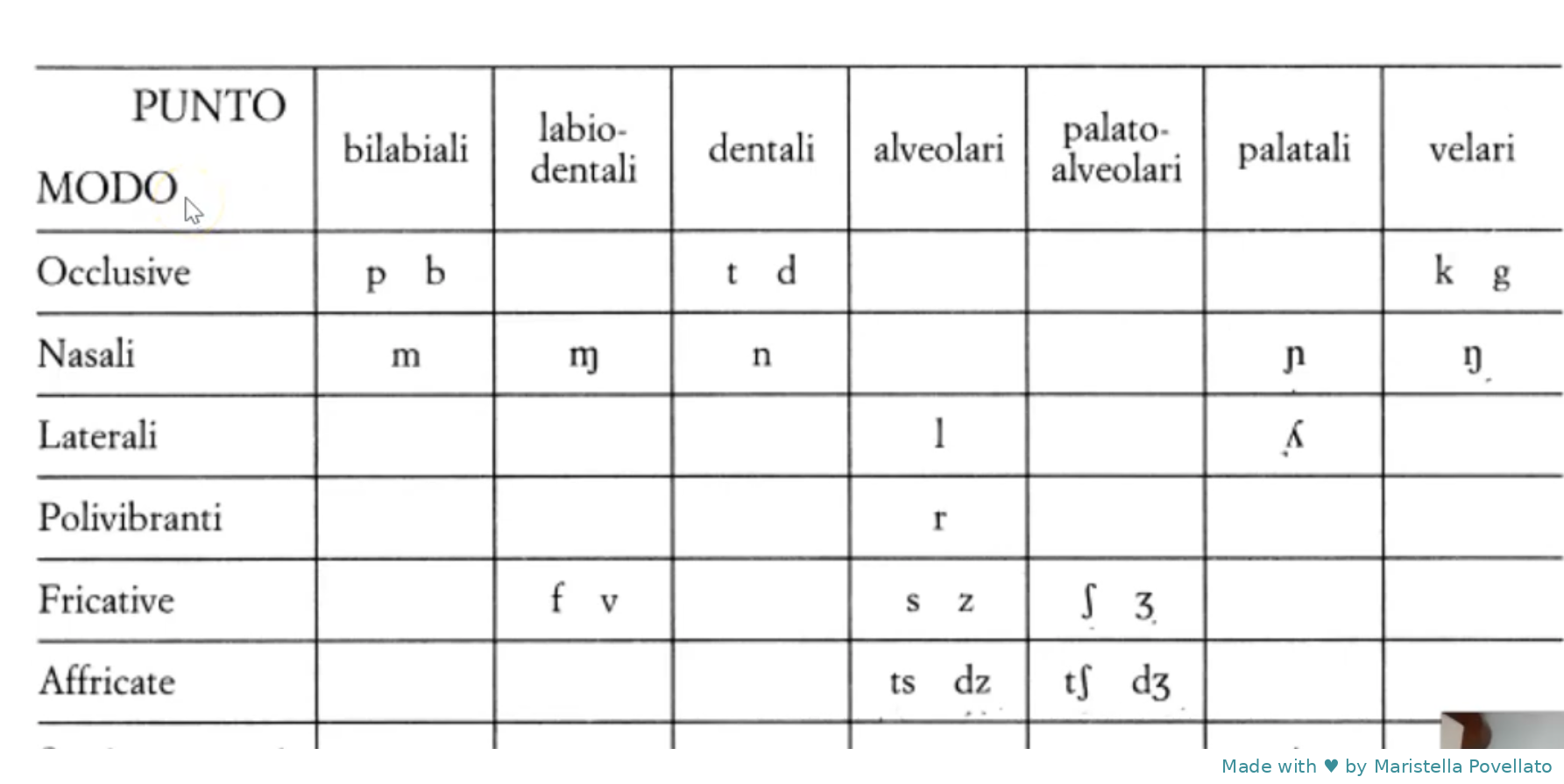
Consonants are formed when parts of the mouth (lips, teeth, tongue, palate, uvula) come close together or close off the airflow. The IPA chart arranges them by place — where the obstruction occurs — and by manner — how it happens: plosives block the air and release it suddenly (p, t, k), nasals let it pass through the nose (m, n, gn), fricatives let it pass with friction (f, s), affricates combine the two actions (ts, c in «cena»), and the trill makes the tip of the tongue vibrate (r).
| MANNER ↓ / PLACE → | bilabiali | labio-dentali | dentali | alveolari | palato-alveolari | palatali | velari |
|---|---|---|---|---|---|---|---|
| Occlusive | p b | · | t d | · | · | · | k g |
| Nasali | m | ɱ | n | · | · | ɲ | ŋ |
| Laterali | · | · | · | l | · | ʎ | · |
| Polivibranti | · | · | · | r | · | · | · |
| Fricative | · | f v | · | s z | ʃ ʒ | · | · |
| Affricate | · | · | · | ts dz | tʃ dʒ | · | · |
| Semiconsonanti | · | · | · | · | · | j | · |
Within the same cell, the symbol on the left is voiceless (the vocal cords do not vibrate: p, t, k, f, s), while the one on the right is voiced (they vibrate: b, d, g, v, z). Try placing your fingers on your larynx and saying «sss», then «zzz»: with the second sound, you can feel the buzzing.
Sounds, letters, examples
In Italian, the same letter can represent different sounds: the c in «casa» (/k/) is not the same as the c in «cena» (/tʃ/), and the s in «sole» (/s/) is not the same as in «sveglio» (/z/); gn e gl each represent a single sound (/ɲ/ and /ʎ/). The IPA removes any doubt.
| IPA sound | How it is written | Example |
|---|---|---|
| p · b | p, b | pasta · bella |
| t · d | t, d | terra · dado |
| k · g | c, ch, q · g, gh | casa, che · gola, spaghetti |
| m | m | mamma |
| ɱ | m before f or v | invidia, anfora |
| n | n | nonno, luna |
| ɲ | gn | gnomo, agnello |
| ŋ | n before c or g | panca, lungo |
| l | l | latte, sole |
| ʎ | gl (i) | aglio, figlio |
| r | r | rosa, carro |
| f · v | f, ff · v | fila, caffè · vetro, uva |
| s · z | s, ss · s between vowels | sole · sveglio, rosa |
| ʃ · ʒ | sc + e/i, sci | scena, azione · giorno (in some pronunciations) |
| ts · dz | z, ti · z, zz | zio, piazza · zero, azzurro |
| tʃ · dʒ | c + e/i, ci · g + e/i, gi | cena, cielo · giorno, genere |
| j | i, y | piede, miele, yogurt |
The chart does not include the semiconsonant w (the u in «uomo», «uovo», «guerra»), which in Italian forms a pair with j (the i in «piede», «miele»).
Consonants in singing
- Consonants are very brief interruptions: make them quick and percussive, then return immediately to the vowel.
- Double consonants must really be doubled, with a clear stop: «ar-resto», «bel-la», «som-ma».
- Shortened words end with their final consonant: «andré», «cantâr».
- For nasal consonants (m, n, gn), move your lips and tongue only at the very last moment, to keep the vowel sound clear.
Exercises
A reading exercise sheet to use during singing activities: read, tap the rhythm and sing in tune.
Made with ♥ by Maristella Povellato
The school anthem — "Scuola Albinoni Rap"
Music: Prof.ssa Maristella Povellato · Lyrics: classes 2B and 2C
Why sing our school anthem
"Scuola Albinoni Rap" was created as the anthem ofIstituto Comprensivo Selvazzano1 in Selvazzano Dentro (PD): the music was composed by Prof.ssa Maristella Povellato, while the lyrics were developed together with pupils from classes 2B and 2C in previous years. Singing it today means carrying on a project that brings together words and rhythm, memory and creativity, teachers and pupils.
An anthem is not just a song: it is the sound of a community. When we all sing it together, we become part of something bigger: we feel that we belong to the same school, share the same values and build the same memories. Music, especially rap, allows us to express ourselves in everyday language, making the message accessible, engaging and memorable.
Singing "Scuola Albinoni Rap" is a way to feel more united: our voices blend, the rhythm carries us along and the words remind us of who we are, where we study and what connects us. This is why I would like future pupils to learn it too, make it their own and sing it with pride: music has the power to make us more united, more confident and happier to be part of a school that believes in creativity and sharing.
Class identity
An anthem helps us see ourselves as a group.
Sense of belonging
Singing together strengthens our connection to the school.
Shared creativity
Music and lyrics grow out of working together.
The school rap is sung by everyone together: the opening slogan, the verses written by the classes about subjects, rules, friendship, teachers, sport, art and music, and the chorus over the chords DO – FA – LAm – SOL. Below you will find the full lyrics with chords and the backing track to practise with and sing along to in class.
Made with ♥ by Maristella Povellato
Albinoni Rap Anthem backing track
Use the player to listen to the backing track, or download it to use in class or at home.
Made with ♥ by Maristella Povellato
SONG LINKS
Open the folder containing the songs, backing tracks and materials for classroom singing activities.