1

Middle school · Year 1

01

Sound and its properties

Sound and its properties: pitch, loudness, timbre, duration Download

Made with ♥ by Maristella Povellato

Listen to the text

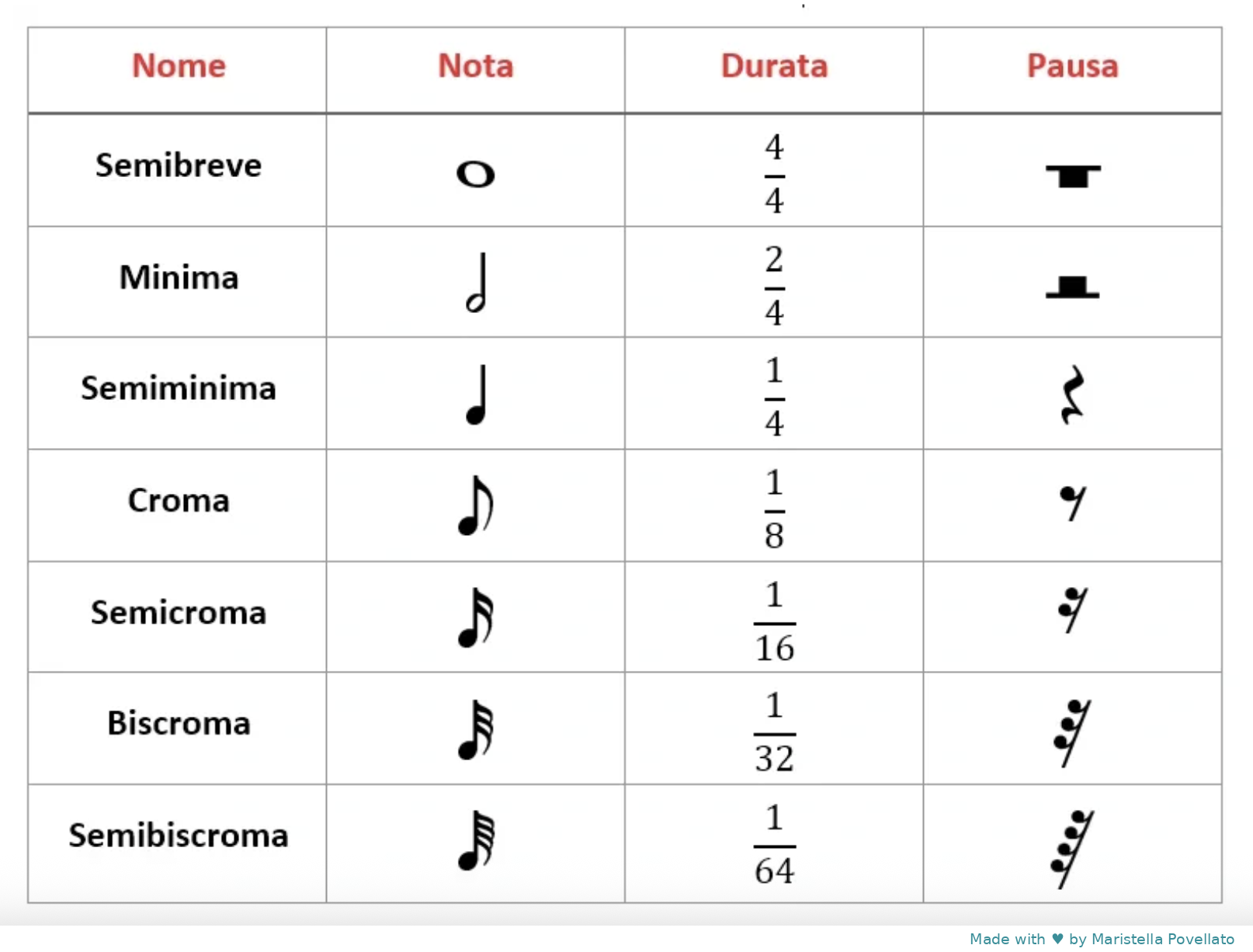
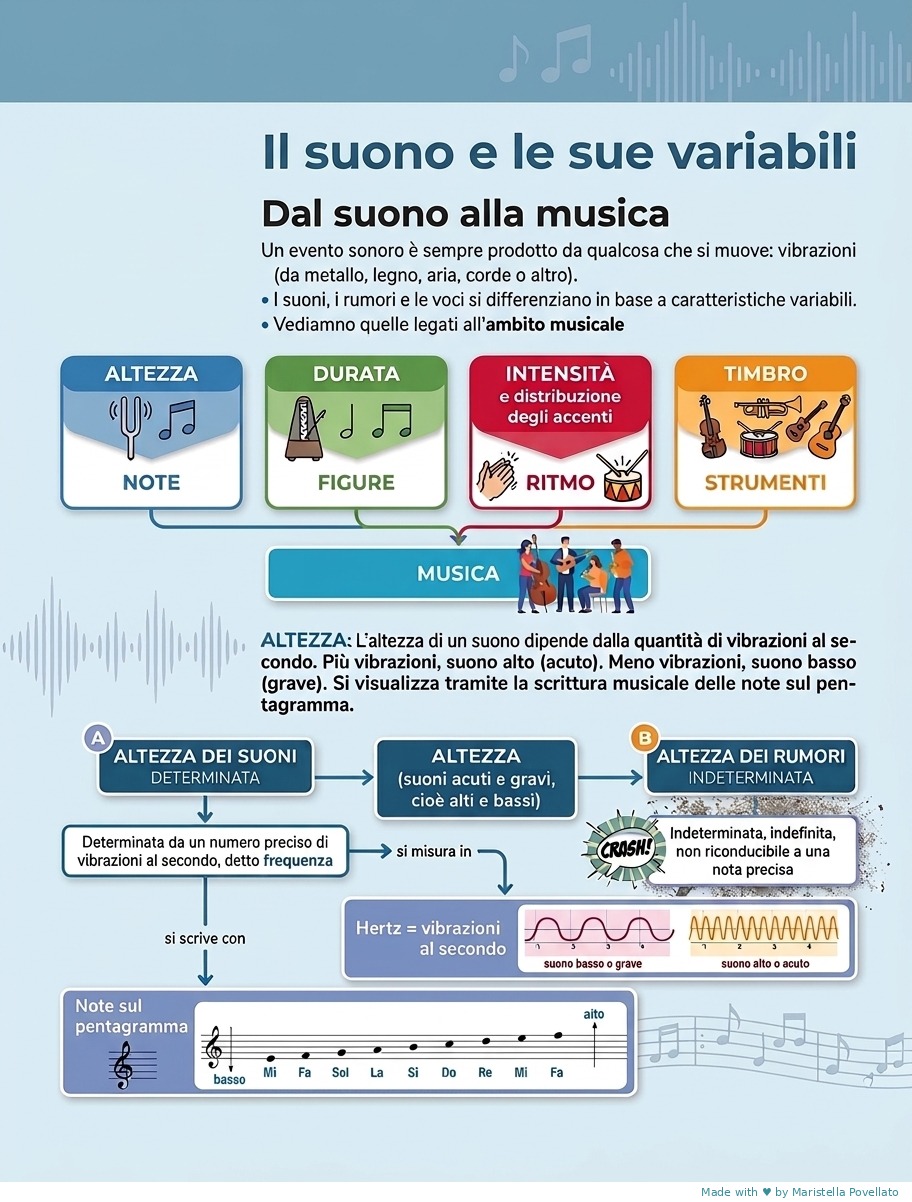
Sound is a vibration that travels through the air in the form of waves. When a wave reaches our ear, it makes the eardrum vibrate and we hear the sound. Musical sounds have regular (periodic) vibrations; noises have irregular vibrations. Every sound has four basic properties: pitch, loudness, timbre and duration. PITCH — Pitch depends on frequency, which is the number of vibrations per second (measured in hertz, Hz). More vibrations = a high-pitched sound (e.g. flute, soprano voice, violin). Fewer vibrations = a low-pitched sound (e.g. double bass, tuba, bass voice). The human ear can hear sounds from about 20 Hz to 20,000 Hz. Pitch is written on the stave: the higher the note is placed, the higher its pitch. LOUDNESS — Loudness depends on the amplitude of the vibration and is measured in decibels (dB). In music, Italian terms called dynamic markings are used: pianissimo (pp), piano (p), mezzopiano (mp), mezzoforte (mf), forte (f), fortissimo (ff). Crescendo (<) and diminuendo (>) signs indicate a gradual change in loudness. TIMBRE — Timbre is the 'colour' of a sound: it allows us to distinguish different instruments and voices even when they play the same note. It depends on the harmonics produced by the vibrating object. In music, timbre is described using many adjectives: light, dark, bright, warm, cold, sweet, harsh, ringing, soft, rough, velvety, nasal, metallic, woody, crystalline, rich, full, thin, penetrating, veiled, mellow, silvery, sombre, clear. Examples: the flute is light and crystalline, the oboe is nasal and penetrating, the cello is warm and rich, the trumpet is ringing and metallic, the clarinet is soft and velvety, and the bassoon is dark and woody. DURATION — Duration is the length of time a sound lasts. It is represented by note values: semibreve (4 beats), minim (2), crotchet (1), quaver (1/2), semiquaver (1/4), demisemiquaver (1/8). Each note value has a matching rest of the same duration. Note values are organised into bars according to the time signature (2/4, 3/4, 4/4, 6/8). We pick up and hear music through our ears. Here is an infographic of our hearing system (the ear). SOUND PROPERTIES APP
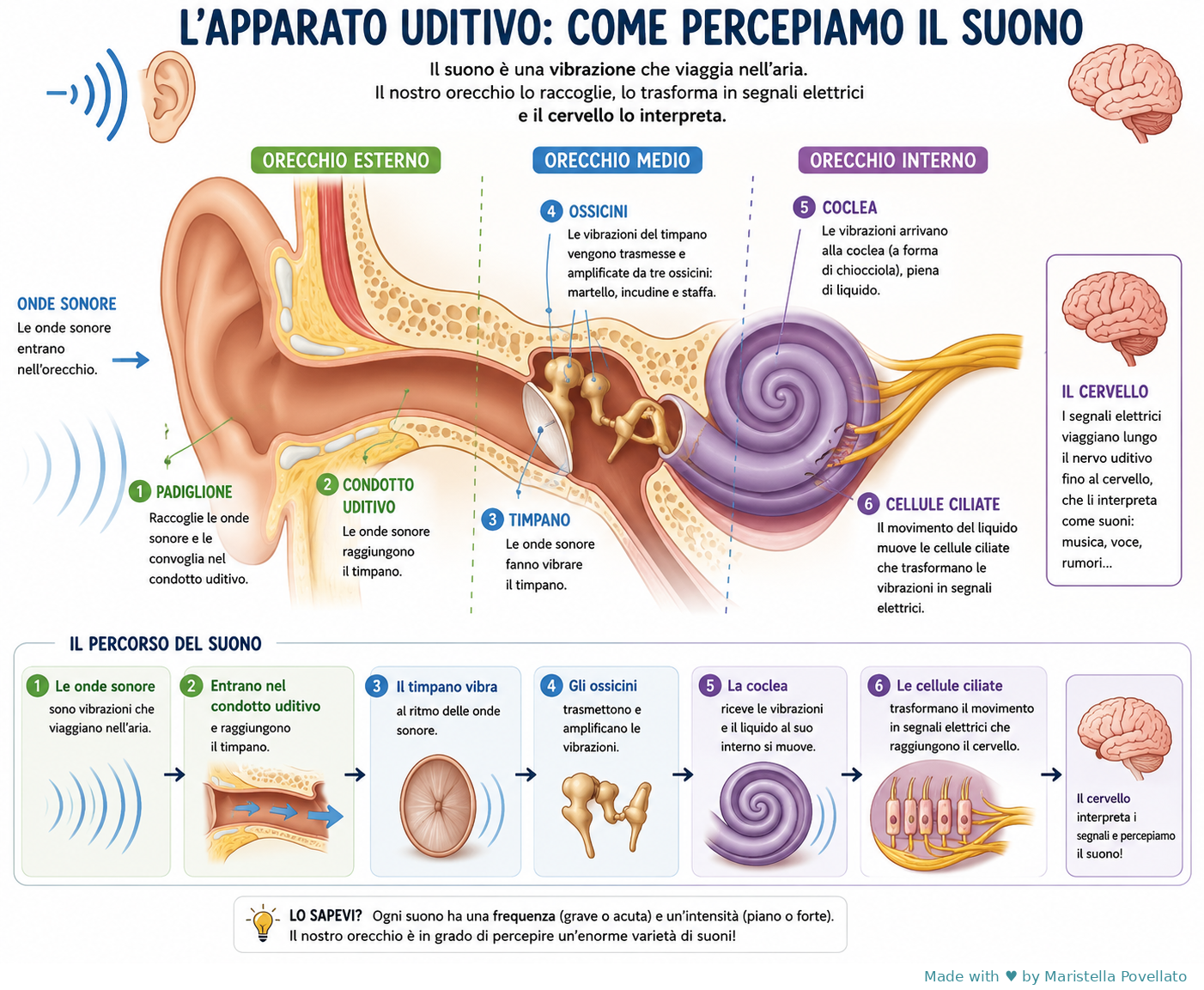
L'apparato uditivo: come percepiamo il suono
The hearing system: how we hear sound Download

Made with ♥ by Maristella Povellato

GO TO QUIZ
02

Notes and the stave

Listen to the text

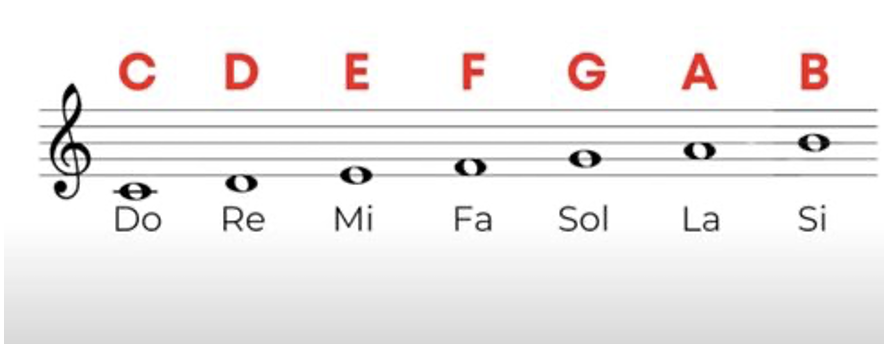
THE STAVE — The seven musical notes are: DO – RE – MI – FA – SOL – LA – SI. To write them, we use the stave, which consists of 5 lines and 4 spaces, numbered from bottom to top.

Notes in the treble clef
Download infographic

Made with ♥ by Maristella Povellato

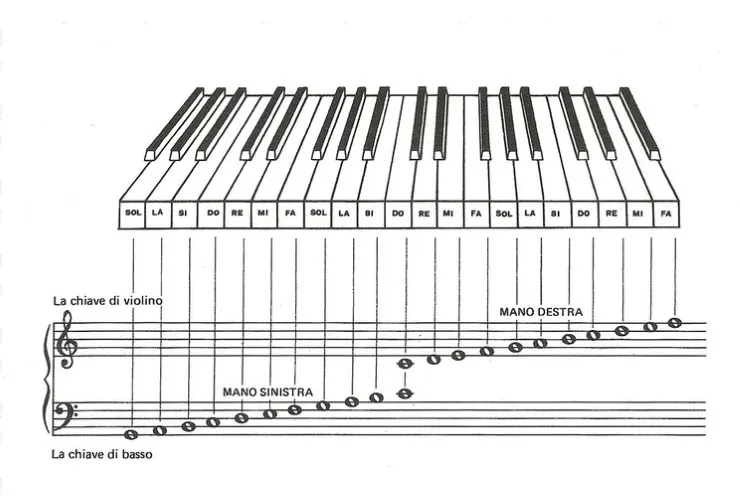
🔑 WHAT IS A CLEF FOR? — A musical clef is usually placed at the beginning of the stave and tells us the pitches of the notes. The most important ones are: 🎼 Treble clef, or SOL clef → marks SOL on the second line. 🎼 Bass clef, or FA clef → marks FA on the fourth line. The clef therefore acts as a reference point: once one note has been established, we can identify all the others. 🎻 THE TREBLE CLEF — The treble clef is also called the SOL clef because its symbol marks SOL on the second line of the stave. It is one of the most widely used clefs and is used for the violin, flute, clarinet, piano and voice, among others. ⬆️⬇️ HOW DO WE READ NOTES? — Once we have found SOL on the second line, we can proceed like this:

Relationship between the treble clef and the bass clef
Download infographic

Made with ♥ by Maristella Povellato

Upwards → increasingly high-pitched sounds: SOL → LA → SI → DO → RE → MI → FA... Downwards → increasingly low-pitched sounds: SOL → FA → MI → RE → DO → SI → LA... The notes alternate between lines and spaces. 🧠 A MEMORY TRICK — In the treble clef, we can learn these separately: NOTES ON THE LINES: MI – SOL – SI – RE – FA. NOTES IN THE SPACES: FA – LA – DO – MI. 💡 Remember: as we move up the stave, the notes become higher in pitch; as we move down, they become lower. ➕ WHAT IF THE NOTES GO BEYOND THE STAVE? — When we need to write notes higher or lower than the five lines allow, we use ledger lines: short lines that effectively extend the stave. IN SUMMARY — 🎼 The clef tells us where to start. 📍 SOL on the second line is our reference point. ⬆️ Moving up = higher-pitched sounds. ⬇️ Moving down = lower-pitched sounds.

Here are some useful exercises to practise reading notes:

GO TO QUIZ
03

Duration

Listen to the text

In music, the duration of sounds and silences is shown using specific written symbols. Just as a word is made up of letters and syllables, a piece of music is built by combining sounds and silences (rests) of different lengths. To understand note values, imagine a whole cake being divided into smaller and smaller pieces. The longest note is worth 4 quarter-note beats (the whole cake), and the following notes represent fractions of it.

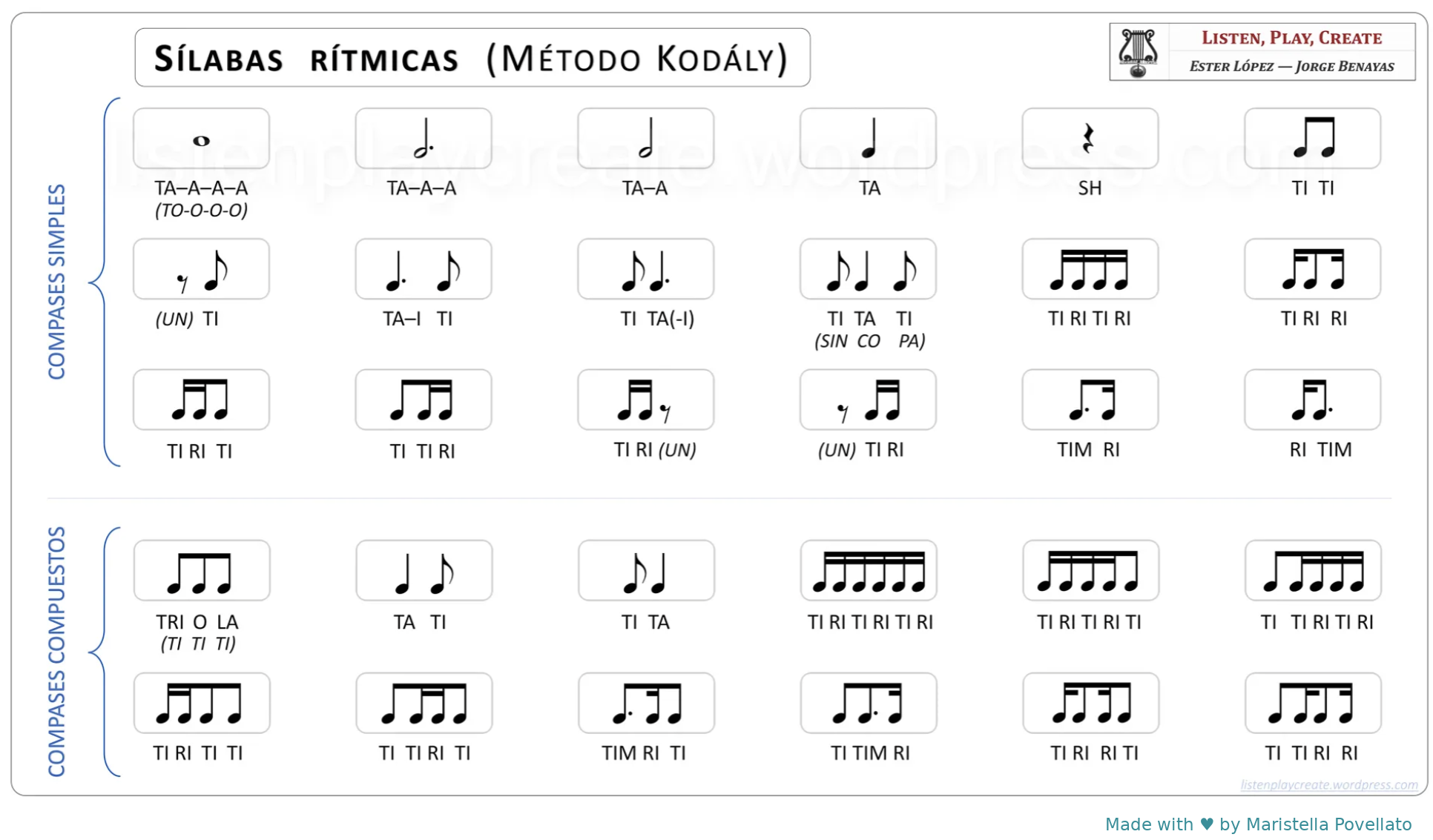
🎵 THE KODÁLY METHOD OF RHYTHM SYLLABLES The Kodály method, developed by the Hungarian composer and music educator Zoltán Kodály, offers a natural and enjoyable way to explore music through singing, the voice and movement. One of its best-known techniques is the use of rhythm syllables: each note value is matched with a spoken syllable, so that you learn to read and sing rhythms before playing them on an instrument. The table below shows the most commonly used syllables: TA for a quarter note, TI-TI for eighth notes, TI-RI-TI-RI for sixteenth notes, and so on. Try reading the notes while moving your hands to the beat: sound becomes words, and rhythm becomes a game!

Rhythm syllables in the Kodály method
Download infographic

Made with ♥ by Maristella Povellato

Interactive duration chart

Tap a note symbol to hear its duration in a 4-beat rhythm

Durata di note e pause
Duration of notes and rests Download

Made with ♥ by Maristella Povellato

GO TO QUIZ
04

Voices: classification in opera and pop

Listen to the text

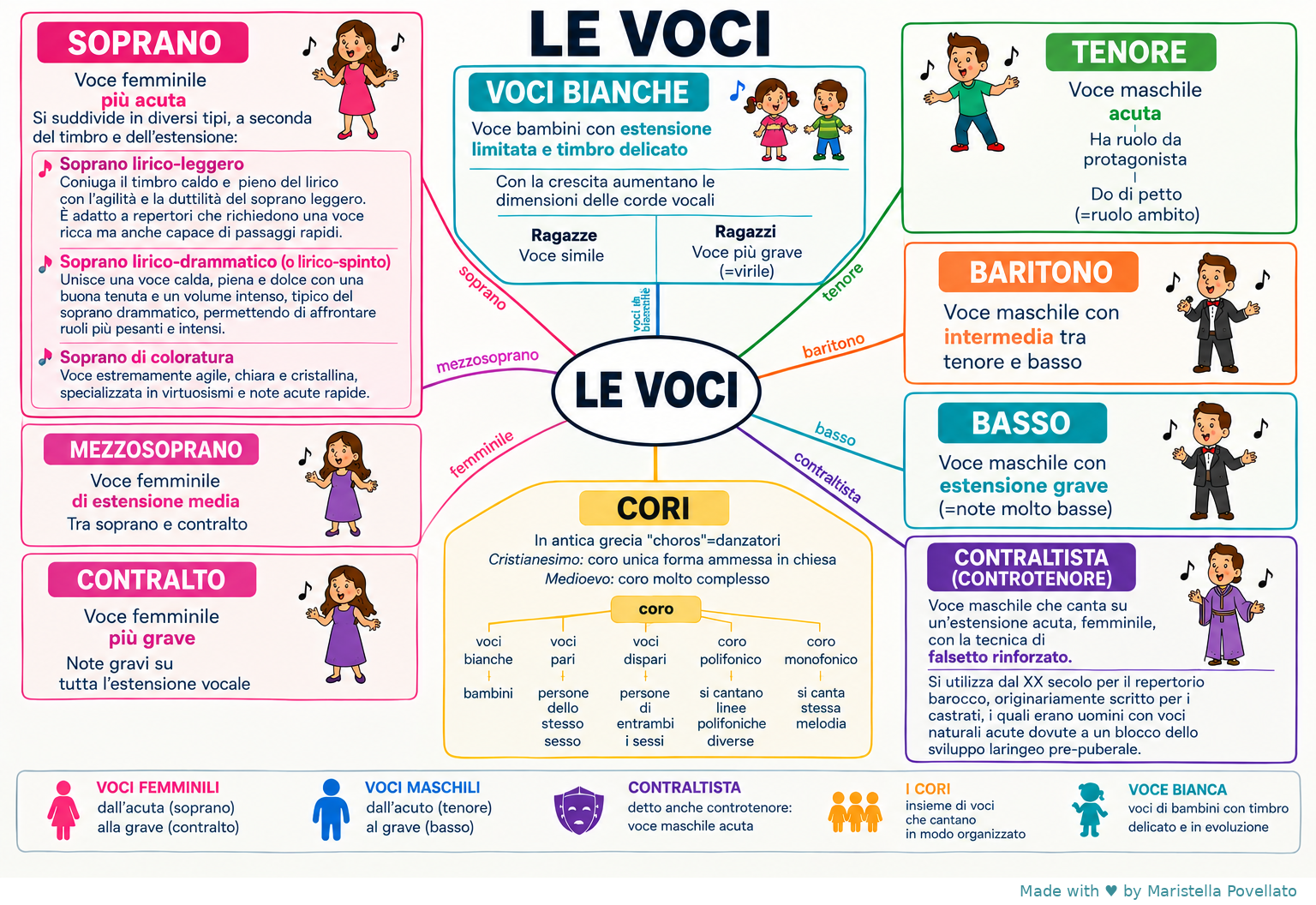
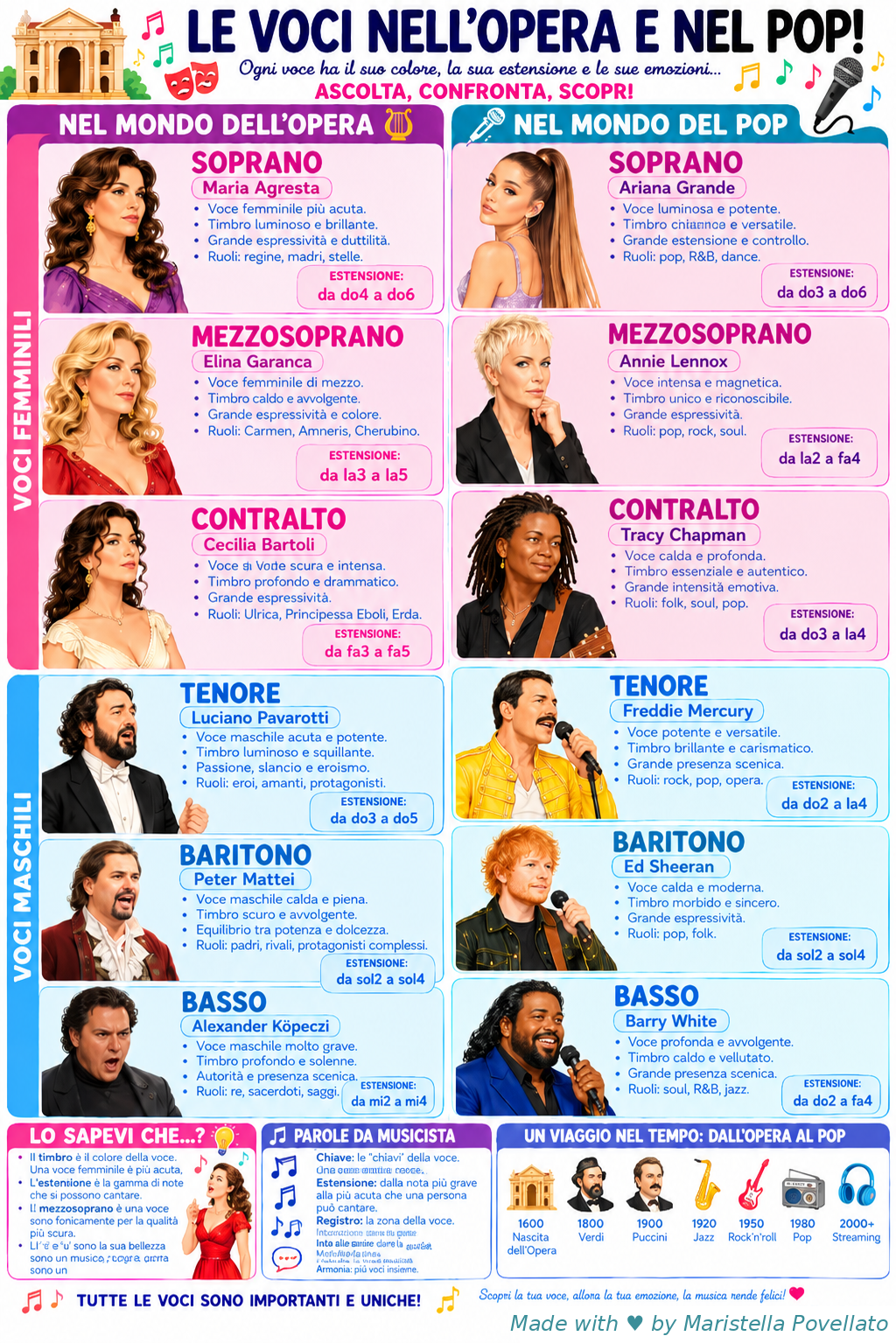
Human voices are classified according to two main features: RANGE (the lowest and highest notes a voice can sing) and TIMBRE (the 'colour' of the voice). ═══ IN OPERA ═══ FEMALE VOICES • SOPRANO — the highest female voice. Types include light soprano (agility and very high notes, e.g. Regina della Notte in Mozart) and dramatic soprano (middle register, powerful voice). • MEZZO-SOPRANO — a female voice between soprano and contralto, lower than a soprano. • CONTRALTO — the lowest female voice, with a deep, dark timbre. MALE VOICES • TENOR — a high male voice, often singing the leading role in an opera. The famous 'Do di petto' is the note tenors most aspire to sing. • BARITONE — a middle-range male voice, between tenor and bass. • BASS — a male voice with a low range (very low notes). CHILDREN'S VOICES — children's voices have a limited range and a delicate timbre. As children grow, their vocal cords lengthen: girls' voices remain similar, while boys' voices become deeper and more adult — this is the 'voice change' of puberty. CHOIRS — from the Greek 'choros' (dancers). In Christianity, choral singing was the only form of music allowed in church; in the Middle Ages it became very complex. Types of choir: children's choir, equal-voice choir (people of the same sex), mixed-voice choir (both sexes), polyphonic choir (different melodic lines), monophonic choir (the same melody in unison). ═══ IN POP MUSIC ═══ In pop, rock, jazz and light music, voices are not classified as strictly as in opera, but according to RANGE (from the lowest to the highest note a person can sing) and the VOCAL TECHNIQUE used. FEMALE VOICES • POP SOPRANO — a very high, bright voice (Mariah Carey, Ariana Grande, Whitney Houston). • POP MEZZO-SOPRANO — a middle-range female voice, warm and full (Adele, Beyoncé, Rihanna). • POP CONTRALTO — a low, deep female voice, which is rare (Cher, Amy Winehouse). MALE VOICES • POP TENOR — a high male voice (Freddie Mercury, Bruno Mars, Michael Jackson on high notes). • POP BARITONE — a middle-range male voice, the most common in pop (Frank Sinatra, Elvis Presley, Ed Sheeran). • POP BASS — a very low male voice (Johnny Cash, Barry White). POP VOCAL TECHNIQUES • CHEST VOICE — the full, powerful voice of the middle-to-low register. • HEAD VOICE — a light, high voice, with resonance felt higher in the head. • MIXED VOICE — blends chest and head voice: it is the basic technique of modern pop. • FALSETTO — an artificially high, thin male voice (Bee Gees, Prince, The Weeknd). • BELTING — powerful singing in a high register, typical of musicals and pop (Beyoncé, Christina Aguilera). • GROWL / SCREAM — a rough, distorted voice, used in rock, metal and blues. • VIBRATO — a slight wavering in a note's pitch that adds expression. Unlike in opera, in pop the voice is almost always AMPLIFIED with a microphone and can be altered using effects (reverb, autotune, delay).

🎵 Listen to the vocal examples in the VOICE PLAYLIST.

Le voci: classificazione e cori
Voices: classification and choirs Download

Made with ♥ by Maristella Povellato

Le voci nell'opera e nel pop
Voices in opera and pop Download

Made with ♥ by Maristella Povellato

GO TO QUIZ
05

Classification of instruments (Hornbostel-Sachs)

Listen to the text

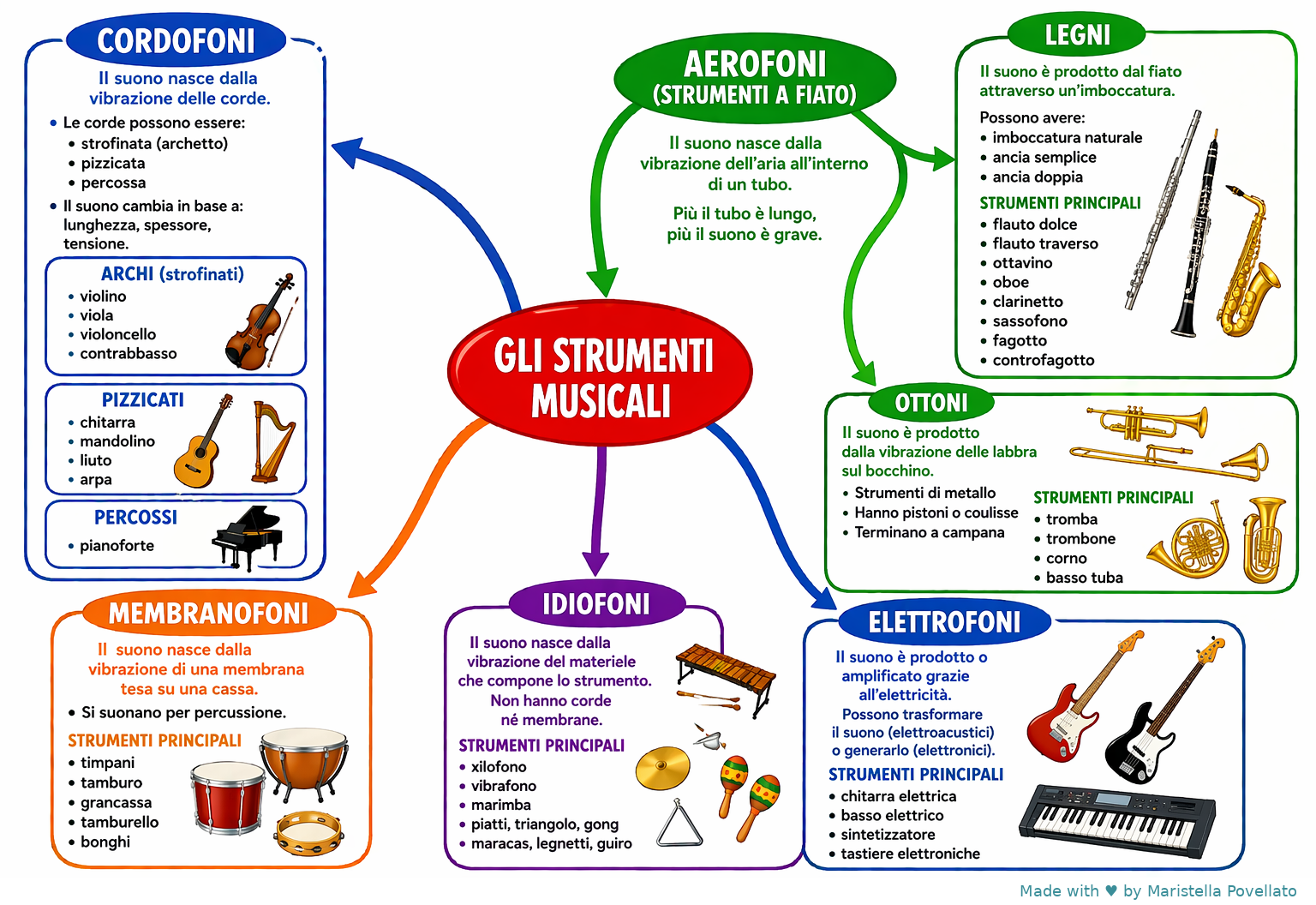
The scientific classification divides instruments according to what vibrates to produce sound: • AEROPHONES — a column of air vibrates. They are divided into woodwinds (transverse flute, piccolo, piccolo, clarinet, oboe, cor anglais, bassoon, contrabassoon, saxophone) and brass (trumpet, trombone, horn, tuba, bass tuba). The organ, accordion and harmonica also belong to this group. • CHORDOPHONES — a string vibrates. Bowed strings: violin, viola, cello, double bass. Plucked strings: guitar, harp, mandolin, electric bass. Struck strings: piano, harpsichord. • MEMBRANOPHONES — a stretched membrane vibrates. Timpani, bass drum, snare drum, tom-tom, bongos, congas, tambourine. • IDIOPHONES — the body of the instrument itself vibrates. Triangle, cymbals, gong, xylophone, marimba, vibraphone, tubular bells, maracas, castanets, claves. • ELECTROPHONES — sound is produced or amplified electrically. Electric guitar, electric bass, synthesiser, theremin, electronic organ.

Mappa degli strumenti musicali
Map of musical instruments Download

Made with ♥ by Maristella Povellato

Recommended listening
PieceComposer / ArtistFormLink
Le quattro stagioni — Primavera
Listen to how the strings imitate birdsong.
Antonio VivaldiBrano strumentale Listen
Concerto per due violini
Bowed string instruments: a dialogue between two solo violins.
J.S. BachConcerto Listen
Concerto per clarinetto
A wind instrument with a cylindrical body: a soft, velvety tone.
W.A. MozartConcerto Listen
Toccata e Fuga in Re minore (organ)
A wind instrument with pipes: the organ, the 'king of instruments'.
J.S. BachFuga Listen
Il carnevale degli animali
Identify the instrumental families that portray each animal.
Camille Saint-SaënsBrano strumentale Listen
Rapsodia ungherese n. 2
A struck-string instrument: virtuoso piano playing.
Franz LisztRapsodia Listen
GO TO QUIZ

Made with ♥ by Maristella Povellato

06

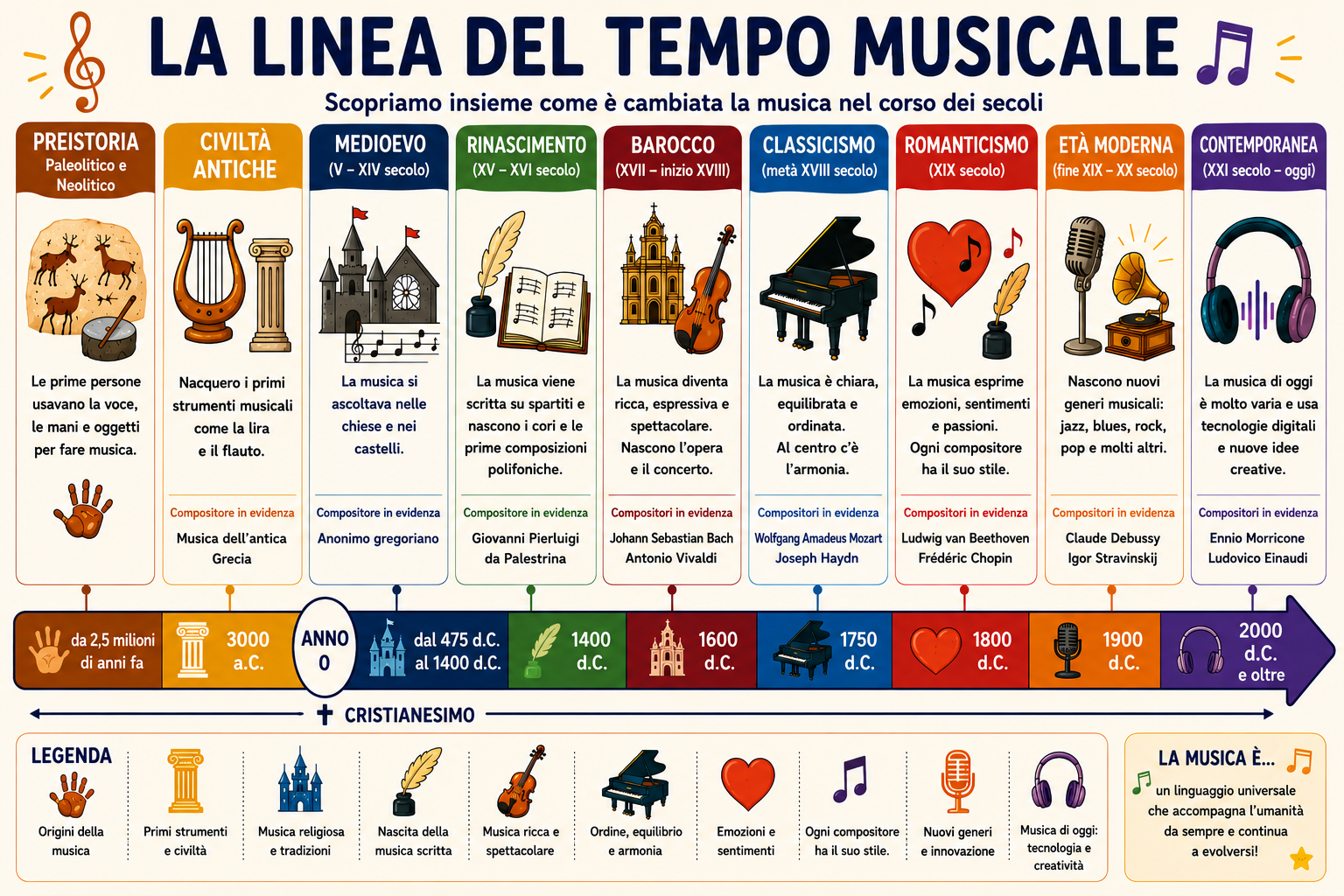
Music in the earliest civilisations

Listen to the text

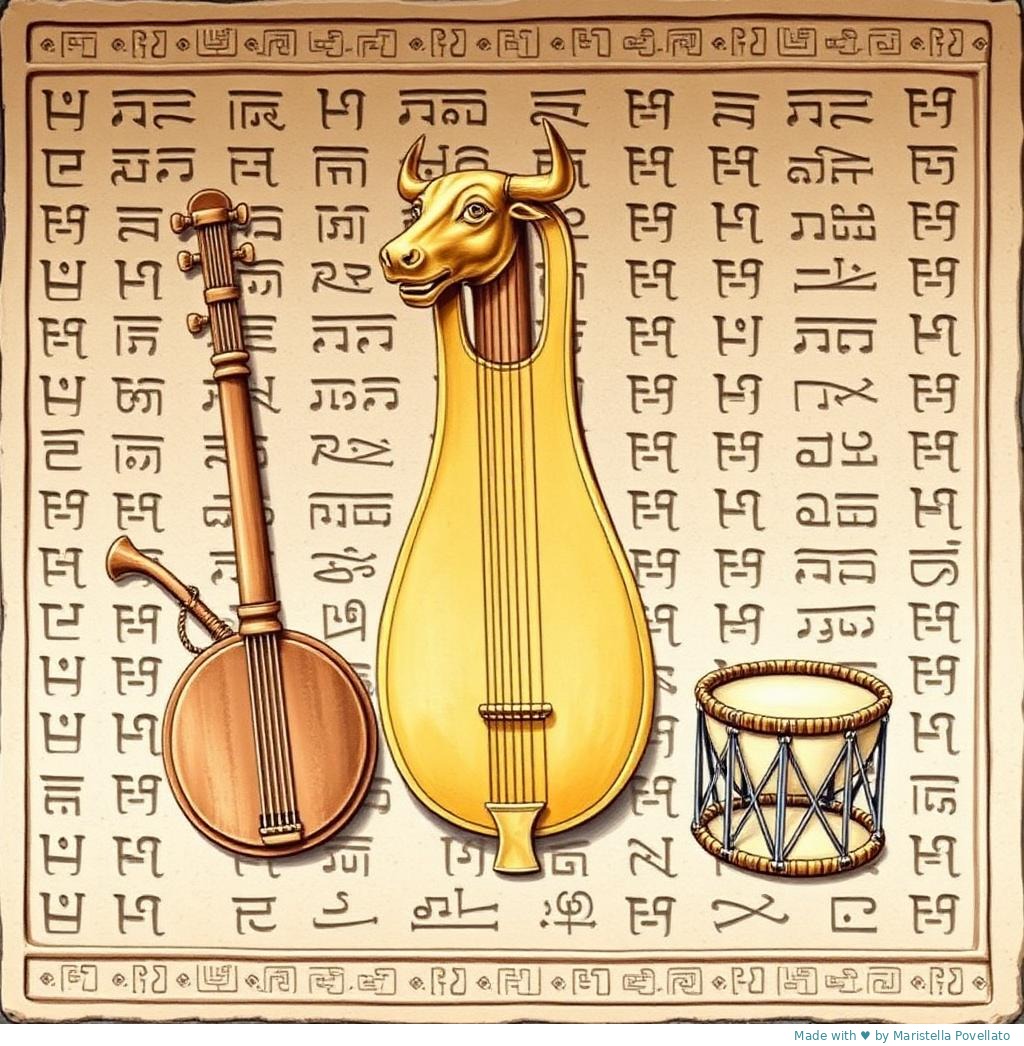
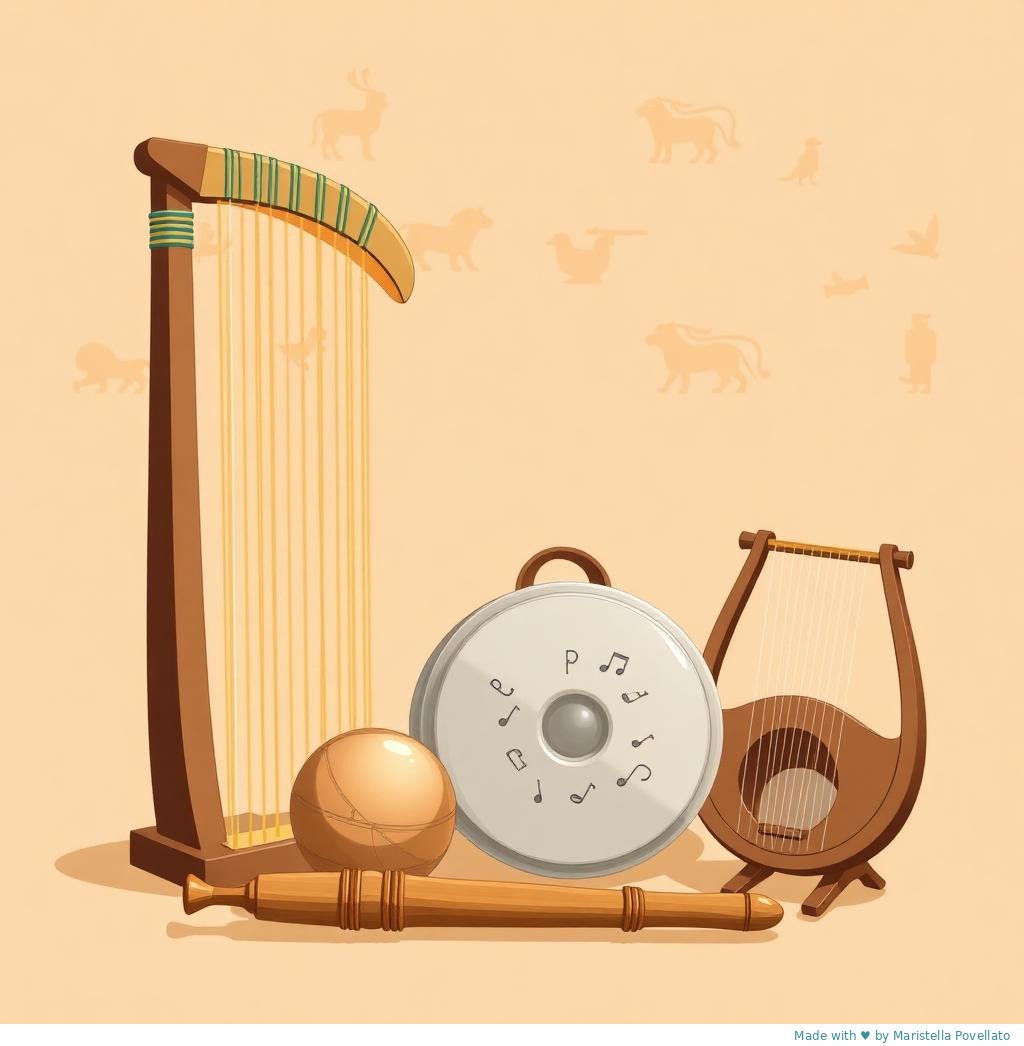
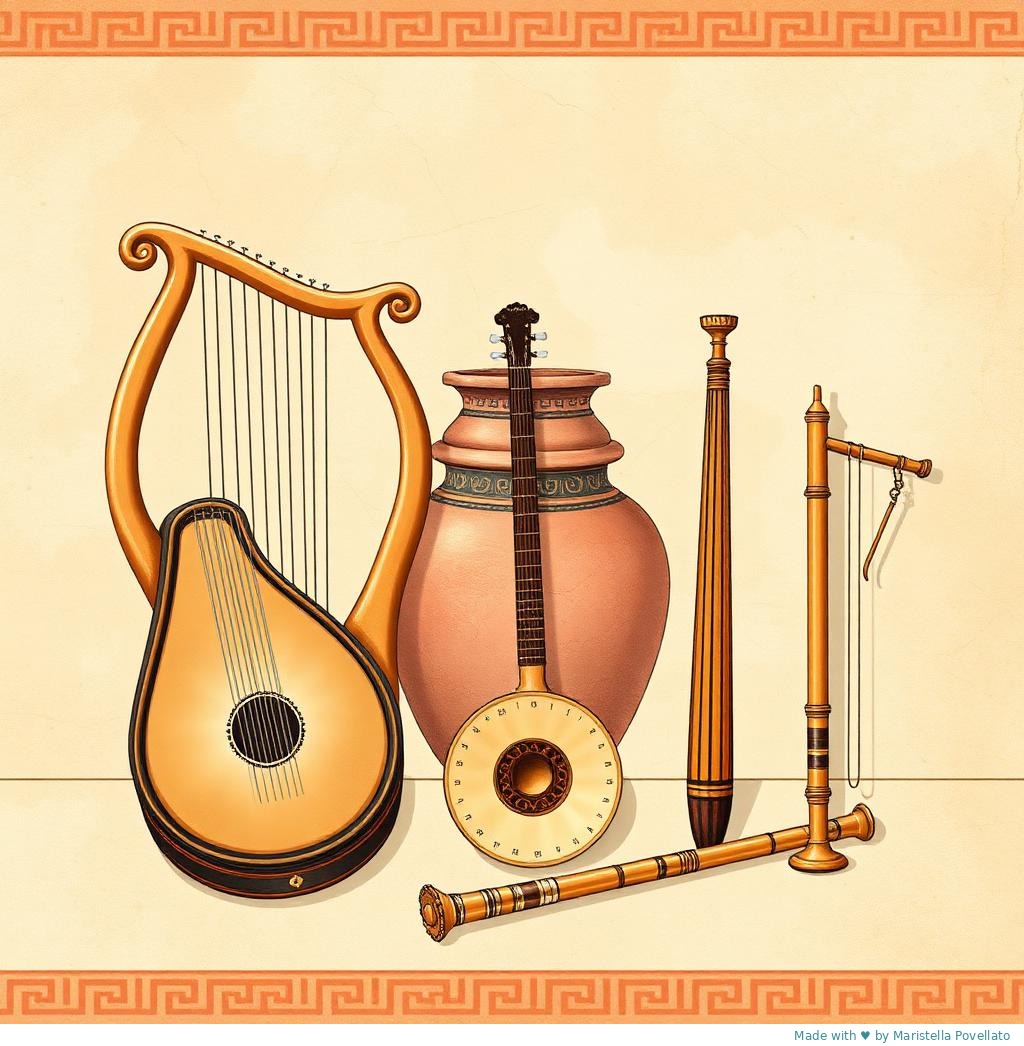
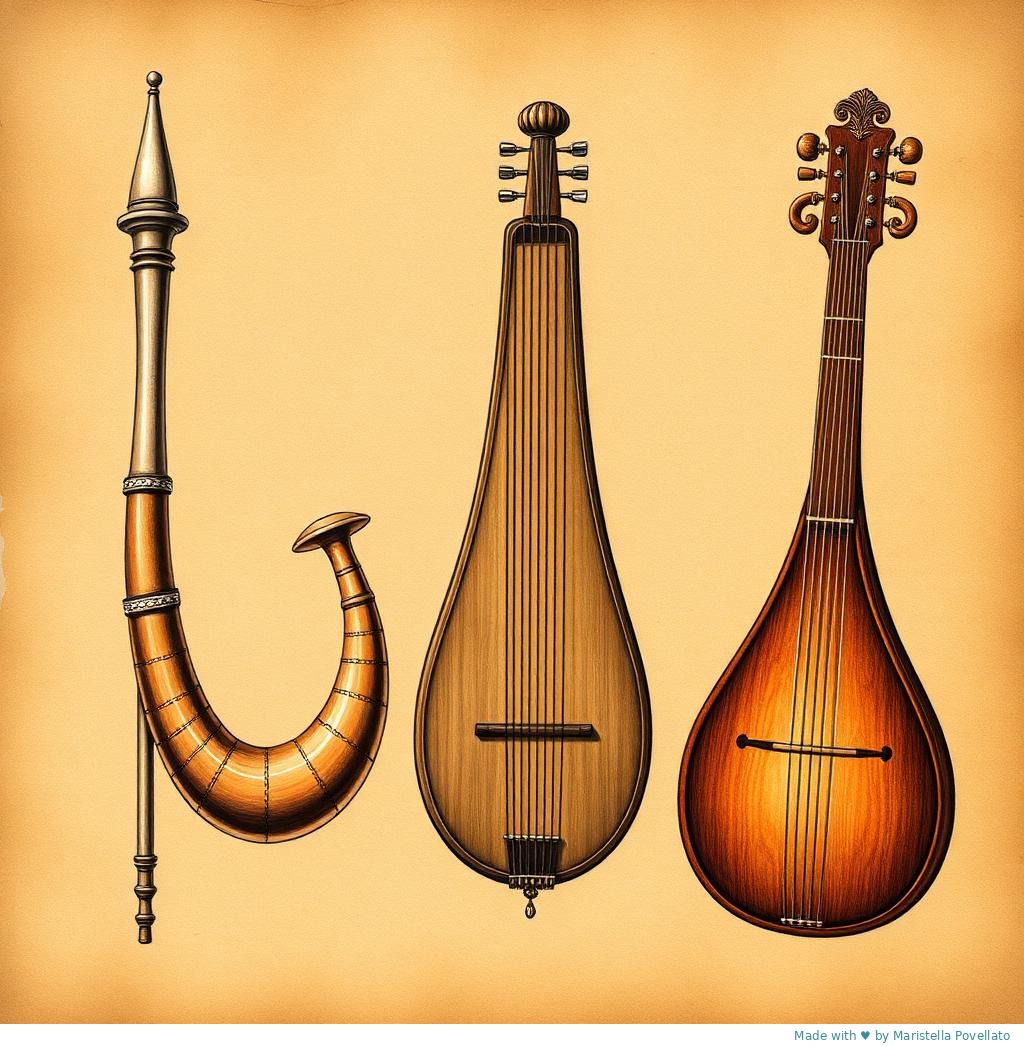
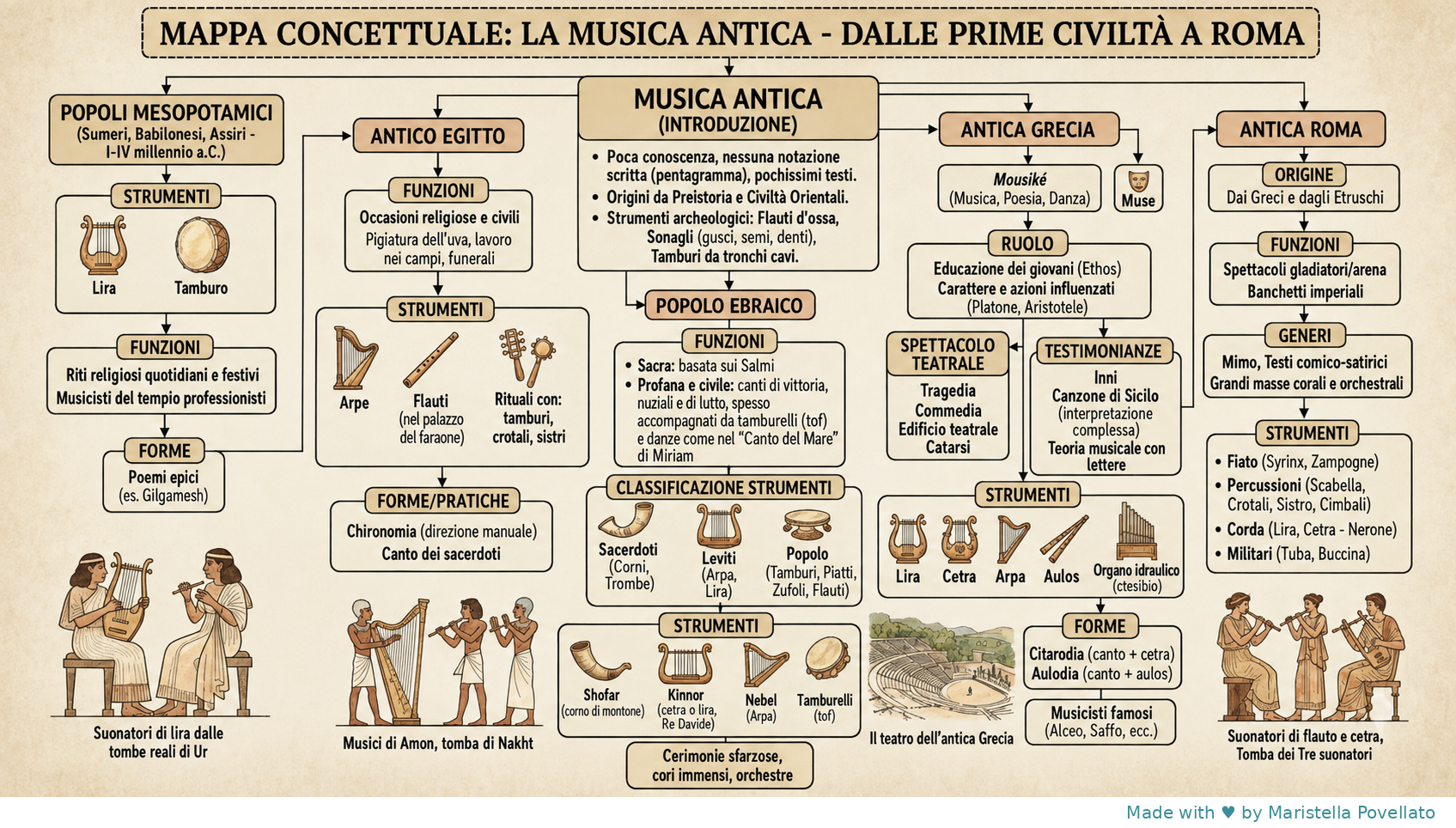
Music is as old as humankind. Since prehistoric times, humans have made sounds with their voices, by clapping their hands, striking stones, bones and pieces of wood, and blowing into reeds and horns. Music accompanied hunting, religious rituals, celebrations, work and war. MESOPOTAMIA (Sumerians, Babylonians, Assyrians — from 3500 BC): magnificent LYRES with soundboxes decorated with golden bulls' heads have been found in the royal tombs of Ur. Harps, reed flutes and frame drums were also used, along with the first religious hymns written on clay tablets in cuneiform script (the Hurrian hymn to Nikkal, ~1400 BC, is the oldest known musical notation). EGYPT: music was an essential part of worship and court celebrations. Frescoes show female harpists, flute players and singers. Instruments: arched harp, long-necked lute, double aulos (a flute with two pipes), sistrum (a metal rattle sacred to the goddess Hathor), tambourine. ANCIENT GREECE: music was considered a divine gift and a mathematical science (Pitagora discovered numerical relationships between notes). Instruments: LYRE (associated with Apollo and poetry), KITHARA (a larger lyre for concerts), AULOS (a double flute, associated with Dioniso), syrinx (panpipes). The Greeks left only a few notated fragments: the most complete is the EPITAFFIO DI SICILO (1st century AD), inscribed on a stone slab and considered the oldest musical composition to survive in its entirety. ANCIENT ROME: inherited Greek instruments and added new ones for military and theatrical use: TIBIA (Roman aulos), CORNU and BUCCINA (large curved bronze horns), hydraulis (water organ, an ancestor of the organ). CHINA and INDIA: traditions stretching back thousands of years, with instruments such as the guqin (Chinese zither), pipa (lute) and vina (Indian zither), and music theory linked to philosophy and meditation.

Strumenti della Mesopotamia (Lira di Ur)
Instruments of Mesopotamia (Lyre of Ur)

Made with ♥ by Maristella Povellato

Strumenti dell'Antico Egitto (arpa, sistro, aulos, lira)
Instruments of Ancient Egypt (harp, sistrum, aulos, lyre)

Made with ♥ by Maristella Povellato

Strumenti della Grecia antica (lira, kithara, aulos, syrinx)
Instruments of Ancient Greece (lyre, kithara, aulos, syrinx)

Made with ♥ by Maristella Povellato

Roma, Cina, India (cornu, guqin, vina)
Rome, China, India (cornu, guqin, vina)

Made with ♥ by Maristella Povellato

Mappa concettuale: la musica antica dalle prime civiltà a Roma
Concept map: ancient music from the earliest civilisations to Rome Download

Made with ♥ by Maristella Povellato

Recommended listening
PieceComposer / ArtistFormLink
Epitaffio di Sicilo
The oldest musical composition to survive in its entirety.
Anonimo greco (I sec. d.C.)Brano strumentale Listen
Inno hurrita a Nikkal
The oldest known musical notation, on a cuneiform tablet.
Anonimo (~1400 a.C.)Inno Listen
Lyre of Ur — reconstruction
The reconstructed sound of the lyre with a golden bull's head (2500 BC).
Tradizione sumeraBrano strumentale Listen
Inno delfico ad Apollo
A Greek hymn carved in stone at Delphi.
Anonimo greco (II sec. a.C.)Inno Listen
GO TO QUIZ
07

Music in the Middle Ages

Music in the Middle Ages Download

Made with ♥ by Maristella Povellato

Listen to the text

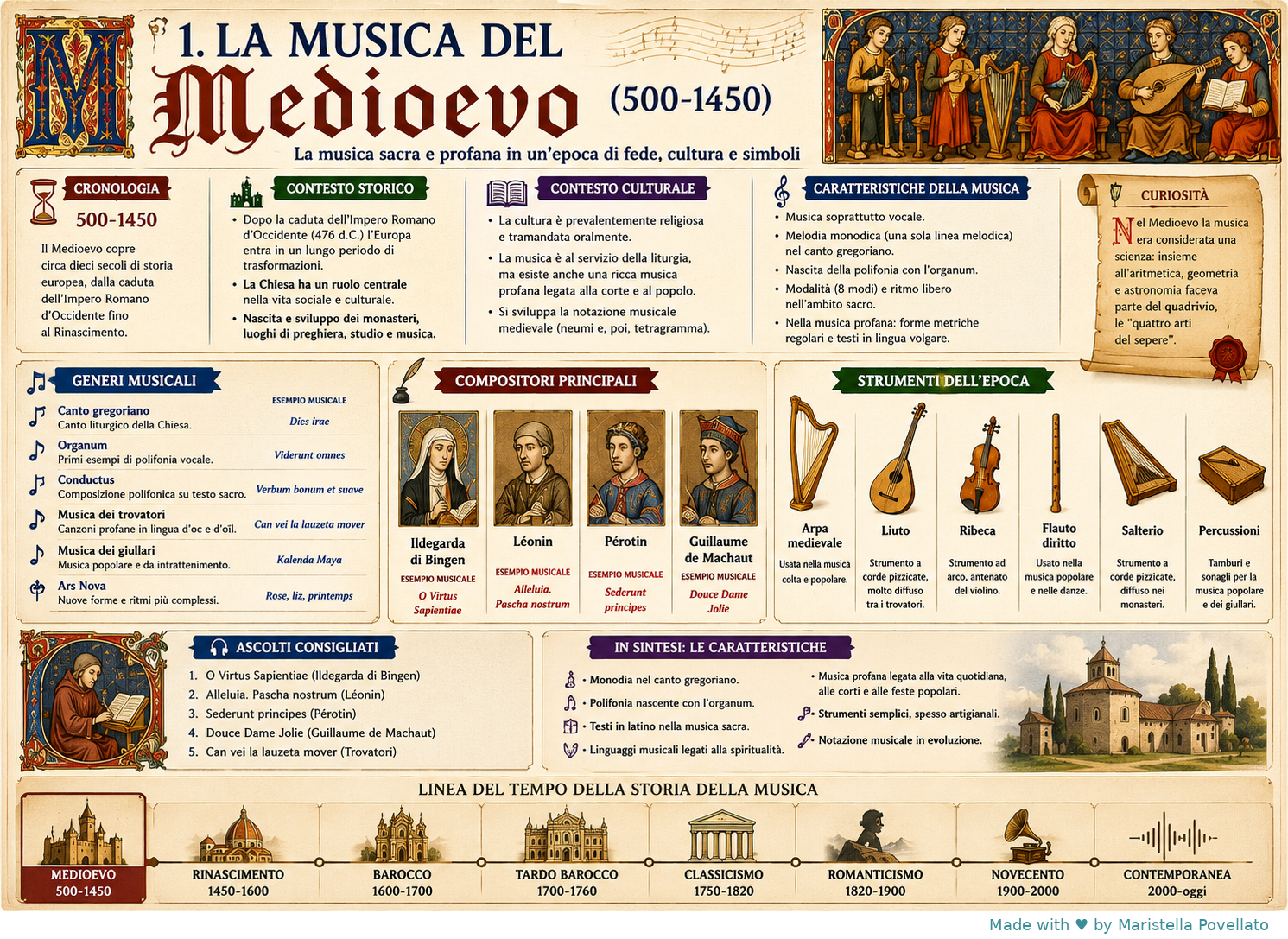
In the Middle Ages (5th–15th centuries), music was closely linked to the CHURCH. GREGORIAN CHANT emerged (named after Pope Gregory the Great, 6th century): monophonic singing (a single melodic line), performed a cappella (without instruments), in Latin, and used in church worship. The monk GUIDO D'AREZZO (11th century) brought about a revolution: he invented the FOUR-LINE STAFF, the ancestor of the five-line staff, and named the notes (Ut, Re, Mi, Fa, Sol, La, taken from the opening syllables of the hymn to Saint John; Si was added later, and Ut became Do). After the year 1000, POLYPHONY emerged: several voices singing different melodies together (organum, motet). Outside the church, SECULAR MUSIC developed through the TROUBADOURS in Provence, the TROUVÈRES in northern France, and the MINNESÄNGER in Germany: poet-musicians who sang in everyday languages about courtly love, knightly deeds, and nature. In Italy there were travelling entertainers and MINSTRELS, who went from place to place making music. Medieval instruments: lute, rebec (an ancestor of the violin), vielle, psaltery, portative organ, recorder, bagpipes, drums, and bells. MUSICAL INSTRUMENTS IN THE MIDDLE AGES Watch the video about medieval instruments — let's listen to the lute, rebec, psaltery, portative organ, and other instruments of the time. NOTATION AND GUIDO D'AREZZO Musical notation developed long after people began making music: people first sang and played instruments, and only later looked for a way to put sounds down on paper.

StageWhat is usedHow it works
Emergence of the Gregorian chant repertoireNEUMESSigns that indicate the shape of the melody; at first they were written above the text, without a staff
Around the middle of the 10th centuryCOLOURA horizontal red line indicates Fa, and a yellow line indicates Do
Still used today in English-speaking countriesLETTERS OF THE ALPHABETA = La, B = Si, C = Do, D = Re, E = Mi, F = Fa, G = Sol
Early 11th centuryFOUR-LINE STAFFFour lines on which square-shaped notes are written; adopted by the Benedictine monk Guido d'Arezzo
Early 11th centuryNOTE NAMESGuido uses the opening syllables of the first six lines of a hymn to Saint John the Baptist to name the first six notes
Only laterSI AND DOSi is formed by combining the S of «Sancte» and the I of «Iohannes»; only later does the first note, Ut, become Do

THE HYMN TO SAINT JOHN THE BAPTIST Ut queant laxis resonare fibris mira gestorum famuli tuorum solve polluti labii reatum Sancte Iohannes Translation: «So that your servants may sing freely of the wonders of your deeds, remove the sin from their unclean lips, O Saint John». ARS NOVA Around the 14th century, ARS NOVA («new art») became established, in contrast to Ars Antiqua («old art»): theorists and composers of this new movement introduced many musical innovations. Ars Nova began in France and spread to literary circles in Florence and to other regions; its leading figure was Guillaume de Machaut (1302-1377).

FormFeatures
CACCIAA piece with words inspired by hunting scenes, in which two voices create a rich echo effect, as though chasing each other
BALLATAIntended for singing and dancing, it is the most elaborate form of Ars Nova; its words are about love, with two or three melodic lines
MADRIGALMainly about love or country life, for two or three voices, with words arranged in a series of three-line verses

THREE LISTENING EXAMPLES: THE FORMS OF ARS NOVA CACCIA — «Tosto che l'alba» by Gherardello da Firenze — the two voices chase each other as in a real hunt, creating a rich echo effect. BALLATA — «Ecco la primavera» by Francesco Landini — a song of spring and love, the most carefully crafted and widespread form of Ars Nova. MADRIGAL — «O pianta vagha» by Francesco Landini — three voices singing words about love and country life, arranged in three-line verses.

Recommended listening
PieceComposer / ArtistFormLink
Gregorian chant - Dies Irae
A medieval liturgical sequence about death and the Last Judgement.
Tradizione medievaleCanto gregoriano Listen
Organum - Viderunt omnes
Four-part polyphony from the Notre-Dame School.
PérotinOrganum Listen
Conductus - Verbum bonum et suave
A sacred or secular polyphonic composition using an original, non-liturgical text.
AnonimoConductus Listen
Bernard de Ventadorn, troubadour - Can vei la lauzeta mover (langue d'oc, Occitan)
A love song in langue d'oc by the most famous troubadour.
Bernard de VentadornCanso Listen
Anonymous, minstrel - Kalenda Maia
A dance-song from the tradition of troubadours and travelling entertainers.
AnonimoCanzone dei trovatori Listen
Guillaume de Machaut - Rose, liz, Printemps (chanson, song)
A secular chanson from the 14th century in rondeau form.
Guillaume de MachautChanson Listen
Ildegarda di Bingen - O virus sapientiae
A mystical, liturgical piece with a single melodic line by the famous visionary nun.
Ildegarda di BingenMonodia sacra Listen
Léonin - Alleluja, Pascha nostrum
Two-part organum from the Notre-Dame School.
LéoninOrganum Listen
Pérotin - Sederunt principes
A grand four-part organum for Christmas worship.
PérotinOrganum Listen
Guillaume de Machaut - Douce Dame Jolie
One of the most famous chansons of the 14th century.
Guillaume de MachautChanson Listen
GO TO QUIZ