Infographic: Renaissance music (1450-1600) Download
Made with ♥ by Maristella Povellato
Listen to the text
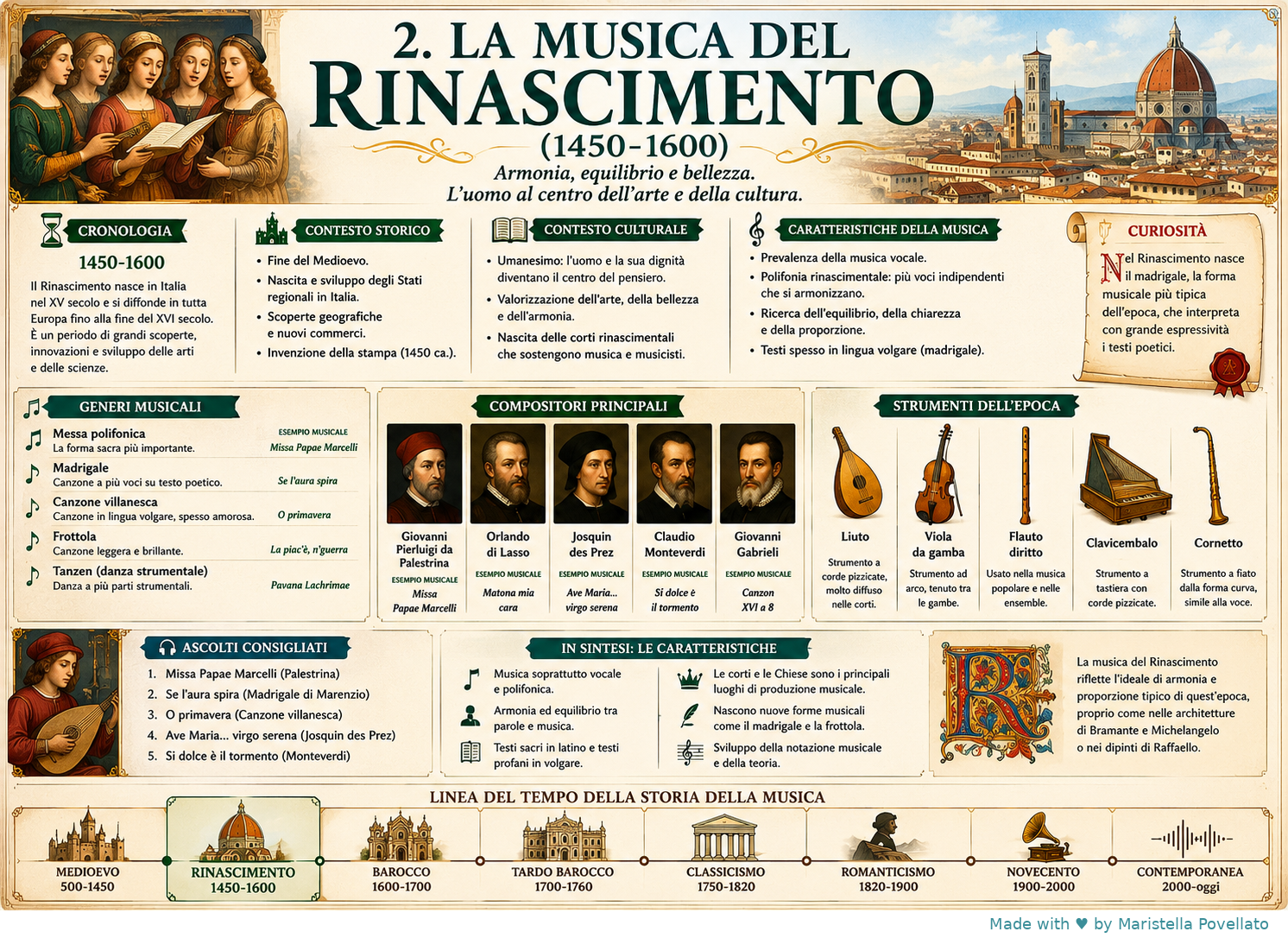
THE RENAISSANCE (1450-1600) — The Renaissance began in Italy in the 15th century and spread throughout Europe until the end of the 16th century. This was the age of Humanism: human beings, with their dignity and reason, became the centre of thought. The Middle Ages came to an end, regional Italian states emerged, geographical discoveries and trade increased, and the invention of printing (around 1450) also allowed printed music to circulate. Until then, music had been copied by hand.
CULTURAL CONTEXT — Renaissance courts (Firenze, Ferrara, Mantova, Urbino) and the large musical establishments of churches supported musicians. Art, beauty, harmony and proportion were valued: music was expected to be clear, balanced and expressive, just like Bramante's architecture or Raffaello's paintings.
CHARACTERISTICS OF THE MUSIC — VOCAL music predominated. Renaissance polyphony combines several independent voice parts that nevertheless blend together in a very balanced way. Texts were in Latin in sacred music and in the everyday language (Italian) in secular music. Music theory also developed, and notation was refined.
MUSICAL GENRES — The POLYPHONIC MASS was the most important sacred form (e.g. Missa Papae Marcelli). The MADRIGAL is a song for several voices set to a poem, and was the most characteristic form of the period. The CANZONE VILLANESCA is a song in the everyday language, often about love and in a popular style. The FROTTOLA is light and lively. TANZEN, or instrumental dances (e.g. the pavane and galliard), are instrumental pieces in several parts.
MAIN COMPOSERS — Giovanni Pierluigi da Palestrina (master of sacred polyphony), Orlando di Lasso, Josquin des Prez, Claudio Monteverdi (who would pave the way for the Baroque) and Giovanni Gabrieli, famous for his music for separated choirs at San Marco in Venice.
INSTRUMENTS OF THE PERIOD — Lute (a plucked string instrument very popular at court), viola da gamba (a bowed instrument held between the legs), recorder, harpsichord (a keyboard instrument with plucked strings) and cornett (a wind instrument with a sound similar to the human voice).
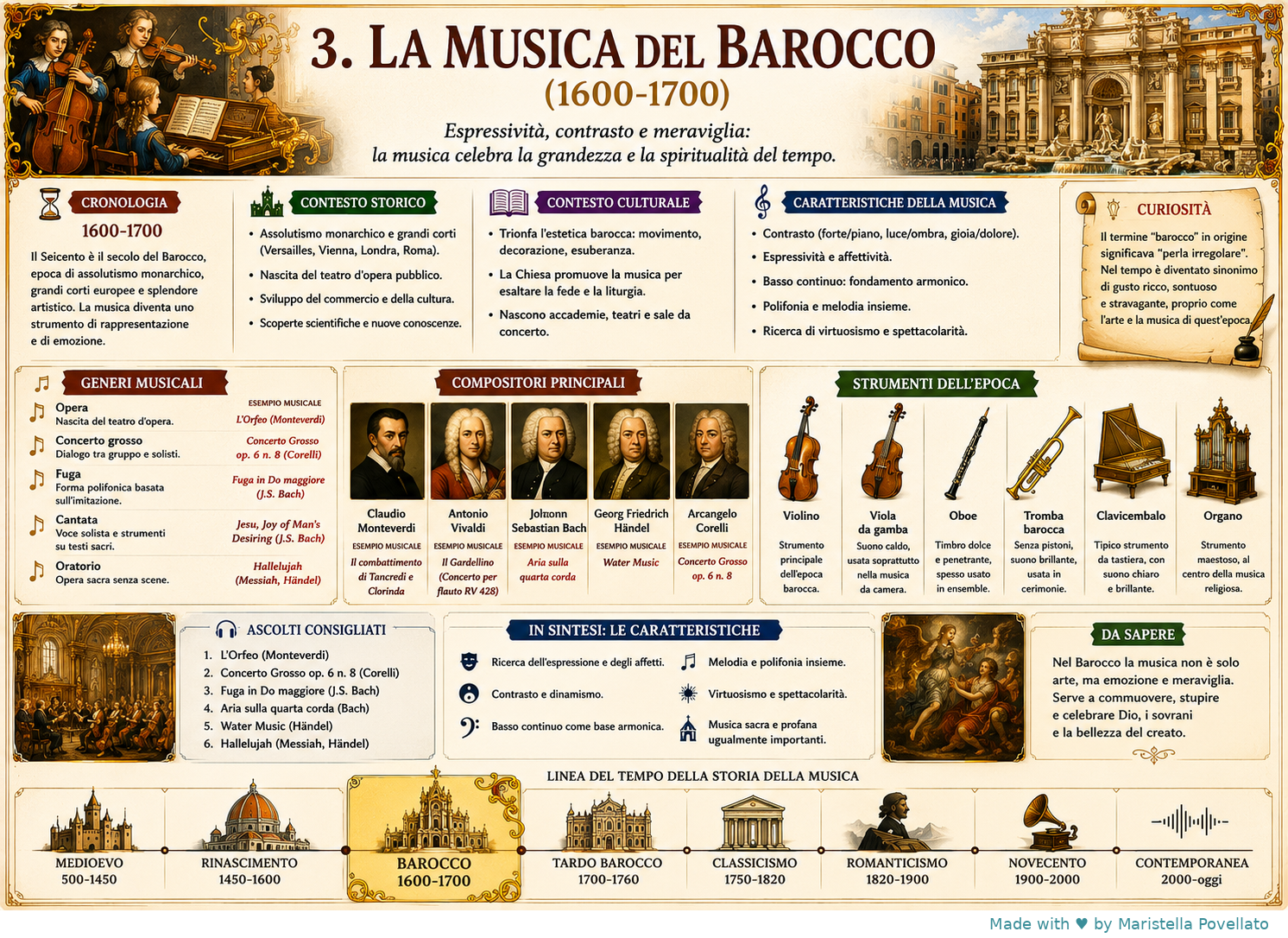
THE BAROQUE (1600-1700) — The 17th century was the century of absolute monarchy, the great European courts (Versailles, Vienna, London, Rome) and artistic splendour. Music became a means of displaying power and expressing emotion. The term 'baroque' originally meant 'irregular pearl' and described a rich, lavish and extravagant style.
HISTORICAL AND CULTURAL CONTEXT — The public opera house emerged (Venice, 1637): for the first time, anyone who paid for a ticket could attend a musical performance. The Church promoted music to celebrate faith and worship; academies, theatres and concert halls were established. The Baroque artistic style, full of movement, decoration and exuberance, flourished.
CHARACTERISTICS OF THE MUSIC — The guiding principle was CONTRAST: forte/piano, light/shadow, joy/sorrow, soloist/orchestra. Expressiveness and the theory of the affections, which linked music to emotions, were very important. BASSO CONTINUO (harpsichord or organ plus cello or bassoon) was the harmonic foundation of almost every piece. Polyphony and melody existed side by side, and composers and performers aimed for impressive instrumental and vocal skill.
MUSICAL GENRES — OPERA (the birth of opera theatre, L'Orfeo by Monteverdi, 1607); the CONCERTO GROSSO, a dialogue between a small group of soloists (concertino) and the orchestra (ripieno); the FUGUE, a polyphonic form based on imitation of a theme; the CANTATA for voice and instruments, using sacred or secular texts; the ORATORIO, a sacred opera without scenery or costumes (e.g. Messiah by Händel).
MAIN COMPOSERS — Claudio Monteverdi, Antonio Vivaldi, Johann Sebastian Bach, Georg Friedrich Händel and Arcangelo Corelli.
INSTRUMENTS OF THE PERIOD — Violin (the leading instrument, with the great instrument makers Amati, Stradivari and Guarneri), viola da gamba, oboe, Baroque trumpet (without valves), harpsichord and organ, a majestic instrument at the heart of religious music.
Infographic: the Late Baroque (1700-1760) Download
Made with ♥ by Maristella Povellato
Listen to the text
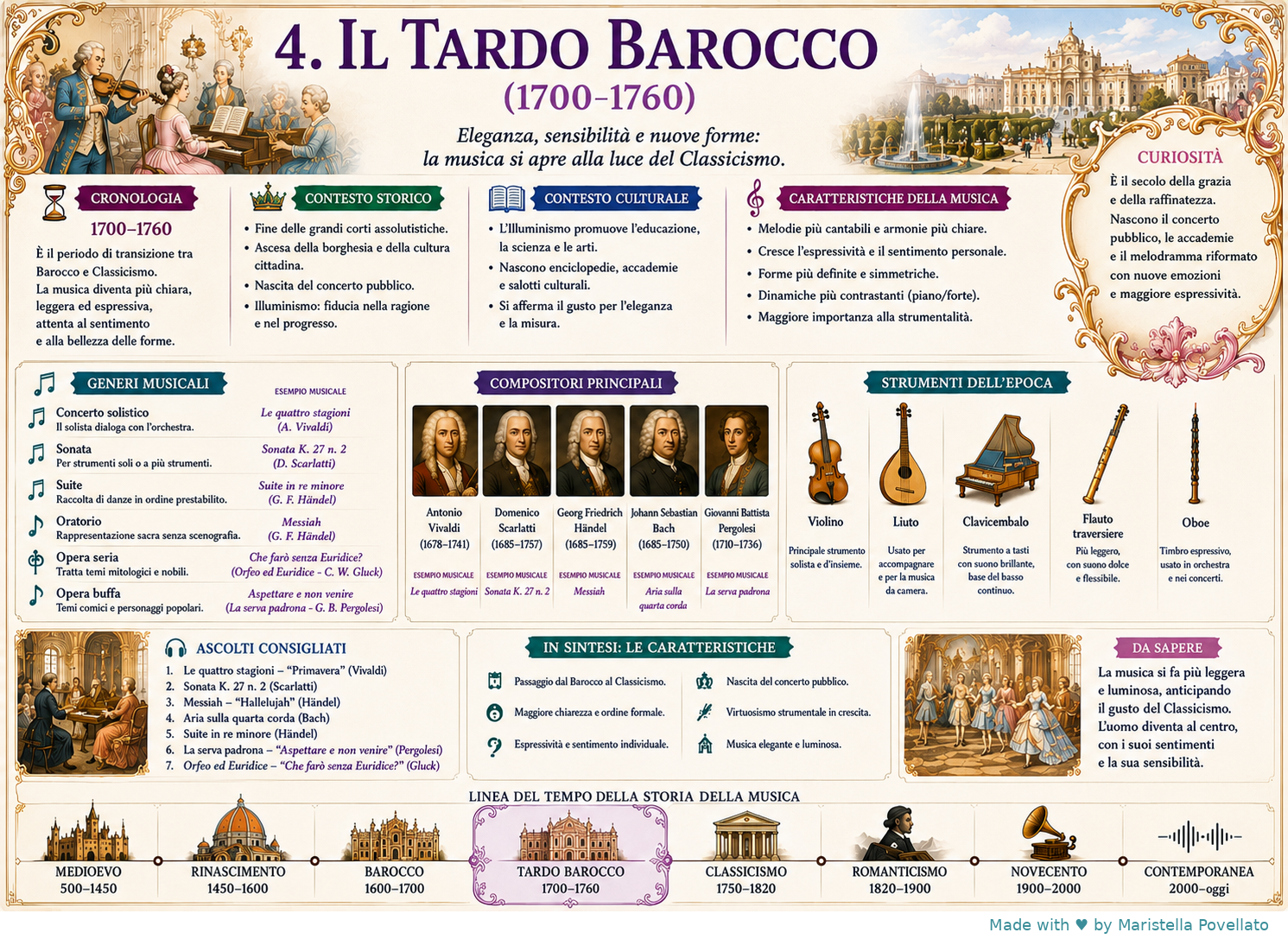
THE LATE BAROQUE (1700-1760) — This was the period of transition between the Baroque and the Classical period. Music became clearer, lighter and more expressive, focusing on emotion and beauty of form: this was the century of grace and refinement.
HISTORICAL AND CULTURAL CONTEXT — The age of the great courts of absolute monarchs came to an end, and the urban middle class grew. Its members wanted to listen to music, leading to the emergence of the PUBLIC CONCERT with paid admission. The Enlightenment promoted education, science and the arts; encyclopedias, academies and cultural salons emerged, and a taste for elegance and restraint became established.
CHARACTERISTICS OF THE MUSIC — Melodies became more songlike, and harmonies clearer and simpler; expressiveness and personal feeling became more important; musical forms became more clearly defined and symmetrical; dynamics became more contrasting (piano/forte), partly thanks to new instruments; instrumental music became increasingly important.
MUSICAL GENRES — The SOLO CONCERTO, in which a soloist has a musical dialogue with the orchestra (Le quattro stagioni by Vivaldi); the SONATA for a solo instrument or several instruments; the SUITE, a collection of dances in a set order; the ORATORIO, a sacred performance without scenery; OPERA SERIA and the new OPERA BUFFA, which brought new life to opera with ordinary characters and comic situations (La serva padrona by Pergolesi, 1733).
MAIN COMPOSERS — Antonio Vivaldi (1678-1741), Domenico Scarlatti (1685-1757), Georg Friedrich Händel (1685-1759), Johann Sebastian Bach (1685-1750) and Giovanni Battista Pergolesi (1710-1736).
INSTRUMENTS OF THE PERIOD — Violin, lute, harpsichord (the basis of basso continuo), transverse flute (lighter and more flexible than the recorder), oboe and natural horn, used in hunts and ceremonies. During these years, Bartolomeo Cristofori invented the piano.
Infographic: the Classical period in music (1750-1820) Download
Made with ♥ by Maristella Povellato
Listen to the text
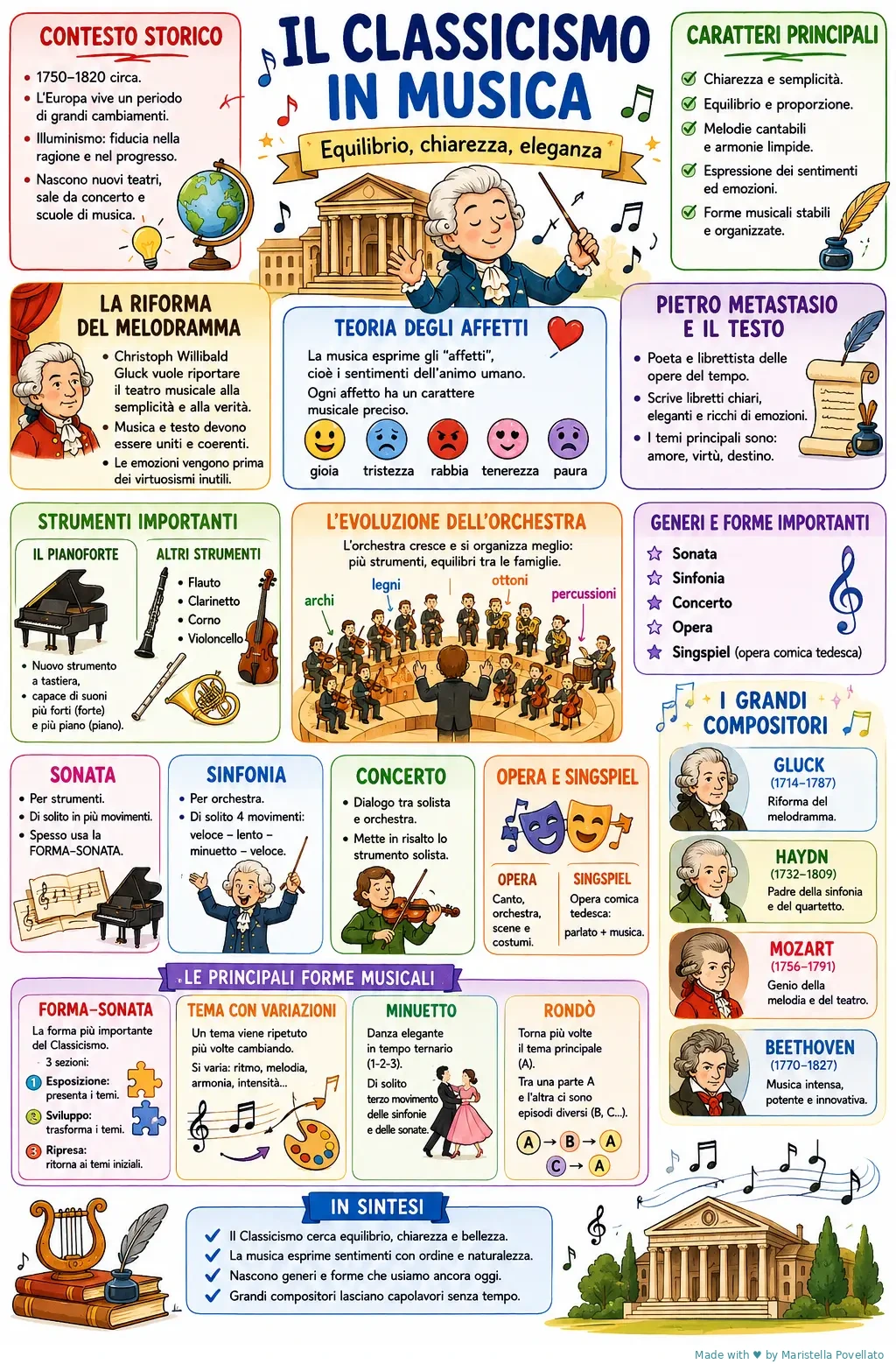
THE CLASSICAL PERIOD (1750-1820) — Europe is going through a period of great change: the Enlightenment spreads faith in reason and progress, and the American and French Revolutions break out. New theatres, concert halls and music schools are established: middle-class audiences take centre stage.
MAIN FEATURES — Clarity and simplicity, balance and proportion, songlike melodies supported by clear harmonies, a controlled expression of feelings, and stable, well-organised musical forms. Music is no longer made up of several interwoven voices as in the Baroque period, but of a main melody with an accompaniment.
THE REFORM OF OPERA — Christoph Willibald Gluck brings musical theatre back to simplicity and truth: music and words must work together as a coherent whole, and emotions come before unnecessary displays of technical skill. The poet Pietro Metastasio writes clear, elegant librettos on the themes of love, virtue and destiny. According to the DOCTRINE OF THE AFFECTIONS, music expresses human feelings (joy, sadness, anger, tenderness and fear), each with its own specific musical character.
THE ORCHESTRA AND ITS INSTRUMENTS — The orchestra grows and becomes better organised, with a stable balance between strings, woodwind, brass and percussion. The PIANO is the new keyboard instrument, capable of playing both loudly and softly; the flute, clarinet, horn and cello are also important.
GENRES AND FORMS — SONATA (for instruments, in several movements), SYMPHONY (for orchestra, usually in four movements: fast - slow - minuet - fast), CONCERTO (a dialogue between a soloist and an orchestra), OPERA and SINGSPIEL (German comic opera with spoken sections). The main forms are SONATA FORM (exposition, development, recapitulation), THEME AND VARIATIONS, the MINUET (an elegant dance in triple metre) and the RONDO (A-B-A-C-A).
THE GREAT COMPOSERS — Gluck (1714-1787), reformer of opera; Haydn (1732-1809), father of the symphony and the string quartet; Mozart (1756-1791), a genius of melody and theatre; Beethoven (1770-1827), whose intense, innovative music paves the way for Romanticism.
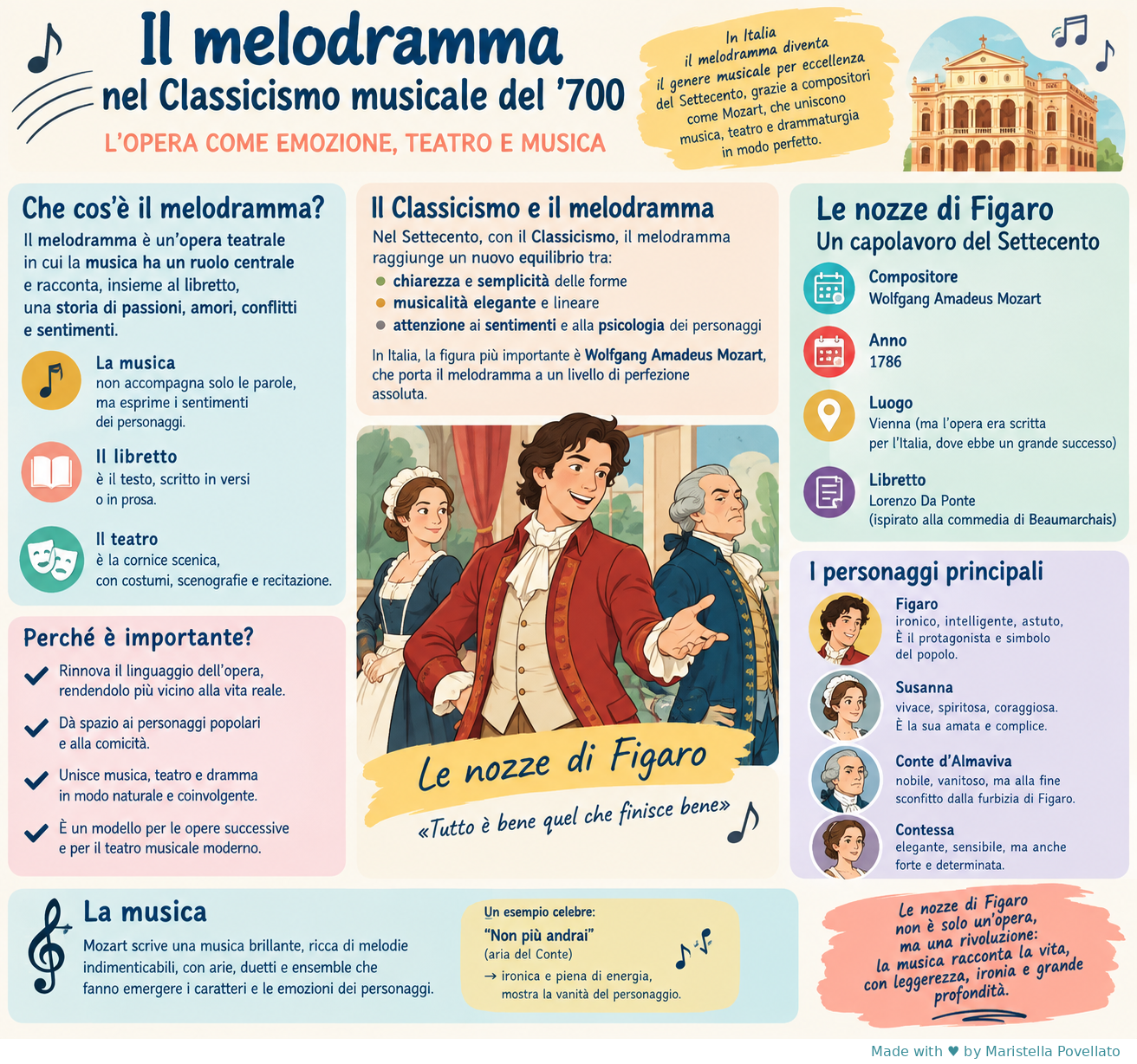
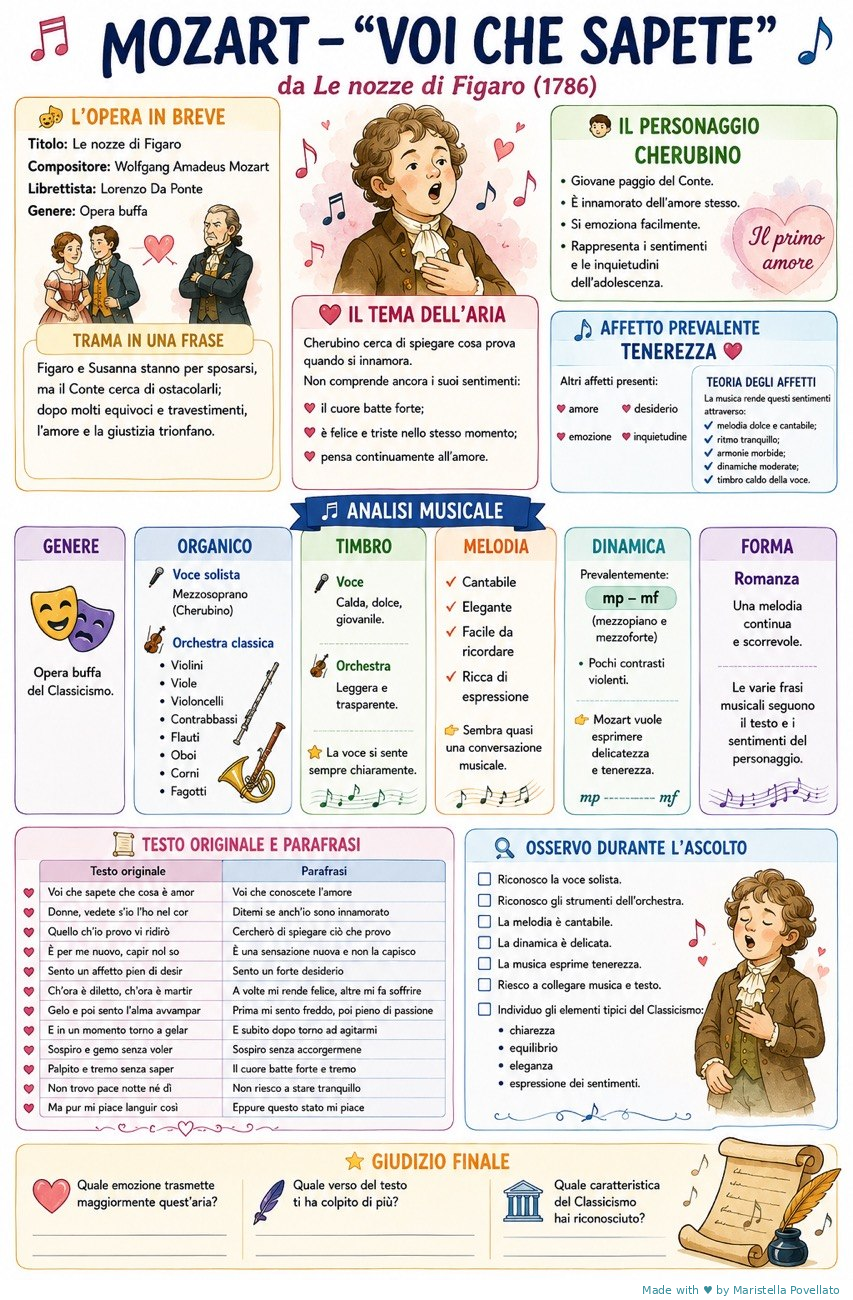
OPERA IN THE CLASSICAL PERIOD — In Italy, opera becomes the leading musical genre of the eighteenth century: music, theatre and dramatic storytelling blend perfectly. The greatest composer of Classical opera is Wolfgang Amadeus Mozart, who writes masterpieces in Vienna such as Le nozze di Figaro (1786), with a libretto by Lorenzo Da Ponte. The opera tells the story of the servant Figaro and his bride-to-be Susanna as they resist the demands of Conte d'Almaviva: the music portrays each character's feelings with irony and depth. One of the most famous arias is «Voi che sapete», sung by Cherubino, a young page in love with love: the voice (mezzo-soprano) is warm and youthful, the melody elegant and songlike, and the orchestral accompaniment light and transparent — a perfect example of Classical balance and the doctrine of the affections (tenderness, desire, anxiety).
NEW DEVELOPMENTS IN OPERA — Thanks to Gluck's reform, opera changes profoundly: music once again serves the words and emotions, without excessive vocal ornaments; the chorus and ballet return to leading roles on stage; the overture sets the mood of the drama; recitative becomes simpler and closer to spoken language, while the aria becomes more focused and expressive, with a clearly shaped melody and an orchestra that comments on the characters' feelings.
OPERA SERIA AND OPERA BUFFA — Two different genres exist side by side in eighteenth-century theatre. OPERA SERIA deals with mythological, historical and heroic subjects: its main characters are gods, kings and heroes, its arias are solemn, and its singing requires great technical skill. One example is Giulio Cesare in Egitto by Georg Friedrich Händel, in which Tolomeo reveals his wickedness through restless, insinuating music in the aria «Empio, dirò, tu sei». OPERA BUFFA, by contrast, develops from comic theatre: its characters are ordinary people, its situations are amusing and drawn from everyday life, its dialogue is quick, and its music is lively and playful. One example is La serva padrona by Giovanni Battista Pergolesi, in which the cunning servant Serpina pretends to be offended in the aria «Aspettare e non venire, che quell'impertinente» to win over her master: a musical comedy that will pave the way for Mozart's comic operas.
COMPARISON OF OPERA SERIA AND OPERA BUFFA
Feature
Opera seria
Opera buffa
Subjects
Mythological, historical and heroic
Everyday, comic, «drawn from daily life»
Main characters
Gods, kings and heroes
Servants, middle-class people and ordinary people
Tone
Solemn and dramatic
Light, lively and playful
Titles
Connected with kings, heroes and myths (Giulio Cesare in Egitto)
Quirky and ironic: Il conte caramella, La moglie in calzoni, Il finto turco
Singing
More elaborate, with ornaments: performed by castrati, who have a wider range of notes
Simple and without ornaments: singers use their natural voices
Vocal pieces
There are arias, but also recitatives; Gluck's reform brings a shift from recitativo secco (solo voice with harpsichord or cello) to accompanied recitative (solo voice with orchestra)
No recitatives (vocal pieces very similar to speech, used for storytelling)
Purpose
To impress and move the audience through grandeur
To entertain the audience and make them laugh
Example
Giulio Cesare in Egitto by Händel
La serva padrona by Pergolesi
EXAMPLE ARIA — OPERA SERIA
«Empio dirò, tu sei» — from the opera seria Giulio Cesare in Egitto by Georg Friedrich Händel
Element
Description
Opera and composer
Giulio Cesare in Egitto, by Georg Friedrich Händel
Character
Tolomeo, king of Egypt, cunning and cruel
Situation
Tolomeo reveals his wickedness
Character of the music
Restless and insinuating
Melody
Broad, with the vocal ornaments typical of opera seria
Emotion expressed
Deceit and wickedness (doctrine of the affections)
EXAMPLE ARIA — OPERA BUFFA
«Aspettare e non venire» — from the opera buffa La serva padrona by Giovanni Battista Pergolesi
Element
Description
Opera and composer
La serva padrona, by Giovanni Battista Pergolesi
Character
Serpina, a cunning household servant
Situation
Serpina pretends to be offended to win over her master Uberto
Character of the music
Lively, playful and sparkling
Melody
Simple and direct, with quick dialogue
Emotion expressed
Pretended indignation and irony (doctrine of the affections)
LET'S LISTEN TO ORNAMENTS
Ornaments on the piano — a video demonstrating the sounds of the mordent, trill, tremolo, turn, acciaccatura, appoggiatura and arpeggio.
WHAT ARE VOCAL ORNAMENTS?
Element
Explanation
What they are
Small extra notes and decorations that a singer adds to the written melody
What they are for
To make the melody more expressive and brilliant, highlight emotions (doctrine of the affections) and show the singer's skill
Where they are used
Mainly in opera seria of the Baroque period and the eighteenth century, often in the final return of the aria's opening section
The most common
Trill (rapid alternation between two notes), mordent, appoggiatura, turn, rapid scale
When the melody returns, the singer adds ornaments: an example of how people sang in the eighteenth century
GLUCK'S REFORM: WHAT CHANGES IN OPERA
Until the reform of Christoph Willibald Gluck (1714-1787), opera was a long sequence of very difficult arias that allowed singers to show off all their skills: high notes, trills, extremely fast scales and everything that belonged to “bel canto”, a technique rich in ornaments and flourishes. His most famous opera, Orfeo ed Euridice, performed in Vienna in 1762, includes all the innovations of the reform: its “splendid simplicity” makes it the purest and most successful expression of musical Classicism.
Before the reform
After Gluck's reform
A long series of extremely difficult arias to show off the singer's skill (bel canto, with ornaments and flourishes)
Melodies that are much simpler to perform and a limited number of characters (in Orfeo there are only three)
Unnecessary displays of technical skill and words that are hard to understand
Clear, understandable words: singers are not allowed to “decorate” arias with unnecessary displays of technical skill
Recitativo secco (voice with harpsichord and cello)
Removal of recitativo secco, replaced by accompanied recitative (voice with orchestra)
Orchestra used only to accompany singers
Orchestra also used to describe the setting and atmosphere of scenes
Little use of ballet and chorus
Ballet brought back into the action and the chorus used more expressively to highlight important moments
Infographic: Opera in the Classical Period — Le nozze di Figaro Download
Made with ♥ by Maristella Povellato
Infographic: Mozart — Voi che sapete (analysis of the aria) Download
A BRIDGE BETWEEN TWO ERAS — Between the late eighteenth century and the early decades of the nineteenth century, music goes through a decisive transition: alongside the balance and clarity of Classicism, a more intense and personal expression develops, paving the way for Romanticism. Ludwig van Beethoven is the central figure in this transition: in this section, we meet him through Inno alla gioia, which became the European anthem, and through his words about suffering and deafness in the Heiligenstadt Testament.
BEETHOVEN BETWEEN CLASSICISM AND ROMANTICISM — Ludwig van Beethoven was born in Bonn in 1770 and died in Vienna in 1827. A pianist and composer, he developed the forms used by Haydn and Mozart, making them broader, more intense and more personal. His nine symphonies, piano sonatas and quartets connect Classical balance with Romantic sensitivity. The Ninth belongs to his mature years: we study it here to complete our portrait of the composer, even though it was performed in 1824, beyond the approximate dates of the Classical period.
INNO ALLA GIOIA — In the fourth movement of the Nona Sinfonia, first performed in Vienna on 7 May 1824, Beethoven introduces soloists and a chorus alongside the orchestra and sets Friedrich Schiller's verses to music. The theme is songlike, moves mainly by step from one note to the next, and returns with different instruments and levels of intensity: it grows from the low strings until the voices join in. Its message is fellowship among all human beings.
THE EUROPEAN ANTHEM — The Council of Europe adopted this melody in 1972; the heads of state and government of the European Community, now the European Union, adopted it in 1985. The European anthem uses only the music: it has no official words, it is not the entire choral finale of the Ninth, and it does not replace national anthems. A melody without words can unite people who speak different languages and represent freedom, peace and solidarity. Listen to the European anthem and read the European Union's information.
THE HEILIGENSTADT TESTAMENT — On 6 October 1802, with an addition on 10 October, Beethoven wrote his brothers a letter that remained among his papers until his death. He describes the pain of gradually losing his hearing, his isolation and his fear of being seen as unfriendly. He reveals a deep crisis, but finds a reason to keep living in his art and the works he has yet to create. The Testament encourages us to understand what a person is feeling before judging their behaviour. Find out more with the Beethoven-Haus (in English).
DEAFNESS, DIGNITY AND PARTICIPATION — Beethoven continued to compose using his skills, musical memory and ability to imagine sounds; in later years, he also used conversation notebooks to help him communicate. His deafness did not disappear: his worth does not depend on having “overcome” his disability. Today, inclusion means reducing barriers, respecting individual needs and enabling everyone to participate, using written texts, subtitles and visual signals when helpful. You do not have to become a genius to have the right to dignity and accessibility.
Monographs — Beethoven: joy that includes everyone, music and citizenship activities. Listen to the theme, read thoughts from the Testament and make a short class agreement on peace, solidarity and inclusion.
Recommended listening
Piece
Composer / Artist
Form
Link
Inno alla gioia — European anthem
From the finale of the Ninth Symphony: freedom, peace and solidarity. The European anthem has no official lyrics.
L. van Beethoven
Tema sinfonico — versione strumentale dell’inno europeo
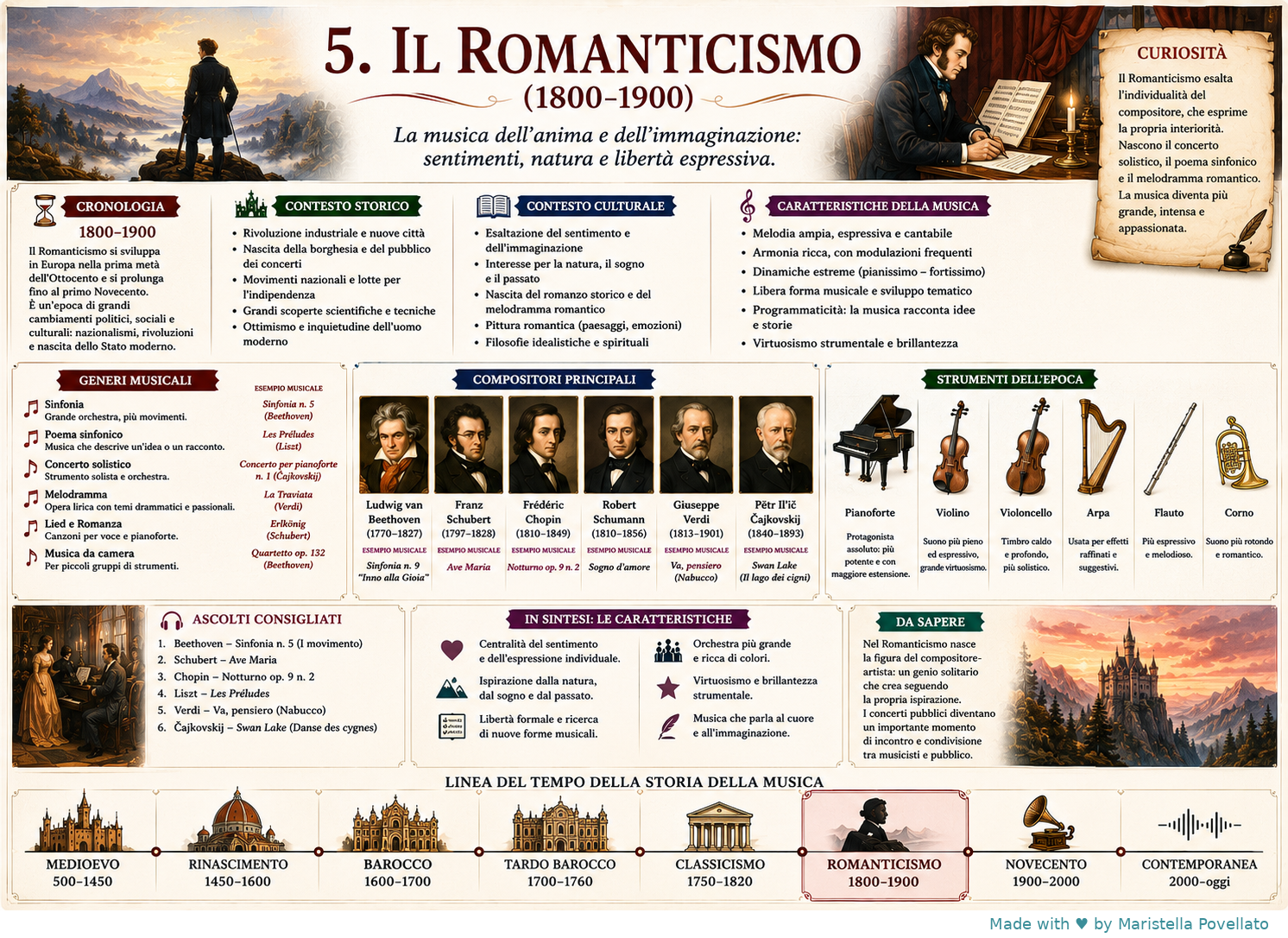
IL ROMANTICISMO (1800-1900) — Il Romanticismo si sviluppa in Europa nella prima metà dell'Ottocento e si prolunga fino al primo Novecento. È un'epoca di grandi cambiamenti politici, sociali e culturali: rivoluzione industriale e nuove città, nazionalismi e lotte per l'indipendenza, nascita della borghesia e del pubblico dei concerti, grandi scoperte scientifiche.
CONTESTO CULTURALE — Si esaltano il sentimento e l'immaginazione; cresce l'interesse per la natura, il sogno, il mistero e il passato; nascono il romanzo storico e il melodramma romantico; la pittura racconta paesaggi ed emozioni. La musica diventa il linguaggio dell'anima.
6.2 La musica romantica: caratteri, generi e compositori
CARATTERISTICHE DELLA MUSICA — Melodia ampia, espressiva e cantabile; armonia ricca con modulazioni frequenti; dinamiche estreme dal pianissimo al fortissimo; forma libera e sviluppo tematico; PROGRAMMATICITÀ, cioè la musica racconta idee, immagini e storie; grande virtuosismo strumentale.
GENERI MUSICALI — SINFONIA per grande orchestra; POEMA SINFONICO, che descrive un racconto o un'idea (Les Préludes di Liszt); CONCERTO SOLISTICO; MELODRAMMA, opera lirica dai temi drammatici e passionali (La Traviata di Verdi); LIED e ROMANZA, canzoni per voce e pianoforte (Erlkönig di Schubert); MUSICA DA CAMERA per piccoli gruppi.
COMPOSITORI PRINCIPALI — Ludwig van Beethoven (1770-1827), Franz Schubert (1797-1828), Frédéric Chopin (1810-1849), Robert Schumann (1810-1856), Giuseppe Verdi (1813-1901) e Pëtr Il'ič Čajkovskij (1840-1893).
STRUMENTI DELL'EPOCA — Il pianoforte è protagonista assoluto, più potente e con maggiore estensione; il violino ha un suono più pieno; il violoncello un timbro caldo e profondo; l'arpa crea effetti raffinati; flauto e corno diventano più espressivi. L'orchestra cresce e si arricchisce di colori. Nasce la figura del compositore-artista: un genio solitario che segue la propria ispirazione.
6.3 Fryderyk Chopin, il pianoforte romantico e il Preludio «La goccia»
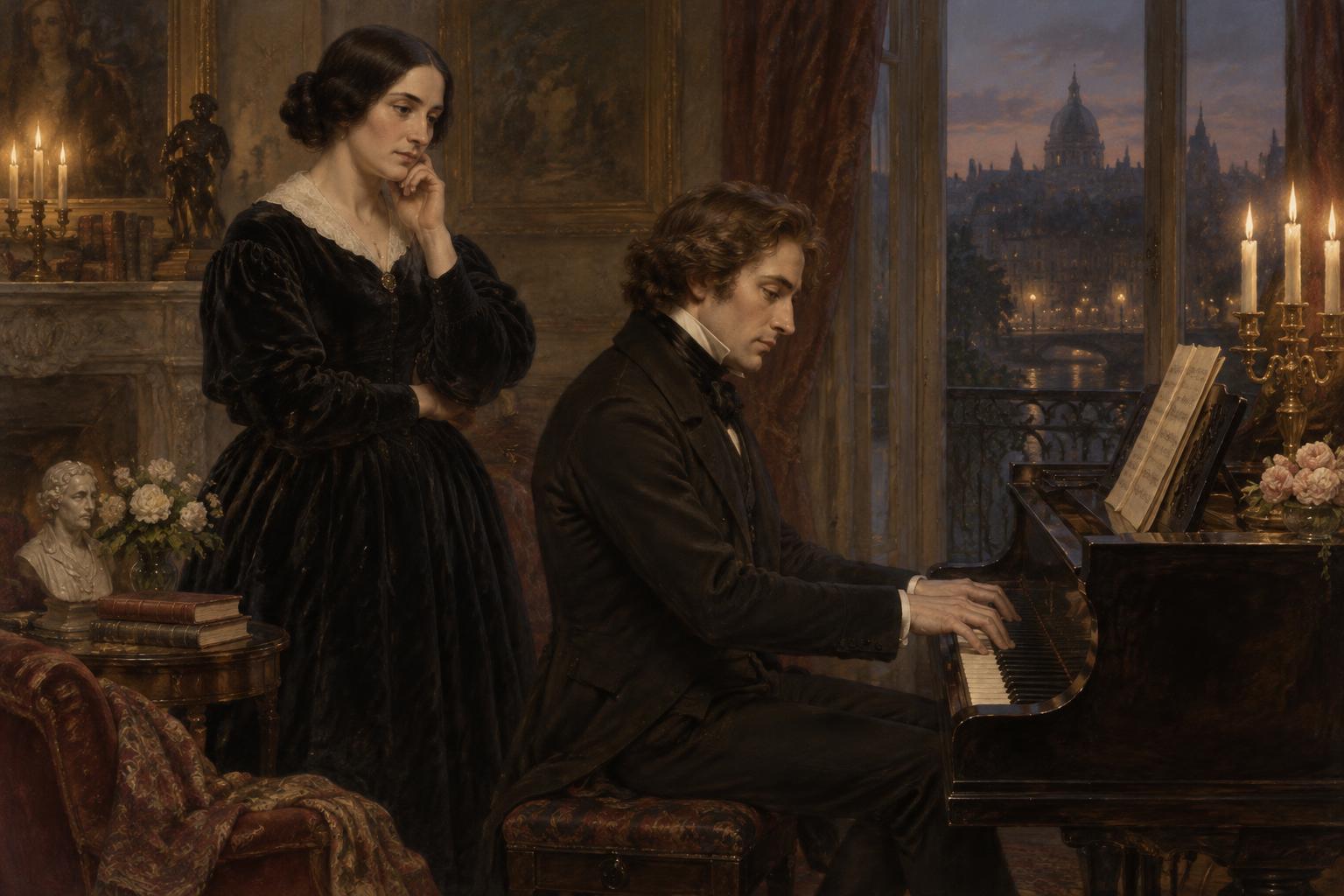
Fryderyk Chopin (Żelazowa Wola, Polonia, 1810 – Parigi, 1849) è il «poeta del pianoforte»: quasi tutta la sua musica è scritta per questo strumento. Lasciata la Polonia, visse a Parigi, dove suonava soprattutto nei salotti, davanti a pochi ascoltatori, più che nelle grandi sale da concerto.
IL PIANOFORTE NEL ROMANTICISMO — Nell'Ottocento il pianoforte diventa lo strumento romantico per eccellenza: si perfeziona la meccanica, la tastiera si allarga e il pedale permette di prolungare e mescolare i suoni. Entra nelle case borghesi e nei salotti, accompagna i Lieder e diventa protagonista di brevi brani lirici (notturni, preludi, studi, mazurche, polacche) che esprimono stati d'animo intimi. Accanto a Chopin, grandi pianisti-compositori come Liszt e Schumann.
IL PRELUDIO OP. 28 N. 15 «LA GOCCIA» — Fa parte dei 24 Preludi op. 28, uno per ogni tonalità. Il titolo non è di Chopin: secondo una leggenda legata a George Sand, la sua compagna, il brano nacque nella Certosa di Valldemossa, a Maiorca, durante giorni di pioggia incessante, e la nota ribattuta ricorderebbe le gocce sul tetto. Chopin però detestava queste descrizioni «letterarie» della sua musica.
Fryderyk Chopin al pianoforte con George Sand in un salotto parigino Download infographic
Made with ♥ by Maristella Povellato
Sezione
Tonalità e andamento
Che cosa ascoltiamo
A
Re bemolle maggiore, Sostenuto
Melodia dolce e cantabile alla mano destra; la sinistra ribatte di continuo la nota La bemolle: la «goccia»
B
Do diesis minore, un poco più mosso
Clima cupo e drammatico: la nota ribattuta (ora Sol diesis) diventa un rintocco grave, come una campana; crescendo minaccioso
A (ripresa)
Re bemolle maggiore
Torna la melodia iniziale, ma l'ombra della tempesta resta; il brano si spegne lentamente e la nota ribattuta svanisce
I CONTRASTI — Per il suo clima sognante e raccolto, questo preludio viene spesso accostato ai notturni. I contrasti sono di tre tipi: espressivi (dalla dolce malinconia al tormento), dinamici (dal piano iniziale fino ai fortissimo) e tonali (dal modo maggiore al modo minore). Una breve coda chiude il brano.
IL GIUDIZIO DI SCHUMANN — Robert Schumann definì i Preludi «strani»: «schizzi, principi di studi», brevi come miniature, ma in ognuno si riconosce la mano di Chopin, «il genio poetico più ardito e più fiero del tempo».
SIGNIFICATO — La forza del brano sta nel contrasto tra la luce della prima parte e il buio di quella centrale. La nota che non smette mai di suonare può essere sentita come un battito del cuore o un pensiero ostinato che resta uguale mentre tutto intorno cambia.
ATTIVITÀ DI ASCOLTO — Batti piano con un dito la nota ribattuta mentre ascolti: quando cambia carattere? Alza la mano all'inizio della sezione B e al ritorno della A. Poi scegli tre aggettivi per ciascuna sezione e confrontali con i compagni.
6.4 Franz Schubert e il Lied
Franz Schubert nasce a Vienna nel 1797 in una famiglia che ama la musica: a sette anni studia composizione, canto e organo e nel 1808 entra come corista nella Cappella Reale. Di carattere mite e per nulla interessato al guadagno, vive grazie al sostegno di amici e ammiratori. Compone moltissimo, in ogni genere: sinfonie, musica sacra, quartetti d'archi, sonate per pianoforte e oltre 600 Lieder. Si ammala gravemente e muore a Vienna nel 1828, a soli 31 anni.
LO STILE — Schubert è un raffinato pianista, con una grande sensibilità melodica e una straordinaria facilità nel comporre. Diventa il protagonista delle «schubertiadi», serate musicali tra amici (pittori, scrittori, poeti) nei salotti viennesi, dove può esprimere la sua arte con toni intimi e confidenziali. La sua intensità espressiva lo rende un'icona del Romanticismo.
CHE COS'È IL LIED — Lied in tedesco significa «canzone» (al plurale Lieder): è una composizione per voce e pianoforte basata su un testo poetico, spesso di grandi poeti come Goethe, Schiller e Shakespeare. Nell'Ottocento diventa una delle forme più amate, un vero manifesto del Romanticismo, perché unisce canto e poesia ed esprime sentimenti, natura e ideali. Il pianoforte non è un semplice accompagnamento: descrive l'atmosfera e dialoga con la voce.
Tipo di Lied
Caratteristica
Lied semplice (strofico)
Ogni strofa ha la stessa musica
Lied variato
La struttura resta simile, ma melodia, ritmo e timbro cambiano
Lied libero
La musica segue liberamente il testo, senza ripetizioni fisse
CURIOSITÀ — La prima bozza di un suo Lied nacque in una birreria: Schubert sfogliava un libro di Shakespeare e, ispirato, scrisse note e pentagrammi sul retro del menu. Alla sua morte i suoi beni erano pochissimi: qualche abito, un materasso, una coperta e alcuni vecchi libri di musica.
INVITO ALL'ASCOLTO — «A Sylvia» (An Silvia) — Lied semplice del 1826 su versi di Shakespeare (I due gentiluomini di Verona): un invito a cantare la bellezza e le virtù di Sylvia. Ascolta la semplicità e la delicatezza della melodia e l'accompagnamento del pianoforte basato su note ribattute. Scheda d'ascolto PDF con testo inglese, tedesco e traduzione italiana
6.5 Il melodramma nell'Ottocento in Italia
Le caratteristiche salienti
• I teatri d'opera diventano il centro della vita musicale: in Italia l'opera è quasi l'unico genere che interessa i compositori, e non a caso l'Italia è il Paese con più teatri d'opera al mondo.
• I libretti mettono in scena personaggi intrappolati in amori tempestosi e passioni travolgenti; quasi sempre la vicenda si conclude con la tragica morte dell'eroina, impersonata da un soprano (Norma, Luisa Miller, La traviata, Lucia di Lammermoor, Maria Stuarda, Anna Bolena).
• L'azione si svolge in un flusso continuo di musica, nel quale a ogni cantante è riservato un momento musicale di particolare importanza: l'aria. Scompaiono il ruolo del castrato, l'uso del clavicembalo e la rigida successione di recitativi tra un'aria e l'altra.
• Al coro, che di solito rappresenta la comunità e il popolo, vengono affidati importanti momenti musicali.
• L'orchestra è sempre più ricca, per numero e varietà di strumenti: accompagna i cantanti e crea particolari atmosfere musicali — strumenti cupi e gravi come corni, tromboni e contrabbassi per le scene buie, minacciose e pericolose; flauti, oboi e clarinetti per le scene allegre o comiche.
• Gli italiani sono maestri nello scrivere magnifiche melodie e nel creare delicati accompagnamenti orchestrali.
• I temi trattati sono spesso l'amore per la patria e la lotta per l'affrancamento dallo straniero: poiché una parte consistente del nord Italia apparteneva all'Impero austro-ungarico, l'opera diventa un momento di identificazione collettiva e di diffusione delle idee risorgimentali d'indipendenza e libertà.
• I principali compositori italiani del periodo sono Gioachino Rossini, Vincenzo Bellini, Gaetano Donizetti e soprattutto Giuseppe Verdi, musicisti che hanno scritto celebri opere ancora oggi eseguite in tutto il mondo.
6.6 Gioachino Rossini: il genio dell'opera buffa
Gioachino Rossini nasce a Pesaro nel 1792 in una famiglia di musicisti e studia al Liceo musicale di Bologna. In vent'anni compone circa 40 opere, tra cui L'italiana in Algeri, Il barbiere di Siviglia (Roma, 1816), La Cenerentola e Guglielmo Tell (1829); poi, a soli 37 anni, smette di scrivere per il teatro. Muore a Parigi nel 1868. La sua musica è piena di energia: melodie brillanti, ritmi travolgenti e il celebre «crescendo rossiniano», in cui una frase si ripete sempre più forte e con sempre più strumenti. La sua musica commosse anche il poeta Giacomo Leopardi: scoprilo nell'approfondimento Leopardi, music and Rossini in Monografie.
INVITO ALL'ASCOLTO — «Largo al factotum» — dal Barbiere di Siviglia, atto I: il barbiere Figaro entra in scena e si presenta come il «tuttofare» più richiesto della città. Ascolta il canto sillabato velocissimo, quasi uno scioglilingua, e il ritmo saltellante. Scheda d'ascolto PDF
6.7 Giuseppe Verdi: la musica che dà voce alle emozioni
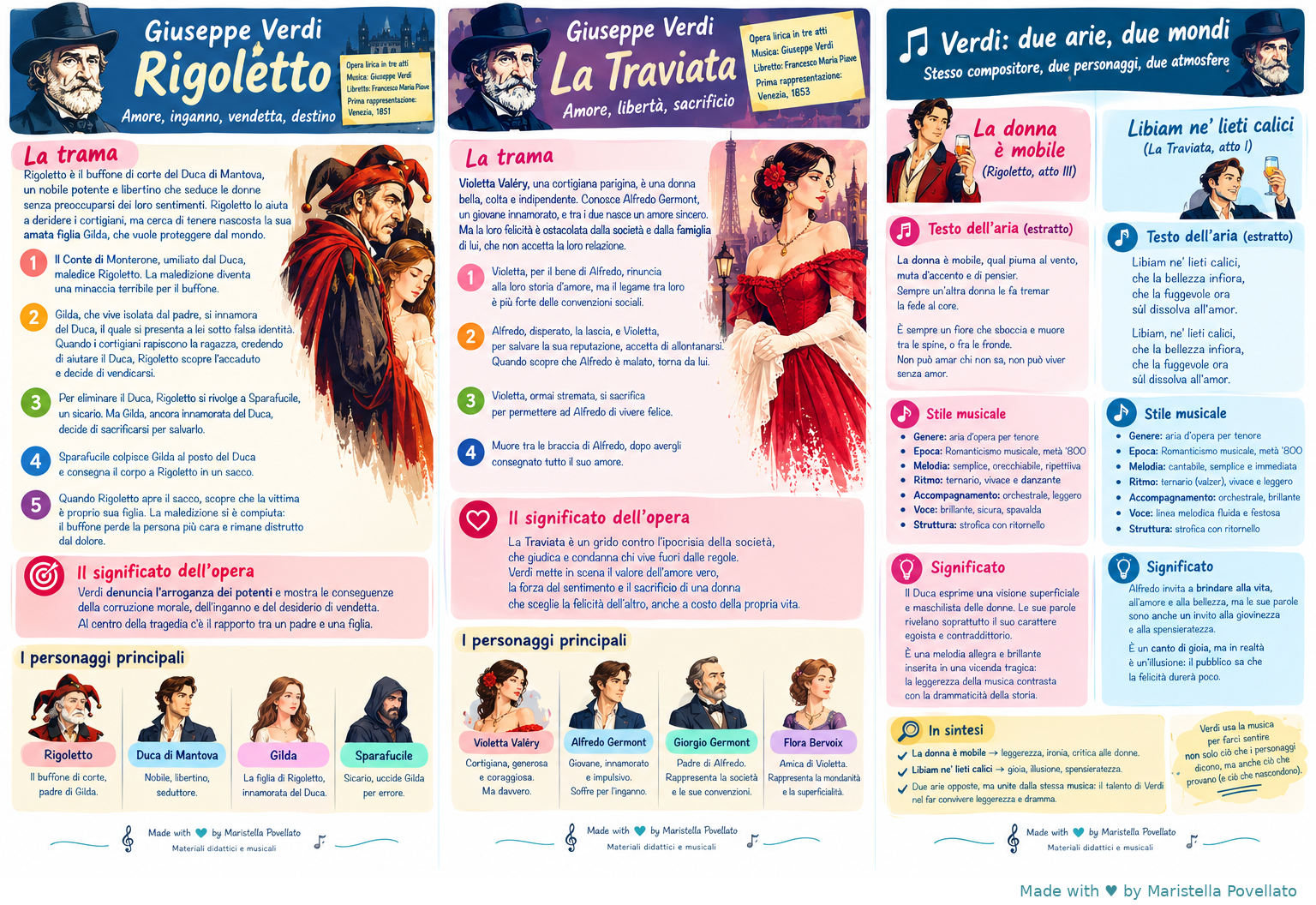
Giuseppe Verdi nasce nel 1813 a Le Roncole, vicino a Busseto (Parma), in una famiglia modesta. Studia musica grazie all'aiuto di un mercante di Busseto, Antonio Barezzi, e si trasferisce a Milano. Dopo anni difficili (perde la moglie e i due figli piccoli) ottiene il grande successo nel 1842 con Nabucco, il cui coro «Va', pensiero» diventa un simbolo del Risorgimento: il suo nome era letto come «Vittorio Emanuele Re D'Italia». Compone 28 opere, tra cui la cosiddetta «trilogia popolare» (Rigoletto, Il trovatore, La traviata), e poi Aida, Otello e Falstaff. Muore a Milano nel 1901. Nelle sue opere mette in scena passioni forti (amore, dolore, gelosia, vendetta) con melodie semplici e orecchiabili che tutti possono ricordare.
RIGOLETTO (Venezia, 1851) — Opera lirica in tre atti su libretto di Francesco Maria Piave. Rigoletto è il buffone di corte del Duca di Mantova, un nobile potente e seduttore; tiene nascosta al mondo l'amata figlia Gilda. Il Conte di Monterone lancia su Rigoletto una maledizione; Gilda si innamora del Duca, che si presenta sotto falsa identità. Per vendicarsi, Rigoletto ingaggia il sicario Sparafucile, ma Gilda si sacrifica al posto del Duca: la maledizione si compie. Verdi denuncia l'arroganza dei potenti e racconta il rapporto tra un padre e una figlia.
L'ARIA «La donna è mobile» — da Rigoletto, atto III
Cantata dal Duca di Mantova nell'osteria di Sparafucile, mentre continua a comportarsi con leggerezza, senza sapere che Gilda è pronta a sacrificarsi per lui.
Testo cantato (estratto)
Significato
La donna è mobile qual piuma al vento
La donna è volubile, come una piuma mossa dal vento
muta d'accento e di pensiero
cambia spesso parole e idee
Sempre un amabile leggiadro viso
Ha sempre un viso grazioso e gentile
in pianto o in riso è menzognero
ma che pianga o rida, mente
Significato: il Duca esprime una visione superficiale e maschilista delle donne, ma il pubblico sa che è proprio lui a essere infedele e incostante. Le sue parole rivelano il suo carattere egoista.
LA TRAVIATA (Venezia, 1853) — Opera lirica in tre atti, sempre su libretto di Piave. A Parigi Violetta Valéry, una cortigiana, si innamora di Alfredo Germont, giovane di buona famiglia. Il padre di lui, Giorgio Germont, le chiede di rinunciare ad Alfredo per l'onore della famiglia; Violetta accetta, ma Alfredo la crede traditrice. Quando scopre la verità torna da lei, ma Violetta, malata di tubercolosi, muore tra le sue braccia. L'opera è un grido contro l'ipocrisia della società che giudica chi vive fuori dalle regole.
L'ARIA «Libiam ne' lieti calici» — da La traviata, atto I
È il famoso BRINDISI cantato da Alfredo (e poi da Violetta e dal coro) durante una festa a Parigi: tutti brindano alla vita e all'amore, senza sapere che dietro la festa si nasconde la tragedia.
Testo cantato (estratto)
Significato
Libiam ne' lieti calici, che la bellezza infiora
Brindiamo con i calici allegri, resi più belli dalla bellezza
e la fuggevol ora s'inebrii a voluttà
e il tempo che fugge si riempia di piacere
Libiam ne' dolci fremiti che suscita l'amore
Brindiamo alle dolci emozioni che fa nascere l'amore
poiché quell'occhio al core onnipotente va
perché quello sguardo arriva dritto al cuore
Significato: è un inno alla giovinezza e alla spensieratezza, un canto di gioia che però è un'illusione: il pubblico sa che la felicità durerà poco.
ASCOLTI A CONFRONTO: «LA DONNA È MOBILE» E «LIBIAM NE' LIETI CALICI»
In entrambe le arie spicca l'orecchiabilità della melodia: il tema viene anticipato da una breve introduzione orchestrale in cui si riconosce subito il ritmo ternario di valzer, e la melodia si snoda con intervalli facili da memorizzare. La leggerezza della musica e del testo crea un forte CONTRASTO con il dramma che chiude le due opere: Verdi porta in scena il desiderio di evasione della gente comune di fronte a una realtà tragica.
Caratteristica
La donna è mobile (Rigoletto)
Libiam ne' lieti calici (La traviata)
Chi canta
Il Duca di Mantova, tenore solista
Alfredo, poi Violetta e il coro
Coro
No
Sì, interviene tutto il coro
Ritmo
Ternario, vivace e danzante (più veloce)
Ternario, valzer brillante
Introduzione
Il tema è anticipato dall'orchestra
Il tema è anticipato dall'orchestra
Atmosfera
Sfogo spavaldo e scherzoso di un solo personaggio
Festa, brindisi collettivo
Tema del testo
Giudica (ingiustamente) l'incostanza delle donne
Inneggia all'amore e alla vita
Struttura
Strofica con ritornello e cadenza finale del tenore
Strofica con ritornello; accelerando finale con il coro
Contrasto drammatico
Spensieratezza che precede la morte di Gilda
Allegria che nasconde la malattia e la morte di Violetta
In comune
Entrambe sono arie, melodie orecchiabili e in tempo ternario
Entrambe sono arie, melodie orecchiabili e in tempo ternario
6.8 Va’, pensiero e il Canto degli Italiani: musica e Risorgimento
«Va’, pensiero», dal Nabucco di Verdi (1842), su libretto di Temistocle Solera, è il coro degli ebrei esiliati a Babilonia: ricordano la patria perduta e chiedono forza nella sofferenza. La melodia ampia e il canto prevalentemente omoritmico fanno sentire una comunità che parla con una sola voce. Il legame simbolico con il Risorgimento si consolidò nel tempo: non è l’inno nazionale italiano. Scheda PDF Va’, pensiero: attività musicali e civiche.
«Il Canto degli Italiani» (Inno di Mameli) nasce nel 1847, con parole di Goffredo Mameli e musica di Michele Novaro. Il ritmo energico di marcia e il ritornello invitano all’unità e alla partecipazione. Adottato provvisoriamente nel 1946, è riconosciuto per legge come inno nazionale nel 2017. Leggiamo il linguaggio del Risorgimento nel suo contesto storico e confrontiamolo con i principi di uguaglianza e pace della Costituzione. Scheda PDF Inno di Mameli: attività musicali e civiche.
ATTIVITÀ A CONFRONTO — Segna la pulsazione dei due brani, confronta andamento, dinamica e fraseggio, poi canta una breve frase insieme ai compagni ascoltando le altre voci. Quale brano esprime nostalgia e quale esorta all’azione? Proponi un gesto concreto di solidarietà per la classe. Le due schede complete sono disponibili anche in In-depth studies.
Recommended listening
Section
Piece
Composer / Artist
Form
Link
6.3
Preludio op. 28 n. 15 «La goccia»
A-B-A form: a dreamy melody over a repeated note that recalls the rain; in the middle, a storm in C-sharp minor.
Infographic: Late Romanticism (1870-1914) Download
Made with ♥ by Maristella Povellato
Listen to the text
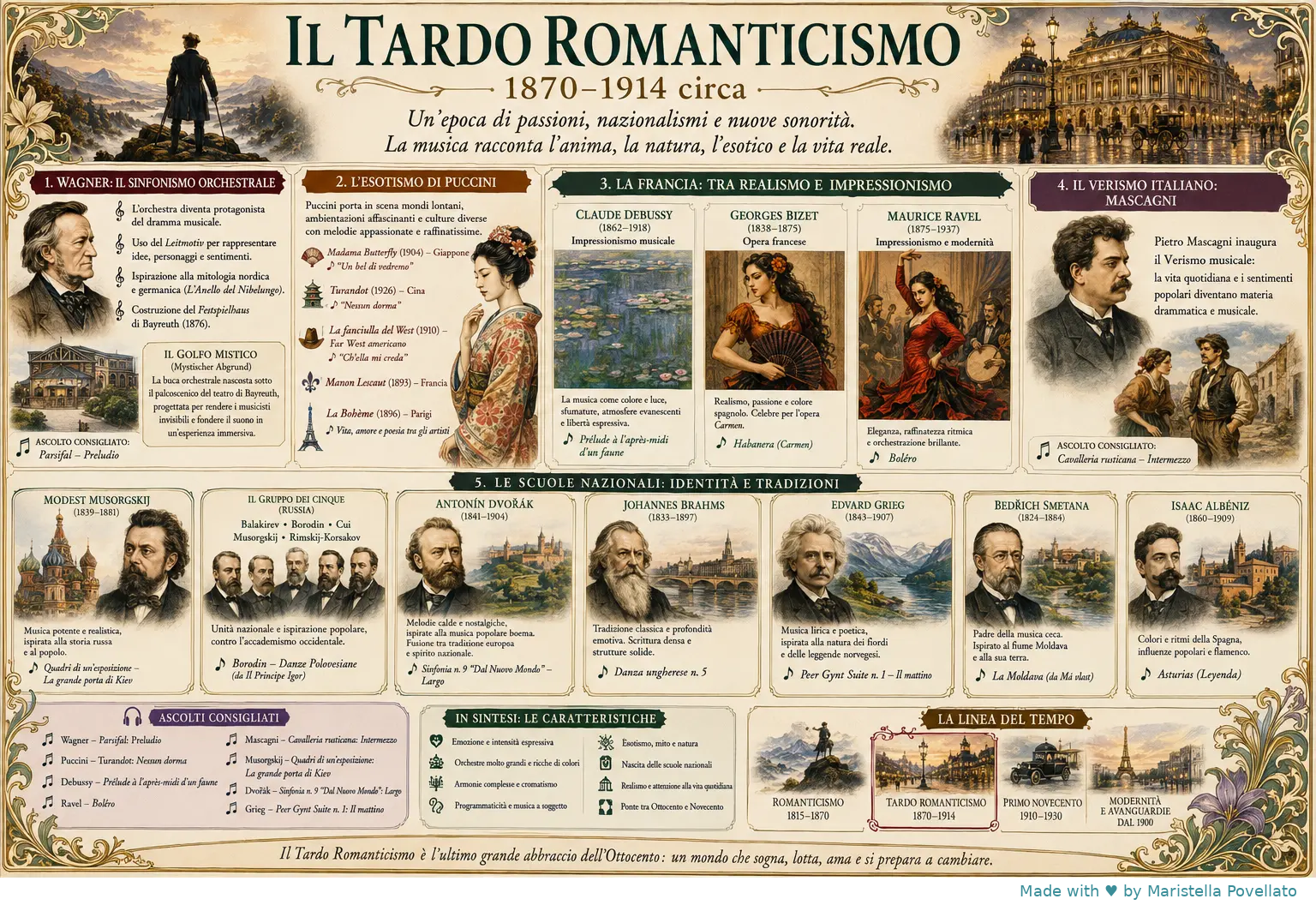
LATE ROMANTICISM (c. 1870-1914) — An age of passions, nationalism and new sounds: music expresses the soul, nature, the exotic and real life. It is the nineteenth century's last great embrace: a world that dreams, struggles, loves and prepares for change.
WAGNER AND ORCHESTRAL SYMPHONIC WRITING — With Richard Wagner, the orchestra takes a leading role in music drama. He uses the LEITMOTIF, a short musical theme representing a character, an object or a feeling. He draws inspiration from Norse and Germanic mythology (L'Anello del Nibelungo) and builds the Bayreuth theatre (1876) with its 'mystic gulf', the orchestra pit hidden beneath the stage that makes the musicians invisible.
PUCCINI'S EXOTICISM — Giacomo Puccini brings distant worlds and different cultures to the stage through passionate melodies: Madama Butterfly (1904, Japan), Turandot (1926, China), La fanciulla del West (1910, the American Wild West), Manon Lescaut (1893, France) and La Bohème (1896, Paris).
FRANCE: REALISM AND IMPRESSIONISM — Claude Debussy (1862-1918) treats music as colour and light, using subtle shades and fleeting atmospheres; Georges Bizet (1838-1875) brings realism, passion and Spanish colour to the stage in Carmen; Maurice Ravel (1875-1937) combines elegance, rhythmic sophistication and brilliant orchestration.
ITALIAN VERISMO — Pietro Mascagni launches musical Verismo: everyday life and ordinary people's feelings become the material for drama and music (Cavalleria rusticana).
THE NATIONAL SCHOOLS — Throughout Europe, composers draw inspiration from their own country's folk music: Musorgskij and the Gruppo dei Cinque in Russia, Dvořák in Bohemia, Brahms in Germany, Grieg in Norway, Smetana in Bohemia and Albéniz in Spain.
IN SUMMARY — Emotion and expressive intensity, very large orchestras rich in tone colours, complex harmonies and chromaticism, exoticism, myth and nature, the rise of national schools and attention to real life: a bridge between the nineteenth and twentieth centuries.
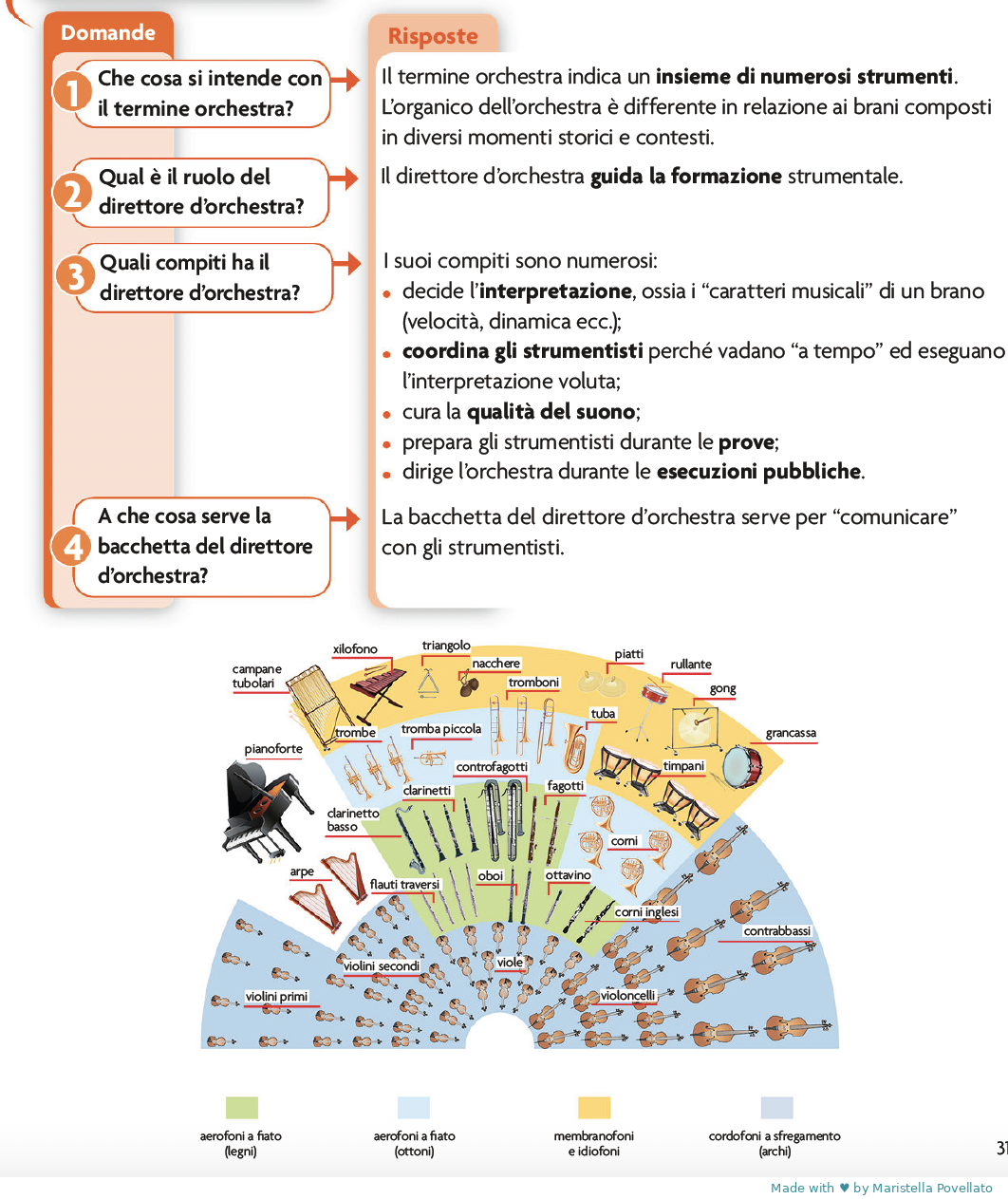
WHAT IS AN ORCHESTRA? — The term orchestra means a GROUP OF MANY INSTRUMENTS playing together. The orchestra's make-up varies according to pieces composed in different historical periods and contexts: it has not always been the same, but has changed over time. At its centre is the CONDUCTOR, who leads the instrumental ensemble: they decide on the interpretation, meaning the 'musical characteristics' of a piece (tempo, dynamics, etc.), coordinate the instrumentalists so that they play 'in time' and follow the intended interpretation, look after sound quality, prepare the instrumentalists during rehearsals and lead the orchestra during public performances. The conductor uses the BATON to 'communicate' with the instrumentalists.
THE SECTIONS OF THE ORCHESTRA — The modern orchestra is divided into families of instruments: STRINGS (bowed): first and second violins, violas, cellos and double basses, the largest section; WOODWIND (blown aerophones): flutes, oboes, clarinets, bassoons and contrabassoons; BRASS (blown aerophones): trumpets, trombones, horns and tuba; PERCUSSION (membranophones and idiophones): timpani, bass drum, cymbals, triangle, drum, gong, snare drum, castanets and xylophone; alongside these are the HARP and PIANO.
THE ORCHESTRA IN THE CLASSICAL PERIOD — In the Classical period (1750-1820), the orchestra grows and becomes better organised, with a stable balance between strings, woodwind, brass and percussion: the strings form the foundation, the woodwind play in pairs, the brass instruments are still 'natural' instruments (without valves), and percussion consists mainly of timpani. There is not yet a conductor with a baton as we know one today: the first violinist or the composer, seated at the harpsichord or piano, leads the ensemble. Haydn, Mozart and Beethoven write the first great SYMPHONIES for this orchestra.
HOW IT CHANGES OVER TIME — IN THE BAROQUE PERIOD, the ensemble is small: a court orchestra with harpsichord and basso continuo leading the group. IN THE CLASSICAL PERIOD, the orchestra's make-up becomes more stable, with balanced sections. IN THE ROMANTIC PERIOD, the orchestra grows enormously: new instruments join it (piccolo, cor anglais, tubas, more percussion and harps), the sound becomes more powerful, and the modern CONDUCTOR emerges, standing with a baton, interpreting the music and coordinating dozens of musicians. IN THE TWENTIETH CENTURY, the traditional orchestra exists alongside new sounds: exotic instruments, electronics, recordings and film music; composers keep experimenting with new combinations.
GREAT CONDUCTORS — The conductor is the musician who gives the orchestra unity and personality: this is why some conductors have become as famous as composers. The table shows some of the most famous: on the left are those who made music history, and on the right are those who still conduct today.
Conductors of the past
Conductors still living
Arturo Toscanini (1867-1957)
Riccardo Muti (born in 1941)
Leonard Bernstein (1918-1990)
Daniel Barenboim (born in 1942)
Herbert von Karajan (1908-1989)
Kirill Petrenko (born in 1972)
Claudio Abbado (1933-2014)
Gustavo Dudamel (born in 1981)
Lorin Maazel (1930-2014)
Riccardo Chailly (born in 1953)
IN SUMMARY — The orchestra is a group of many instruments organised into sections (strings, woodwind, brass and percussion), led by the conductor. From the small Baroque ensemble to the balanced Classical orchestra, from the giant orchestras of the Romantic period to twentieth-century experiments: the orchestra changes over time, but remains the greatest 'musical machine' ever invented by humans.
Infographic: the orchestra and the conductor Download
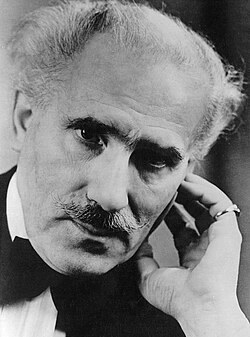 Arturo Toscanini (1867-1957)
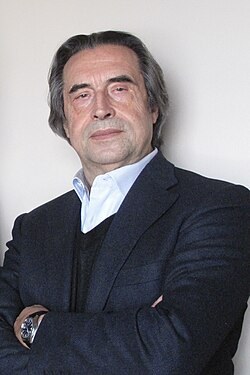 Riccardo Muti (born in 1941)
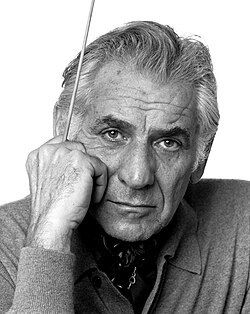 Leonard Bernstein (1918-1990)
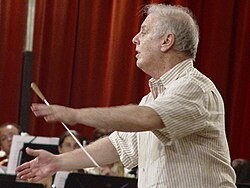 Daniel Barenboim (born in 1942)
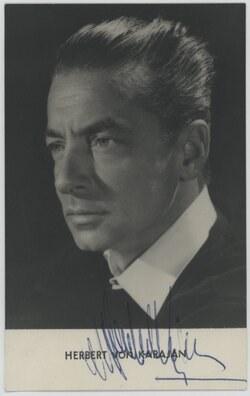 Herbert von Karajan (1908-1989)
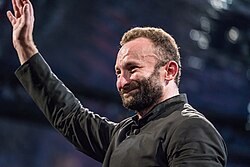 Kirill Petrenko (born in 1972)
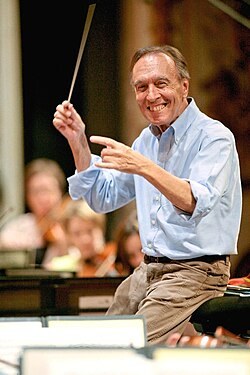 Claudio Abbado (1933-2014)
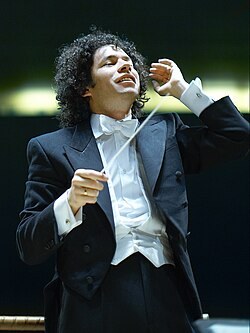 Gustavo Dudamel (born in 1981)
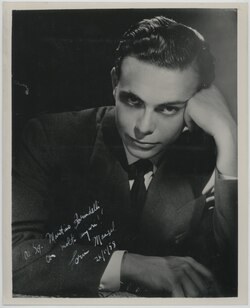 Lorin Maazel (1930-2014)
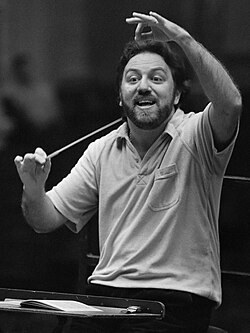 Riccardo Chailly (born in 1953)