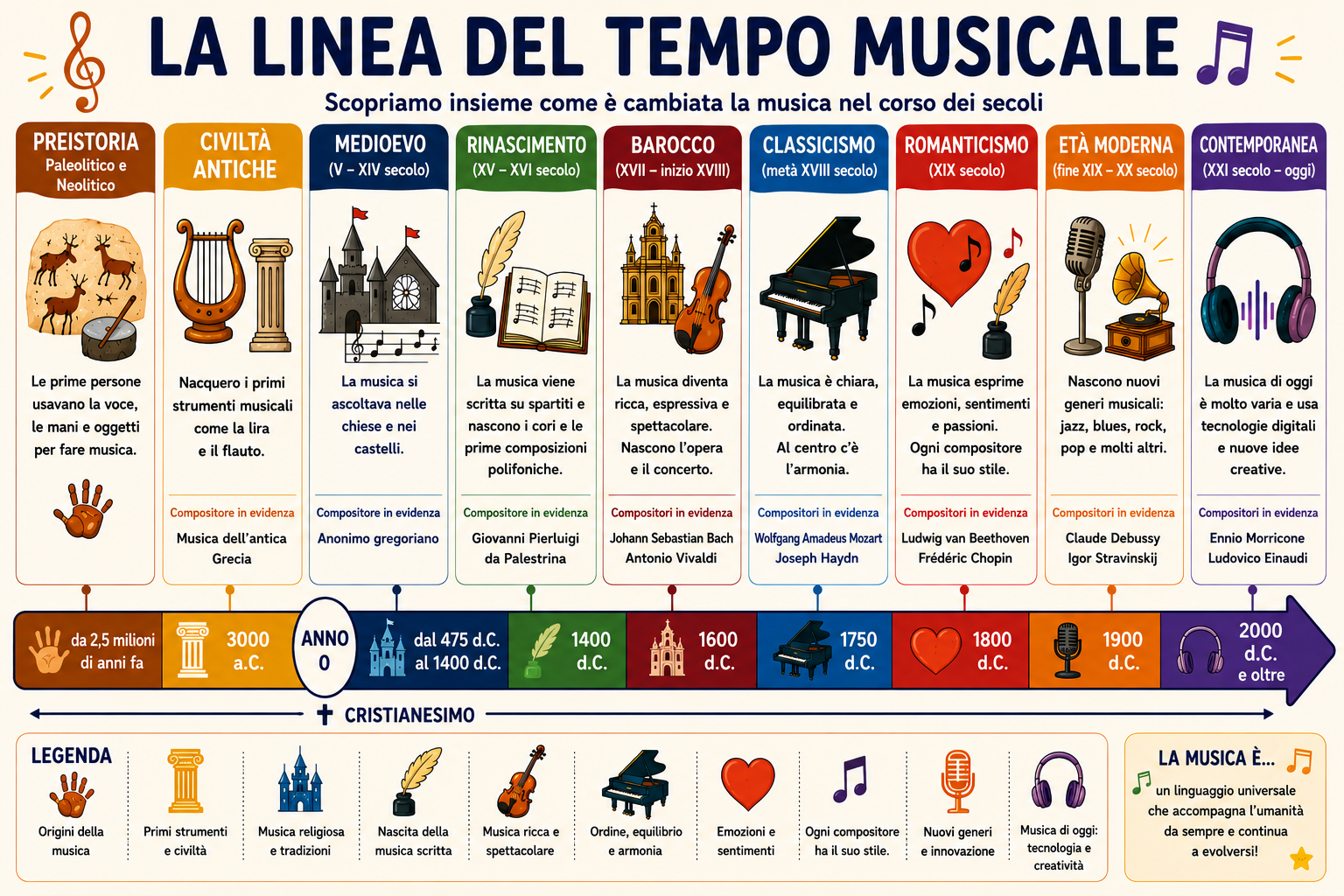
3

Middle school · Year 3

Made with ♥ by Maristella Povellato

01

The Belle Époque

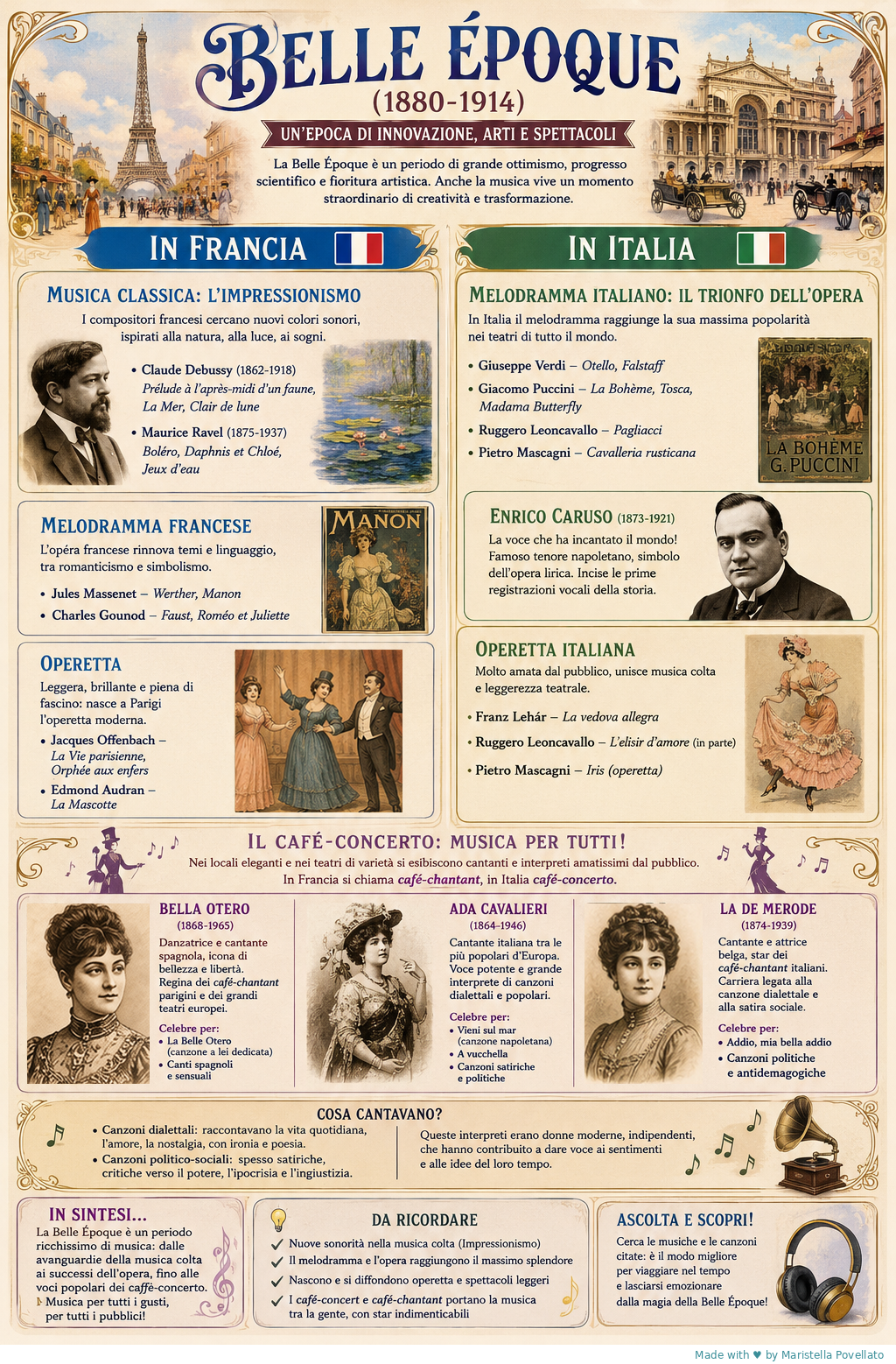
Infographic: music in the Belle Époque (1880-1914) Download

Made with ♥ by Maristella Povellato

Listen to the text

THE BELLE ÉPOQUE (1880-1914) — The Belle Époque, meaning "beautiful era", is the name given to the period from the last decades of the nineteenth century to the outbreak of the First World War. These were years of peace, great inventions (electricity, the car, cinema, the phonograph, the telephone) and confidence in progress. Paris was its capital: the World's Fairs, the Eiffel Tower (1889), café-concerts, the Moulin Rouge and major theatres made the city the cultural centre of Europe. MUSIC IN ENTERTAINMENT VENUES — The middle classes went to ballrooms (where the Viennese WALTZ of Johann Strauss jr. was hugely popular), cabarets and cafés-chantants, where Offenbach's CAN-CAN, operetta and light popular songs emerged. The first African American rhythms also reached these venues: the cakewalk and ragtime, which fascinated even Debussy. IN FRANCE — Claude Debussy created MUSICAL IMPRESSIONISM: just as the painters Monet and Renoir painted light, he built music using timbres, tone colours and subtly shaded atmospheres (whole-tone scales and chords that do not 'resolve'). Maurice Ravel combined refined tone colours with dance rhythms. Erik Satie instead chose simplicity and humour (the Gymnopédies). IN ITALY — Opera flourished with Giacomo Puccini (La Bohème, Tosca, Madama Butterfly) and the VERISMO of Mascagni and Leoncavallo: stories about ordinary people, powerful emotions and passionate melodies. NEAPOLITAN SONGS ('O sole mio, Torna a Surriento) also flourished, along with the first popular songs spread through sheet music and gramophones. NEW TECHNOLOGY — Edison's phonograph and later the gramophone made it possible for the first time to RECORD music and LISTEN TO IT AGAIN: the age of recorded music began, changing the way people listened forever.

Recommended listening
PieceComposer / ArtistFormLink
Clair de lune
Musical Impressionism.
C. DebussyCanzone Listen
Gymnopédie n. 1
Airy, floating piano music, a symbol of late-19th-century Paris.
E. SatieBrano per pianoforte Listen
Can-can (Orfeo all'inferno)
The exhilarating dance of cabarets and the Moulin Rouge.
J. OffenbachDanza Listen
Prélude à l'après-midi d'un faune
Musical Impressionism is born: timbres and tone colours.
C. DebussyPreludio Listen
Pavane pour une infante défunte
The elegance and nostalgia of early-20th-century France.
M. RavelDanza (pavane) Listen
La Bohème — Che gelida manina
Italian opera tells the story of impoverished artists' lives.
G. PucciniCanzone Listen
Torna a Surriento
Neapolitan song conquers the world.
E. De CurtisCanzone Listen
Cakewalk — Golliwogg's Cakewalk
The first African American rhythms arrive in Europe.
C. DebussyCanzone Listen
GO TO QUIZ
02

The Avant-Garde Movements

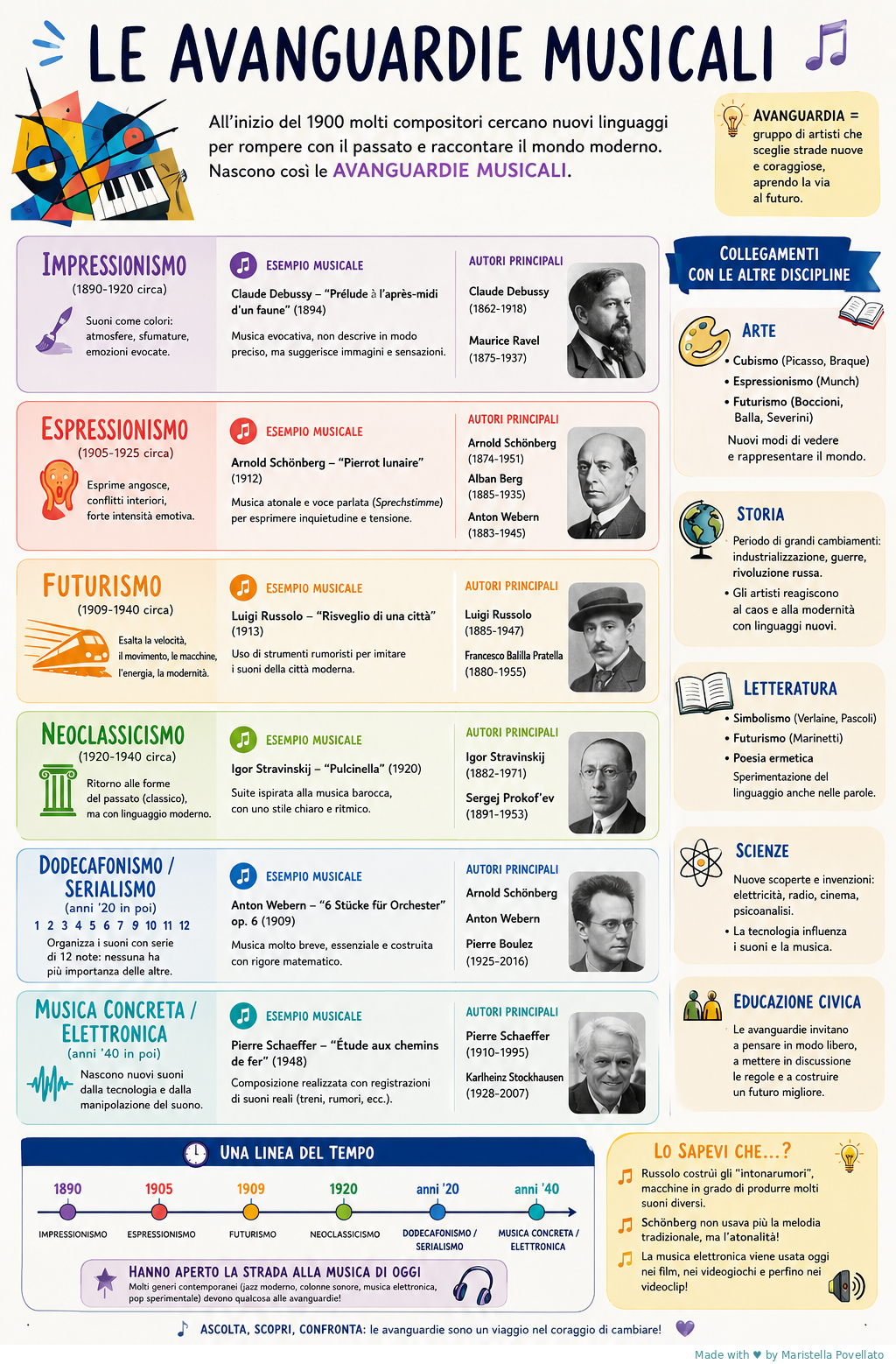
Infographic: twentieth-century avant-garde movements Download

Made with ♥ by Maristella Povellato

Listen to the text

TWENTIETH-CENTURY AVANT-GARDE MOVEMENTS — With the new century and the tragedy of the two world wars, many musicians felt the need to BREAK with the rules of the past. Avant-garde movements emerged: movements that experimented with new sounds, new scales, new instruments and even new ways of writing music. IMPRESSIONISM (Debussy, Ravel) — Music no longer tells a story: it evokes images and sensations through new timbres and harmonies. EXPRESSIONISM AND TWELVE-TONE MUSIC (Schönberg, Berg, Webern) — Art must express inner anguish. Schönberg abandoned tonality (ATONALITY) and invented TWELVE-TONE MUSIC: the twelve notes of the chromatic scale all have equal importance and are arranged in a 'tone row'. In Pierrot Lunaire he used Sprechgesang, halfway between speaking and singing. PRIMITIVISM AND RHYTHM (Stravinsky, Bartók) — La Sagra della primavera (1913) caused a scandal in Paris: fierce, irregular rhythms, dissonances and references to ancient rituals. Bartók studied Hungarian folk music and transformed it into classical music. FUTURISM (Russolo, Marinetti) — In Italy, the Futurists celebrated machines and speed: the INTONARUMORI produced the noises of the modern city. Noise officially became part of music. MUSIQUE CONCRÈTE AND ELECTRONIC MUSIC — After 1948, Pierre Schaeffer in Paris recorded real-world sounds on tape and manipulated them (MUSIQUE CONCRÈTE); in Cologne, Stockhausen generated artificial sounds using oscillators (ELECTRONIC MUSIC); in Milan, the RAI Studio di Fonologia was founded with Berio and Maderna. These were the roots of all today's digital music: sampling, synthesizers and computers. CHANCE AND EXPERIMENTAL MUSIC (Cage) — John Cage introduced CHANCE into composition, and with 4'33" he made silence 'play': music became the act of listening to the surrounding environment. Others, such as Penderecki and Ligeti, worked with masses of sound and tone clusters.

Recommended listening
PieceComposer / ArtistFormLink
Prélude à l'après-midi d'un faune
Musical Impressionism is born: timbres and tone colours.
C. DebussyPreludio Listen
Pierrot Lunaire
Sprechgesang: halfway between speaking and singing, atonality.
A. SchönbergCanzone Listen
Risveglio di una città
The noises of the modern city: Futurism in music.
L. RussoloComposizione futurista Listen
Pulcinella
Neoclassicism: old melodies in a modern musical language.
I. StravinskijSuite per orchestra Listen
6 Stücke für Orchester op. 6
Viennese serialism: brevity and mathematical precision.
A. WebernComposizione per orchestra Listen
Étude aux chemins de fer
Musique concrète: real sounds recorded and manipulated.
P. SchaefferCanzone Listen
GO TO QUIZ
03

Jazz

Infographic: Jazz — origins and styles Download

Made with ♥ by Maristella Povellato

Listen to the text

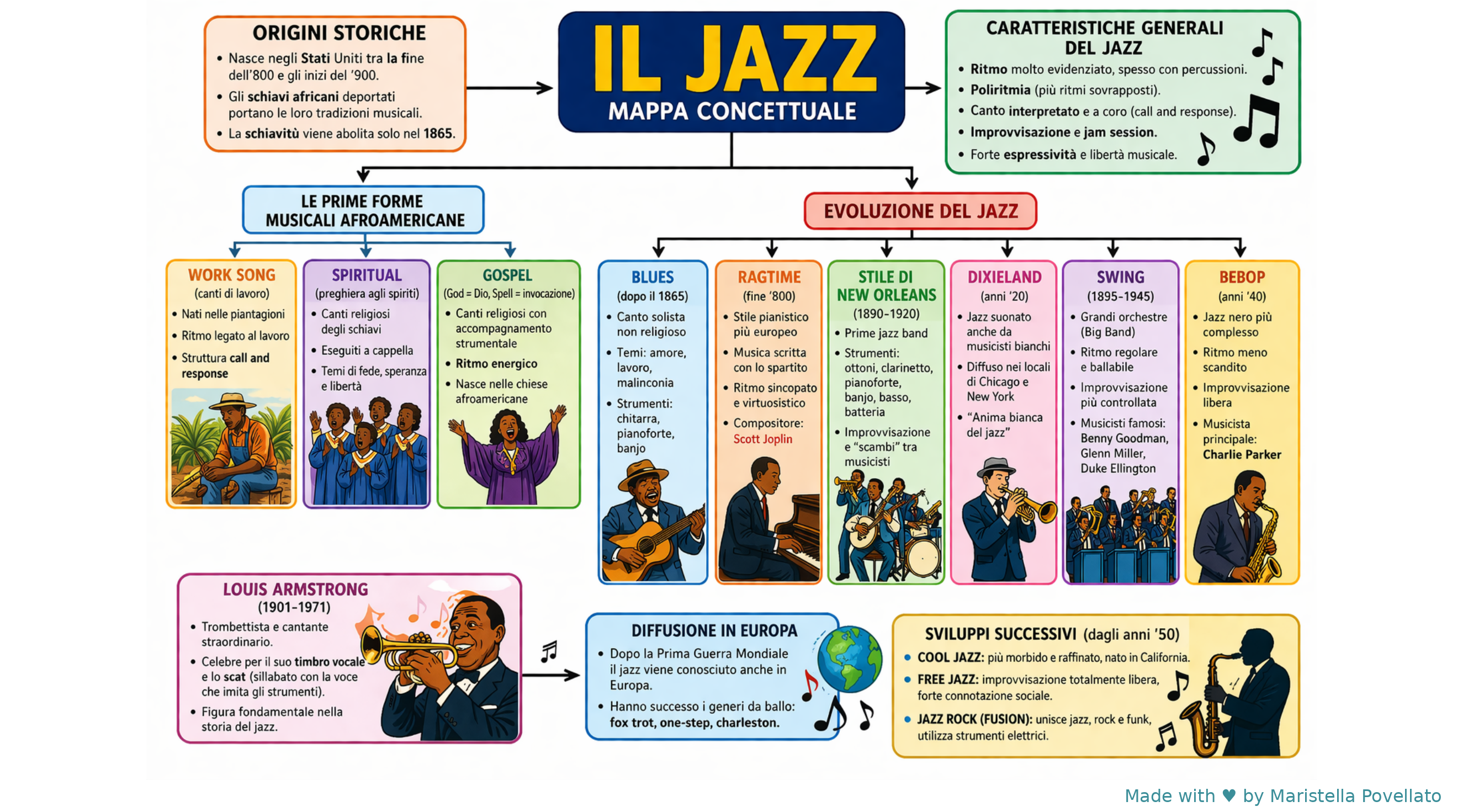
Jazz emerged in the United States between the late nineteenth and early twentieth centuries, from the meeting of African music brought by enslaved people forcibly transported to plantations in the South and the European classical music of the settlers. Its ROOTS lie in the songs of enslaved people: work songs (songs sung while working in the fields, with a call-and-response structure), spirituals (a cappella religious songs inspired by the Bible) and gospel songs (religious songs accompanied by instruments, with an infectious rhythm). AFTER THE ABOLITION OF SLAVERY (1865), THE BLUES EMERGED — It is the solo song of someone telling the story of their life: hard work in the fields, poverty, prison and lost love, but also laughter and the desire for freedom. A single voice, free and expressive, in dialogue with the instruments: almost all jazz starts with the blues. THE STRUCTURE — THE 12-BAR CHORD PROGRESSION — The most traditional Blues is a cycle of 12 bars in 4/4, repeated unchanged from beginning to end, using just three chords: the tonic (I), the subdominant (IV) and the dominant (V).

BarsChordWhat happens
1-4I (tonic)The singer presents their phrase
5-6IV (subdominant)The phrase repeats, moving up a fourth
7-8I (tonic)The phrase returns to the tonic
9V (dominant)The chord that creates tension: the turning point of the progression
10IV (subdominant)The music heads back home
11-12I (tonic, with a move to V)The ending: the progression is complete and can begin again

WORKSHEET — «ROUTE 66»: THE 12-BAR CHORD PROGRESSION «Route 66», written by Bobby Troup in 1946 and made famous by Nat King Cole, is a standard based on the blues. Here we provide a simplified accompaniment for learning in Fa, with three seventh chords: Fa7 (F7), Si♭7 (B♭7) and Do7 (C7). This is not an exact transcription of the recording: jazz versions may add passing chords and chord substitutions. Each bar contains four beats. The progression is divided into three groups of four bars; after the twelfth bar, you return to the first. In the second bar we use the «quick change», an early move to chord IV.

BarChordScale degree and function
1Fa7 — F7I7: tonic, start of the progression
2Si♭7 — B♭7IV7: subdominant, quick change
3Fa7 — F7I7: return to the tonic
4Fa7 — F7I7: end of the first phrase
5Si♭7 — B♭7IV7: start of the second phrase
6Si♭7 — B♭7IV7: staying on the subdominant
7Fa7 — F7I7: return to the tonic
8Fa7 — F7I7: end of the second phrase
9Do7 — C7V7: dominant, tension
10Si♭7 — B♭7IV7: moving down towards the tonic
11Fa7 — F7I7: resolution
12Do7 — C7V7: leading into the next cycle

To finish the piece, bar 12 of the final cycle can stay on Fa7 instead of leading into another cycle with Do7. ACTIVITY — Count «1, 2, 3, 4» aloud for each bar and tap a steady beat along with the progression. Divide the class into three groups: one follows Fa7, one Si♭7 and one Do7; each group raises their hands when their chord comes along. Then compare the chart with the recording: identify where the melody returns and any chords added by the musicians. Listen to «Route 66» — Nat King Cole Find out more: blues form and the chords of «Route 66» WORKSHEET — «SWEET HOME CHICAGO»: THE 12-BAR CHORD PROGRESSION «Sweet Home Chicago», recorded by Robert Johnson in 1936 with voice and guitar, is one of the best-known blues songs. For practice, we use a simplified learning progression in Mi: Mi7 (E7), La7 (A7) and Si7 (B7). The chart is not an exact transcription of the historical recording: Johnson's phrasing is free, and different performances may vary the accompaniment. The time signature is 4/4: count four beats per bar, with a shuffle feel. As in the «Route 66» worksheet, the move to chord IV in bar 2 is the «quick change».

BarChordScale degree and function
1Mi7 — E7I7: tonic, start of the progression
2La7 — A7IV7: subdominant, quick change
3Mi7 — E7I7: return to the tonic
4Mi7 — E7I7: end of the first phrase
5La7 — A7IV7: start of the second phrase
6La7 — A7IV7: staying on the subdominant
7Mi7 — E7I7: return to the tonic
8Mi7 — E7I7: end of the second phrase
9Si7 — B7V7: dominant, tension
10La7 — A7IV7: moving down towards the tonic
11Mi7 — E7I7: resolution
12Si7 — B7V7: leading into the next cycle

To close the final cycle, bar 12 can stay on Mi7. For an even simpler first practice exercise, you can also keep Mi7 in bar 2, without a quick change. ACTIVITY — First follow the progression without the recording, counting «1, 2, 3, 4» and pointing to each bar in the table. One group sings a short phrase they have made up, a second group repeats it and a third responds: this lets you explore AAB form. Then listen to Robert Johnson and identify how the guitar answers the voice; compare this stripped-down sound with Nat King Cole's trio in «Route 66». Listen to «Sweet Home Chicago» — Robert Johnson THE LYRICS — AAB FORM — Each verse lasts twelve bars and has three four-bar phrases: the first is sung, the second repeats it almost unchanged, and the third ends it differently.

PartWhere it fallsWhat it does
A (bars 1-4)over the first chordIntroduces the idea: «I woke up this morning...»
A (bars 5-8)over the secondRepeats the same phrase to fix it in the memory
B (bars 9-12)over the dominantCompletes or reverses it: this is the moral of the story

THE ELEMENTS OF THE SOUND —

ElementWhat it is
Blue notesThe 3rd, 5th and 7th notes of the scale are lowered or «bent»: they give the blues its sad, tense tone colour
Blues scaleSix notes (1, 3b, 4, 5b, 5, 7): the lowered 5th is the typical «blue note»
Shuffle rhythmThe quavers are «drawn out», one long and one short: this is the uneven, loping rhythm of the blues
Bending and slideThe note is bent with the fingers (bending), or its pitch is changed by sliding a bottleneck along the strings (slide)
Call and responseThe voice calls and the instrument answers: this is a legacy of work songs
ImprovisationThe progression stays the same, but the music does not: every performance is different

THE INSTRUMENTS — • VOICE — the first instrument: rough, nasal and full of moans, cries and whispers. • GUITAR — first acoustic in the fields of the South, then electric in the cities; played using slide and bending techniques. • HARMONICA (mouth organ) — played by «bending» notes with the breath: it becomes a cry. • PIANO — in saloons and dance halls, with the alternating bass of boogie-woogie. • BANJO — in the early days, before the guitar was used. • BASS AND DRUMS — in electric bands: they are the heart of the rhythm. • BRASS AND CLARINETS — when the blues meets the first jazz bands. BLUES STYLES —

StyleWhere and whenWhat it sounds like
Delta / country bluesSouthern USA, early 1900sVoice and acoustic guitar alone, bottleneck slide
Classic blues1920s, city theatresA singer with a small jazz band: piano, clarinet and trumpet
Chicago blues1940s-1950s, the industrial NorthElectric guitar, harmonica, bass and drums: an amplified, hard-edged sound
Texas blues1950s-1980sBright electric guitar, soloists with a full, singing tone
Rhythm & blues1940s-1950sFast, danceable blues with shouted vocals: rock 'n' roll would grow out of this

IN THE LISTENING EXAMPLES — «St. Louis Blues» by Bessie Smith is classic blues; «Hoochie Coochie Man» by Muddy Waters is Chicago blues: compare them and identify the guitar, harmonica and drums. Piano RAGTIME spread through saloons (Scott Joplin, Jelly Roll Morton). Brass bands and the first jazz bands emerged in New Orleans (King Oliver, Louis Armstrong): this was the NEW ORLEANS / DIXIELAND style, with collective improvisation. In the 1930s-1940s, big-band SWING was hugely popular (Duke Ellington, Benny Goodman, Glenn Miller): a steady rhythm for dancing. In the 1940s, BEBOP (Charlie Parker, Dizzy Gillespie) brought jazz back to its African American roots: virtuosity, free improvisation and music for listening. This was followed by COOL JAZZ (Miles Davis), FREE JAZZ (Coltrane, Ornette Coleman) and JAZZ ROCK / FUSION with electric instruments.
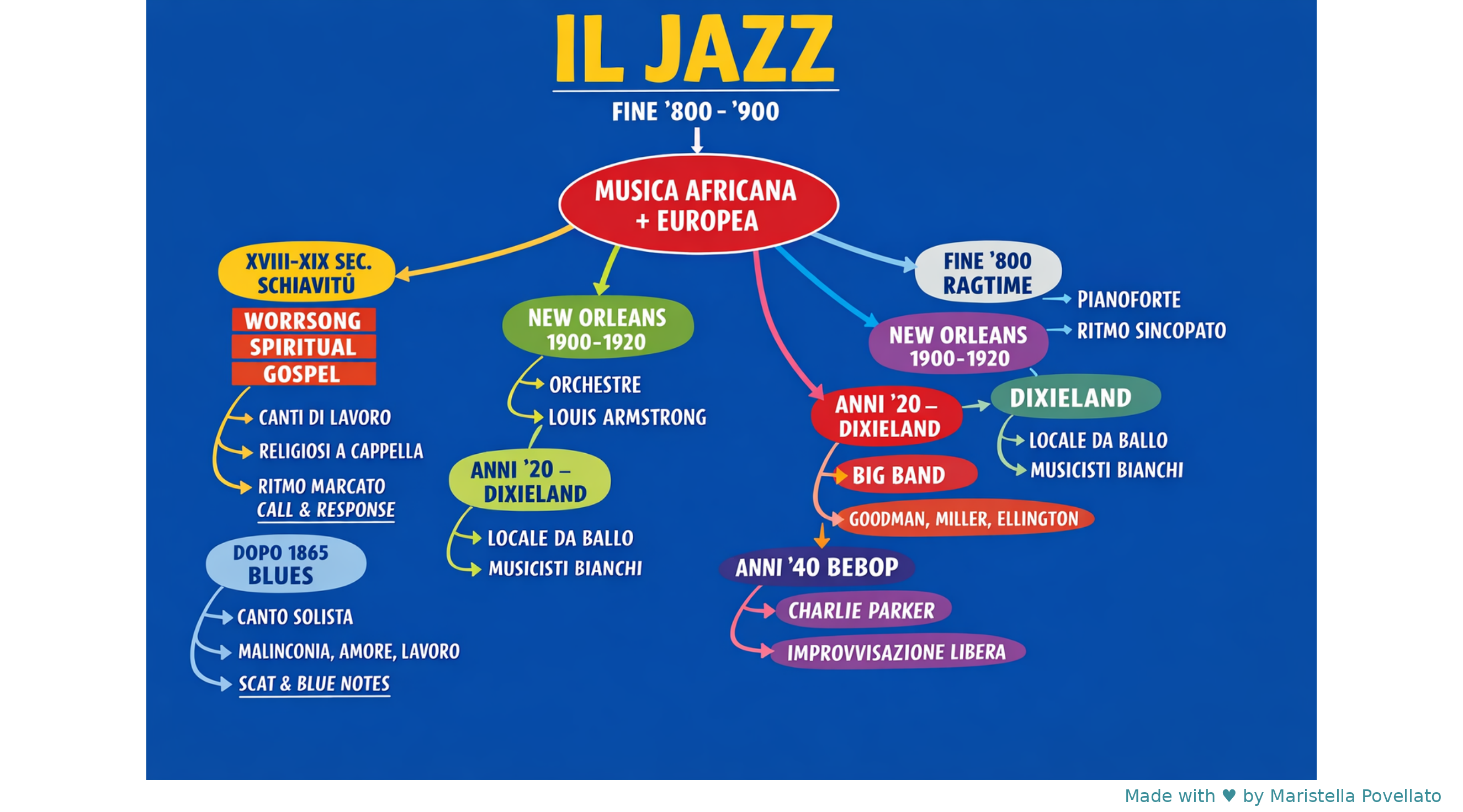
JAZZ STANDARDS — A STANDARD is a famous, well-loved piece that all jazz musicians know and continue to play and reinterpret: its melody and chords become a shared language, on which each musician improvises a fresh version every time. Many standards come from MUSICAL THEATRE and CINEMA (Gershwin, Weill, Porter), while others come from popular songs; «Caravan» by Ellington and Tizol is one of these. Great female singers have made interpreting them their art: Ella Fitzgerald («Summertime», «Mack the Knife»), Billie Holiday («Strange Fruit», «God Bless the Child»), Sarah Vaughan («Misty», «Lullaby of Birdland»), Peggy Lee («Fever»), Nina Simone («Feeling Good»), Etta James («At Last»), Dinah Washington («What a Diff'rence a Day Makes»).

Infografica: mappa del Jazz
Infographic: a map of Jazz Download

Made with ♥ by Maristella Povellato

Illustrated map of Jazz (PDF)
Recommended listening
PieceComposer / ArtistFormLink
Pick a Bale of Cotton
Work song: one voice calls, and the group responds.
Tradizionale (Lead Belly)Work song Listen
Take This Hammer
A work song with a steady rhythm, linked to the movements of physical labour.
Tradizionale (Lead Belly)Work song Listen
Go Down Moses
An a cappella religious song inspired by the Bible.
Fisk Jubilee SingersSpiritual Listen
Joshua Fit the Battle of Jericho
Melody and call-and-response typical of spirituals.
Mahalia JacksonSpiritual Listen
Oh Happy Day
Gospel with instruments, a choir and an infectious rhythm.
Edwin Hawkins SingersGospel Listen
Take My Hand, Precious Lord
Gospel of great expressive intensity.
Mahalia JacksonGospel Listen
St. Louis Blues
The queen of classic blues.
B. SmithBlues Listen
Hoochie Coochie Man
Chicago blues: twelve bars and a repeated riff.
Muddy WatersBlues Listen
Sweet Home Chicago
Delta blues from 1936 for voice and guitar: the 12-bar pattern in its most basic form.
Robert JohnsonBlues Listen
The Entertainer
Ragtime for piano.
Scott JoplinRagtime Listen
Maple Leaf Rag
Ragtime for piano: a steady bass and a syncopated melody.
Scott JoplinRagtime Listen
Dippermouth Blues
Early New Orleans jazz bands, collective improvisation.
King OliverStile di New Orleans Listen
West End Blues
A trumpet introduction that made history.
Louis ArmstrongStile di New Orleans Listen
Tiger Rag
One of the first jazz recordings (1917).
Original Dixieland Jazz BandDixieland Listen
When the Saints Go Marching In
Classic Dixieland, a tune performed by jazz musicians everywhere.
Louis ArmstrongDixieland Listen
In the Mood
Danceable big-band swing.
Glenn MillerSwing Listen
Take the A Train
The masterpiece of Ellington's big band.
D. EllingtonSwing Listen
Caravan
Swing: Ellington's «jungle» theme, performed by jazz musicians everywhere.
D. Ellington / J. TizolSwing Listen
A Night in Tunisia
Bebop: fast tempo, virtuosity, improvisation.
Dizzy GillespieBebop Listen
Round Midnight
Bebop with an angular, melancholy sound.
Thelonious MonkBebop Listen
So What (Kind of Blue)
Modal jazz, a masterpiece from '59.
Miles DavisCool jazz Listen
Take Five
Cool jazz in the irregular time signature of 5/4.
Dave Brubeck QuartetCool jazz Listen
Chasin' the Trane
Free jazz: long, highly free-form solos.
John ColtraneFree jazz Listen
Lonely Woman
Free jazz without fixed chords, with a freely flowing melody.
Ornette ColemanFree jazz Listen
Birdland
Jazz rock with electric instruments and a funk rhythm.
Weather ReportJazz rock (fusion) Listen
Chameleon
Fusion: electric bass, synthesizers and a repeated groove.
Miles DavisJazz rock (fusion) Listen
Summertime
From Porgy and Bess (1935): the most recorded standard of all time.
G. GershwinStandard jazz Listen
Strange Fruit
Billie Holiday, 1939: a song against racism.
B. HolidayStandard jazz Listen
God Bless the Child
Billie Holiday: a song that became a standard.
B. HolidayStandard jazz Listen
Mack the Knife
From Opera da tre soldi: Ella Fitzgerald's virtuoso performance.
K. WeillStandard jazz Listen
Lullaby of Birdland
A tune by George Shearing named after New York's Birdland club.
G. ShearingStandard jazz Listen
Misty
A tune by Erroll Garner made famous by Sarah Vaughan.
E. GarnerStandard jazz Listen
Fever
Peggy Lee, 1958: a stripped-down, sensual version.
E. Cooley / J. DavenportStandard jazz Listen
Feeling Good
Nina Simone, 1965: a standard with a huge sound.
A. Newley / L. BricusseStandard jazz Listen
At Last
Etta James, 1960: the ultimate love-song standard.
H. Warren / M. GordonStandard jazz Listen
What a Diff'rence a Day Makes
Dinah Washington, 1959: based on an old Cuban tune.
M. Adams / T. WhitcupStandard jazz Listen
GO TO QUIZ
04

Rock

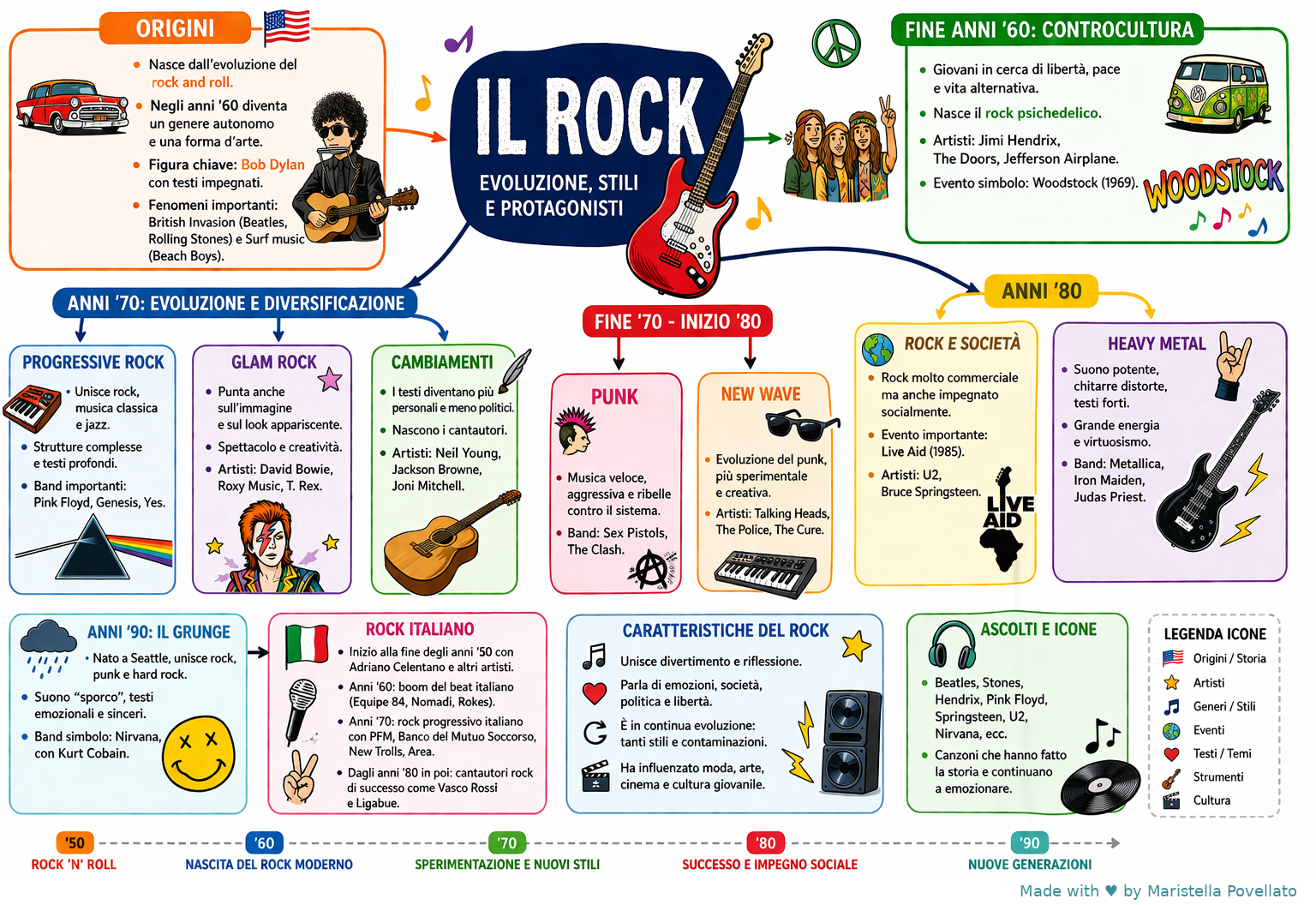
Infographic: the evolution of Rock Download

Made with ♥ by Maristella Povellato

Listen to the text

In the 1950s in the USA, Black rhythm & blues meets white country music, and ROCK 'N' ROLL is born: a driving rhythm, electric guitar, bass, drums and vocals. Elvis Presley becomes 'the King', while Chuck Berry and Little Richard establish its musical language. In the 1960s, British BEAT music takes off (Beatles, Rolling Stones, The Who), and rock becomes more experimental: psychedelia (Jimi Hendrix, Pink Floyd), socially conscious folk (Bob Dylan), soul (James Brown, Aretha Franklin). In the 1970s, many subgenres emerge: HARD ROCK and HEAVY METAL (Led Zeppelin, Deep Purple, Black Sabbath), PROGRESSIVE ROCK (Pink Floyd, Genesis, Yes), GLAM ROCK (David Bowie, Queen), PUNK (Sex Pistols, Ramones), DISCO music (Bee Gees, Donna Summer). In the 1980s, global POP (Michael Jackson, Madonna, Prince), NEW WAVE / synth pop (Depeche Mode, The Cure) and METAL (Metallica, Iron Maiden) dominate, and HIP HOP / RAP emerges. In the 1990s, GRUNGE (Nirvana, Pearl Jam) and Britpop (Oasis, Blur) emerge, rap becomes mainstream (Tupac, Notorious B.I.G.), and ELECTRONIC club music is born (techno, house). Today: digital pop (streaming, social media), TRAP and hip hop, K-POP, indie, contemporary R&B, EDM. In Italy: singer-songwriters (De André, Battisti, Dalla, Vasco, Ligabue), pop and rap (Mengoni, Mahmood, Måneskin).

Recommended listening
PieceComposer / ArtistFormLink
Smells Like Teen Spirit
A grunge anthem of the 1990s.
NirvanaCanzone Listen
Bohemian Rhapsody
Operatic rock with a free structure.
QueenCanzone Listen
Johnny B. Goode
The riff that invented rock guitar.
C. BerryCanzone Listen
Jailhouse Rock
The king of rock'n'roll in the 1950s.
E. PresleyCanzone Listen
Hey Jude
British beat music and a choral finale.
The BeatlesCanzone Listen
Satisfaction
A distorted guitar riff, blues rock.
The Rolling StonesCanzone Listen
Purple Haze
Psychedelic rock and revolutionary guitar playing.
J. HendrixCanzone Listen
Stairway to Heaven
From acoustic music to hard rock in a single track.
Led ZeppelinCanzone Listen
Anarchy in the U.K.
Punk: three chords and plenty of anger.
Sex PistolsCanzone Listen
GO TO QUIZ
05

Pop and Song

Listen to the text

POP AND SONG — The word POP comes from 'popular music': music designed to appeal to a very wide audience, spread through radio, records, television, music videos and, today, streaming and social media. Its basic unit is the SONG: a piece lasting 3–4 minutes, built around a simple, recognizable structure — introduction, verse, chorus (refrain), bridge, ending — with a chorus that is easy to remember (the 'hook'). HOW A HIT IS MADE — Lyrics and melody are just the beginning: the arrangement, studio PRODUCTION, mixing, music video and promotion all matter. From the 1980s onward, the music video (MTV) becomes an essential part of the song; today, streaming platforms and social media play this role, and just a few seconds can launch a song. THE VOICES OF POP — In the 1980s, Michael Jackson and Madonna invent global pop as a complete spectacle (music, dance, image). Whitney Houston and Mariah Carey bring the vocal virtuosity of gospel into pop; Prince combines funk, rock and soul. From the 2000s onward come Beyoncé, Adele, Ed Sheeran, Rihanna, Taylor Swift, Billie Eilish, and the global K-POP phenomena (BTS, Blackpink). TECHNOLOGY — Synthesizers, drum machines, samplers and Auto-Tune have changed the sound of pop. Today, many songs are created on a computer with few real instruments: anyone can produce music, even at home. LISTEN CLOSELY — Recognizing the structure (verse/chorus), the basic rhythm, the electronic instruments and the singing style helps us understand why a song 'works'.

Recommended listening
PieceComposer / ArtistFormLink
Thriller
Global pop of the 1980s.
Michael JacksonCanzone Listen
Like a Prayer
The queen of pop and the music video as art.
MadonnaCanzone Listen
Purple Rain
Funk, rock and soul in a single artist.
PrinceCanzone Listen
I Will Always Love You
Outstanding vocal virtuosity in pop.
W. HoustonCanzone Listen
Rolling in the Deep
Pop soul of the new millennium.
AdeleCanzone Listen
Shape of You
Pop for the streaming age: loops and vocals.
Ed SheeranCanzone Listen
Bad Guy
Minimalist pop produced at home.
Billie EilishCanzone Listen
Dynamite
The global phenomenon of K-pop.
BTSCanzone Listen
GO TO QUIZ
06

Italian song

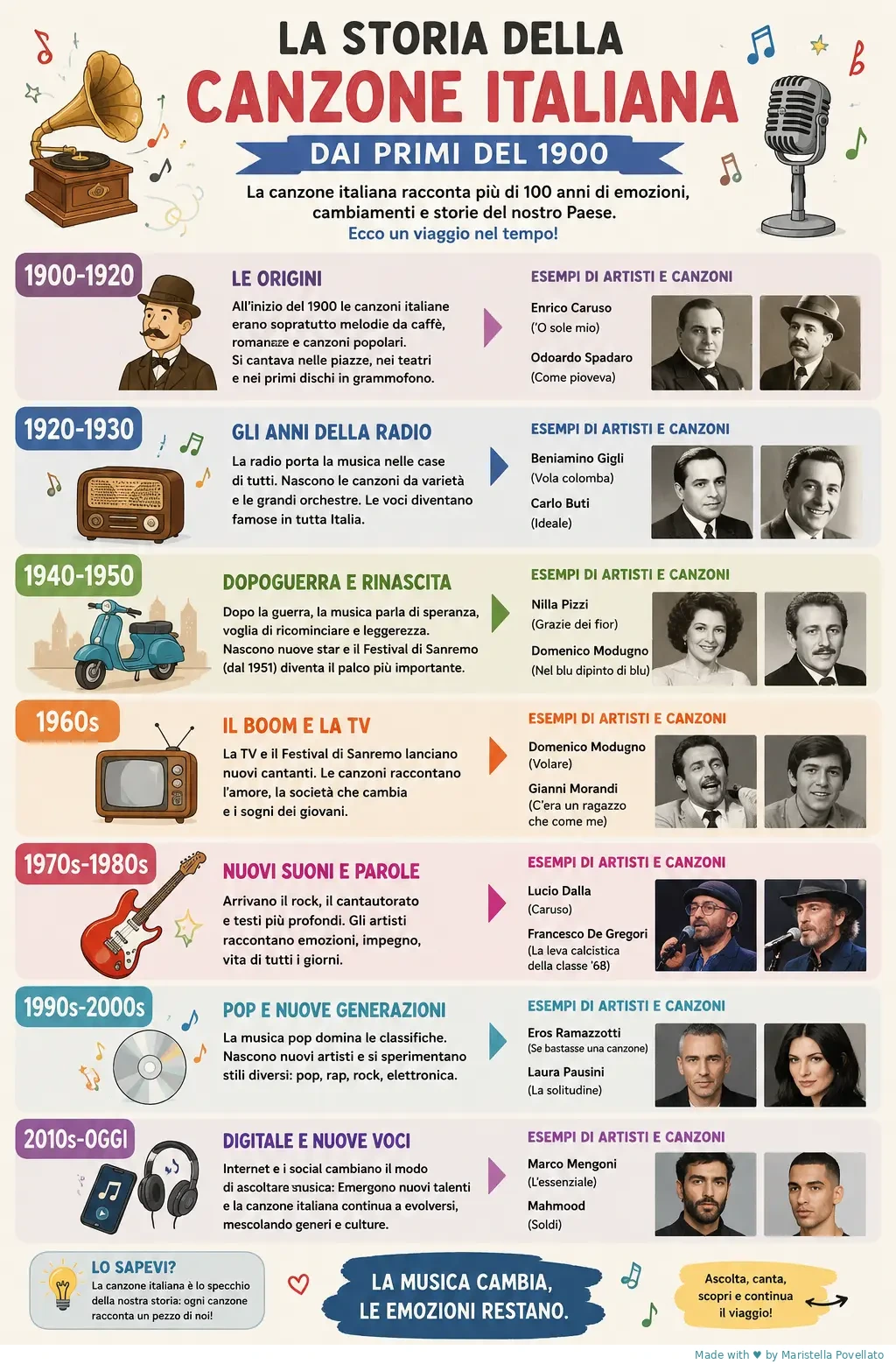
Infographic: the history of Italian song Download

Made with ♥ by Maristella Povellato

Listen to the text

ITALIAN SONG — Italian song grew out of the great melodic tradition of opera and Neapolitan song. The turning point came in 1958, when Domenico Modugno won Sanremo with 'Nel blu dipinto di blu': poetic lyrics, free-flowing gestures and a modern melody. THE 1960s: SHOUTERS AND SINGER-SONGWRITERS — Alongside the 'shouters' (Celentano, Mina, and later Bertè) and the stars of melodic song, SINGER-SONGWRITERS emerged: artists who write their own lyrics and music. The Genoese school (Gino Paoli, Luigi Tenco, Bruno Lauzi, Fabrizio De André) brought poetry, real love and people on the margins of society into song. THE 1970s: SOCIAL COMMITMENT — Lucio Battisti and Mogol renewed the language of song; Francesco Guccini, Francesco De Gregori, Lucio Dalla, Antonello Venditti, Edoardo Bennato and Pino Daniele (with his Neapolitan blues) explored society, politics and feelings. Festivals and large concerts emerged. THE 1980s–1990s — Vasco Rossi and Ligabue brought singer-songwriter rock; Zucchero brought blues; Eros Ramazzotti, Laura Pausini and Andrea Bocelli conquered the international market; Jovanotti paved the way for Italian rap; Paolo Conte and Ivano Fossati developed sophisticated, jazz-influenced songs. TODAY — Singer-songwriter pop (Elisa, Marco Mengoni, Cesare Cremonini, Tiziano Ferro, Carmen Consoli, Niccolò Fabi, Max Gazzé), rap and trap (Ghali, Lazza, Marracash), new singer-songwriters (Angelina Mango, Irama) and Måneskin's rock exist side by side. Sanremo remains the main showcase for Italian song. WHAT IS A SINGER-SONGWRITER? — Someone who both writes and performs: the words matter as much as the music. This is why many Italian songs are studied as poems set to music.

Recommended listening
PieceComposer / ArtistFormLink
Nel blu dipinto di blu (Volare)
Sanremo 1958: modern Italian popular song is born.
D. ModugnoCanzone Listen
Il cielo in una stanza
The greatest voice in Italian popular music.
MinaCanzone Listen
Azzurro
The rhythm and humour of the 'molleggiato', nicknamed for his springy movements.
A. CelentanoCanzone Listen
La canzone di Marinella
The singer-songwriter as a poet of the marginalised.
F. De AndréCanzone strumentale Listen
Caruso
An Italian melody loved all over the world.
L. DallaCanzone Listen
La donna cannone
Poetic imagery and a dream of freedom.
F. De GregoriCanzone Listen
Vita spericolata
Italian singer-songwriter rock of the 1980s.
Vasco RossiCanzone Listen
Zitti e buoni
Italian rock wins Eurovision 2021.
MåneskinCanzone Listen
GO TO QUIZ
07

Songs and messages

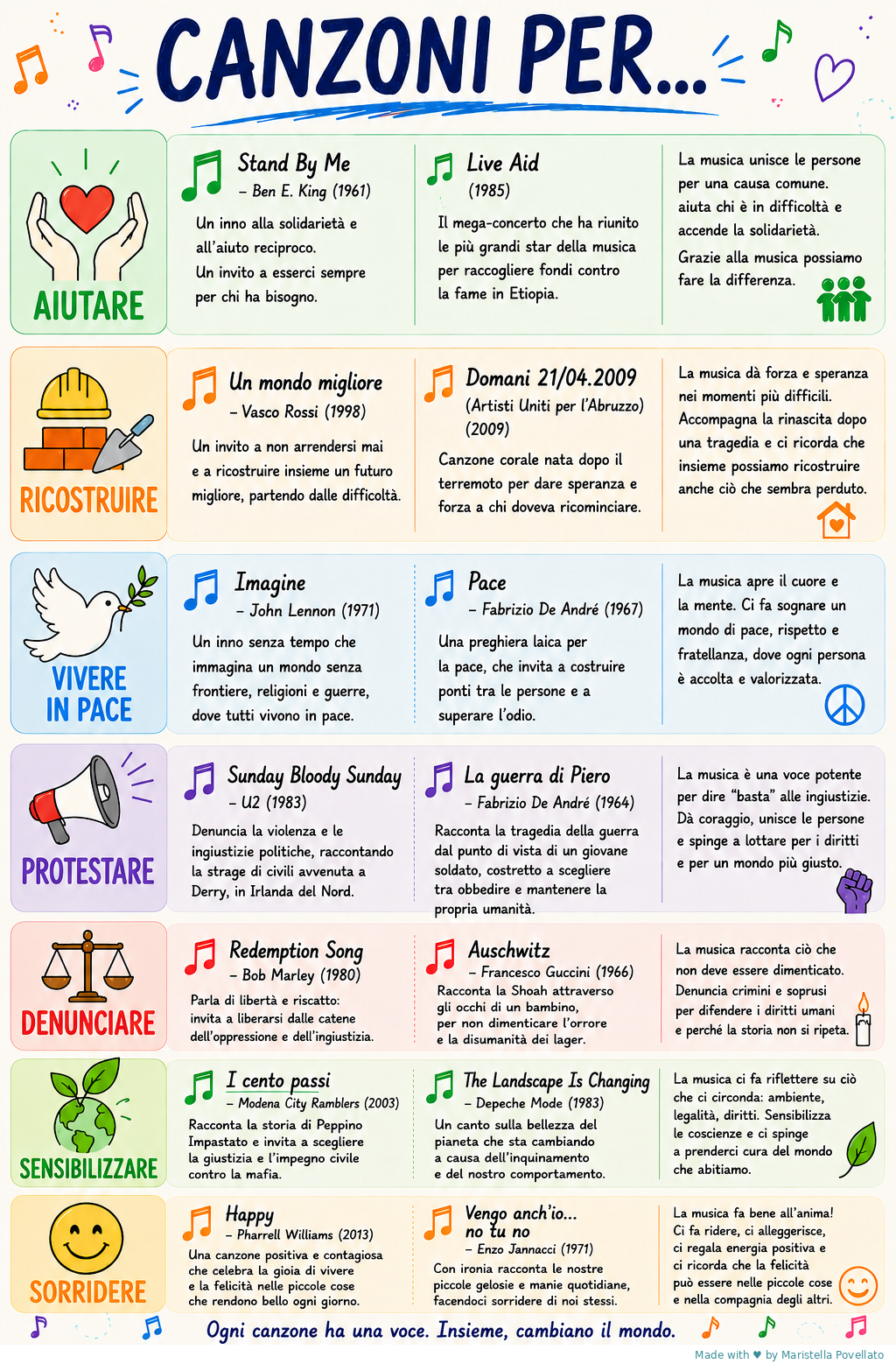
Infographic: songs to help, rebuild, live in peace, protest, speak out, raise awareness and smile Download

Made with ♥ by Maristella Povellato

Listen to the text

SONGS AND MESSAGES — Music is not just for entertainment: it has always been a way to SAY something too. A song can speak out against injustice, call for peace, describe the hardships of work, defend the environment or support those who are suffering. Its power lies in the way it stays in everyone's memory. SONGS FOR PEACE AND AGAINST WAR — 'Imagine' by John Lennon, 'Blowin' in the Wind' by Bob Dylan, 'La guerra di Piero' and 'Girotondo' by De André, 'Il mio nome è mai più' by Ligabue-Jovanotti-Pelù: simple words for big ideas. PROTEST SONGS AND CIVIL RIGHTS — In the United States, spirituals, followed by the folk music of Dylan and Joan Baez, the soul of Sam Cooke ('A Change Is Gonna Come'), the reggae of Bob Marley ('Get Up, Stand Up') and rap from disadvantaged urban neighbourhoods. In Italy, songs of work and struggle ('Bella ciao', 'Contessa'). MUSIC AND SOLIDARITY — Major charity events: Live Aid (1985), 'We Are the World', 'Do They Know It's Christmas?', concerts for the Amazon or for earthquake victims. Music raises funds and awareness. THE ENVIRONMENT AND THE FUTURE — 'Earth Song' by Michael Jackson, 'Big Yellow Taxi' by Joni Mitchell, and many recent songs about climate change. HOW TO ANALYSE A SONG WITH A MESSAGE — Look at the LYRICS (who is speaking? to whom? what are they asking for?), the historical CONTEXT, the MUSIC (a marching rhythm, a gentle melody or a shout changes the meaning) and the effect on the audience.

Recommended listening
PieceComposer / ArtistFormLink
Imagine
The world's most famous anthem for peace.
J. LennonCanzone Listen
Blowin' in the Wind
Protest song and civil rights.
B. DylanCanzone Listen
We Are the World
Music and solidarity against hunger.
USA for AfricaCanzone Listen
La guerra di Piero
An anti-war song.
F. De AndréCanzone Listen
Get Up, Stand Up
Reggae and the struggle for rights.
B. MarleyCanzone Listen
Sunday Bloody Sunday
A protest against violence in Northern Ireland.
U2Canzone Listen
Earth Song
An environmental song.
M. JacksonCanzone Listen
Il mio nome è mai più
Against war, with proceeds going to charity.
Ligabue, Jovanotti, PelùCanzone Listen
GO TO QUIZ
08

Music and gender equality

Listen to the text

MUSIC AND GENDER EQUALITY — For centuries, it was difficult for women to make music their profession: they could sing or play at home, but rarely study composition, conduct an orchestra or publish their own works. Yet history is full of extraordinary women musicians, often forgotten. FORGOTTEN WOMEN COMPOSERS — Hildegard von Bingen (12th century), a nun, poet and composer; Francesca Caccini and Barbara Strozzi in the 17th century; Fanny Mendelssohn, Felix's sister, forced to publish under her brother's name; Clara Schumann, a great pianist and composer; in the 20th century, Lili Boulanger and Nadia Boulanger, who taught generations of musicians. WOMEN PIONEERS OF POPULAR MUSIC — Bessie Smith and Billie Holiday in jazz and blues; Ella Fitzgerald, the queen of scat; Aretha Franklin, a voice of soul and civil rights; Miriam Makeba, who opposed apartheid; in Italy, Mina, Milva, Loredana Bertè, Carmen Consoli and Elisa. STEREOTYPES TO OVERCOME — Even today, there are few women conductors, producers and sound engineers, and some song lyrics repeat offensive or violent portrayals of women. Analysing lyrics critically is a way to practise responsible citizenship. MUSIC AS A TOOL FOR EQUALITY — Many songs are about self-esteem, freedom and respect ('Respect', 'You Don't Own Me', 'Run the World'). Music can change the way we see others: this is why it is important to make thoughtful choices about what we listen to.

Recommended listening
PieceComposer / ArtistFormLink
Respect
An anthem of soul music and women's rights.
A. FranklinCanzone Listen
Run the World (Girls)
Pop and female empowerment.
BeyoncéCanzone Listen
You Don't Own Me
1963: a girl stands up for her freedom.
L. GoreCanzone Listen
Man! I Feel Like a Woman
Witty, liberating country-pop.
S. TwainCanzone Listen
Non sono una signora
Italian rock challenging stereotypes.
L. BertèCanzone Listen
O virtus Sapientiae
The first great female composer in history (12th century).
Hildegard von BingenCanzone Listen
Trio op. 17
A great pianist and composer of the 19th century.
C. SchumannCanzone Listen
Fight Song
A song about strength and reclaiming your life.
R. PlattenCanzone Listen
GO TO QUIZ
09

Artists beyond barriers

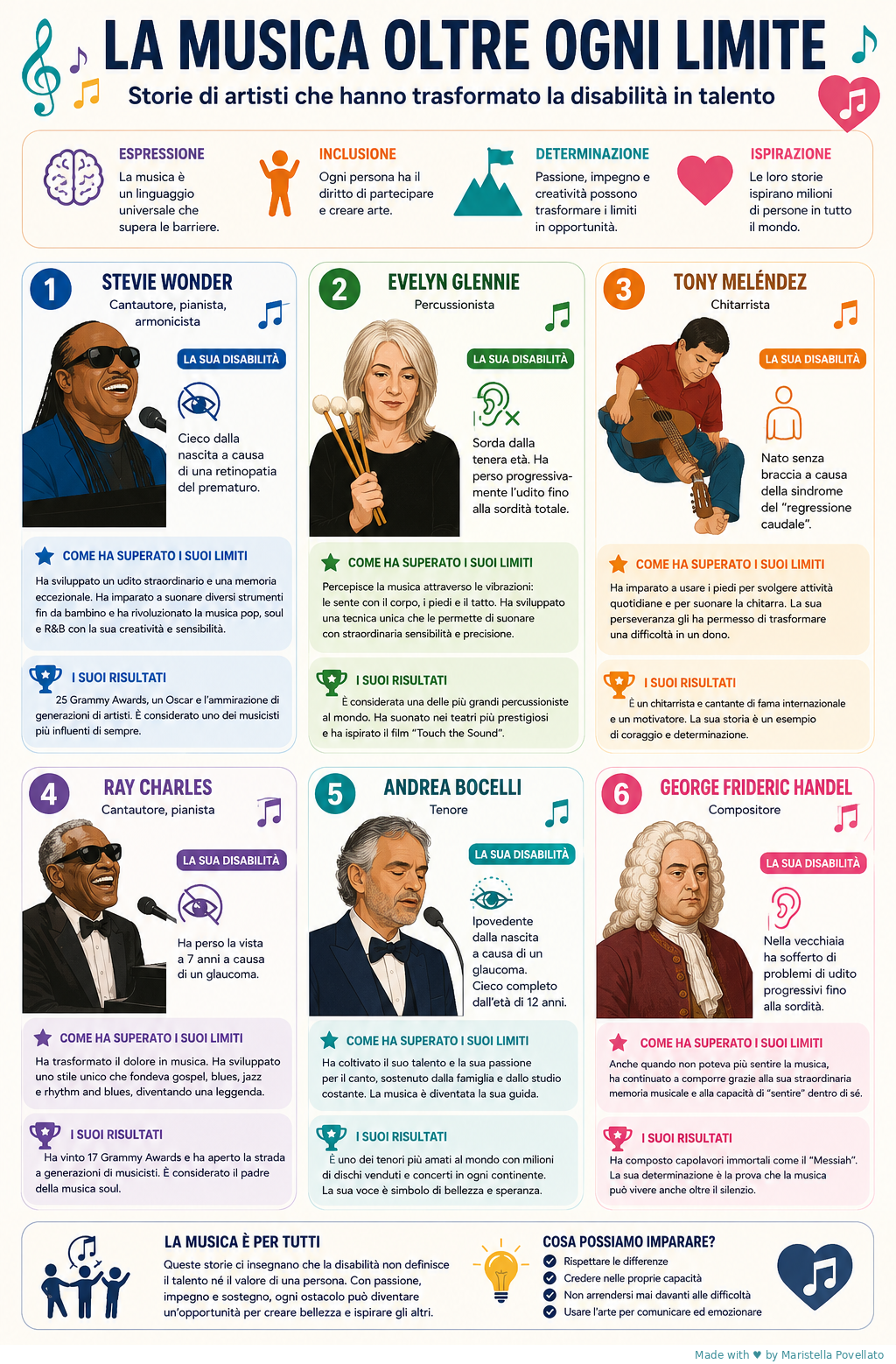
Infographic: artists beyond barriers Download

Made with ♥ by Maristella Povellato

Listen to the text

ARTISTS BEYOND BARRIERS — Music is a language that no barrier can truly stop. Many great artists have made their disability or difficulties a starting point, not a limitation. LUDWIG VAN BEETHOVEN — He began to lose his hearing in his early twenties and became completely deaf: yet he wrote his masterpieces by 'listening' in his mind, right up to the Inno alla gioia from the Nona Sinfonia, now the European anthem. ARTISTS WHO CANNOT SEE — Ray Charles and Stevie Wonder, blind since childhood, revolutionised soul and funk; Andrea Bocelli is known around the world; the French organist Louis Vierne played at Notre-Dame with almost no sight. ARTISTS WHO CANNOT HEAR — Scottish percussionist Evelyn Glennie has been deaf since the age of twelve: she performs barefoot to feel vibrations through her body and shows that listening does not happen only through the ears. ARTISTS WHO OVERCOME AN ACCIDENT OR ILLNESS — Django Reinhardt, whose left hand was burned, invented a new technique using just two fingers and became the father of jazz manouche; Itzhak Perlman, who had polio, is one of the greatest violinists; Ezio Bosso continued to play and conduct during his illness; Rick Allen of Def Leppard plays the drums with only one arm. MUSIC AND INCLUSION — Today there are inclusive orchestras, adapted instruments and software that allows people to play using their gaze or just one finger, while music therapy helps people who cannot speak to communicate. Making music together is one of the most inclusive experiences there is.

Recommended listening
PieceComposer / ArtistFormLink
Sinfonia n. 9 — Inno alla gioia
Composed while deaf: music beyond all limits.
L. van BeethovenSinfonia Listen
Con te partirò
A blind tenor known throughout the world.
A. BocelliCanzone Listen
Georgia On My Mind
Blind since childhood, the father of soul.
R. CharlesCanzone Listen
Superstition
A funk genius, blind from birth.
S. WonderCanzone Listen
Solo percussion
A deaf percussionist who feels music through her body.
E. GlennieCanzone Listen
Minor Swing
He played with only two usable fingers.
D. ReinhardtCanzone Listen
Following a Bird
A pianist and conductor who lived with illness, and a symbol of resilience.
E. BossoCanzone Listen
Concerto per violino
A violinist who contracted polio as a child.
I. PerlmanConcerto Listen
GO TO QUIZ
10

Musical Theatre

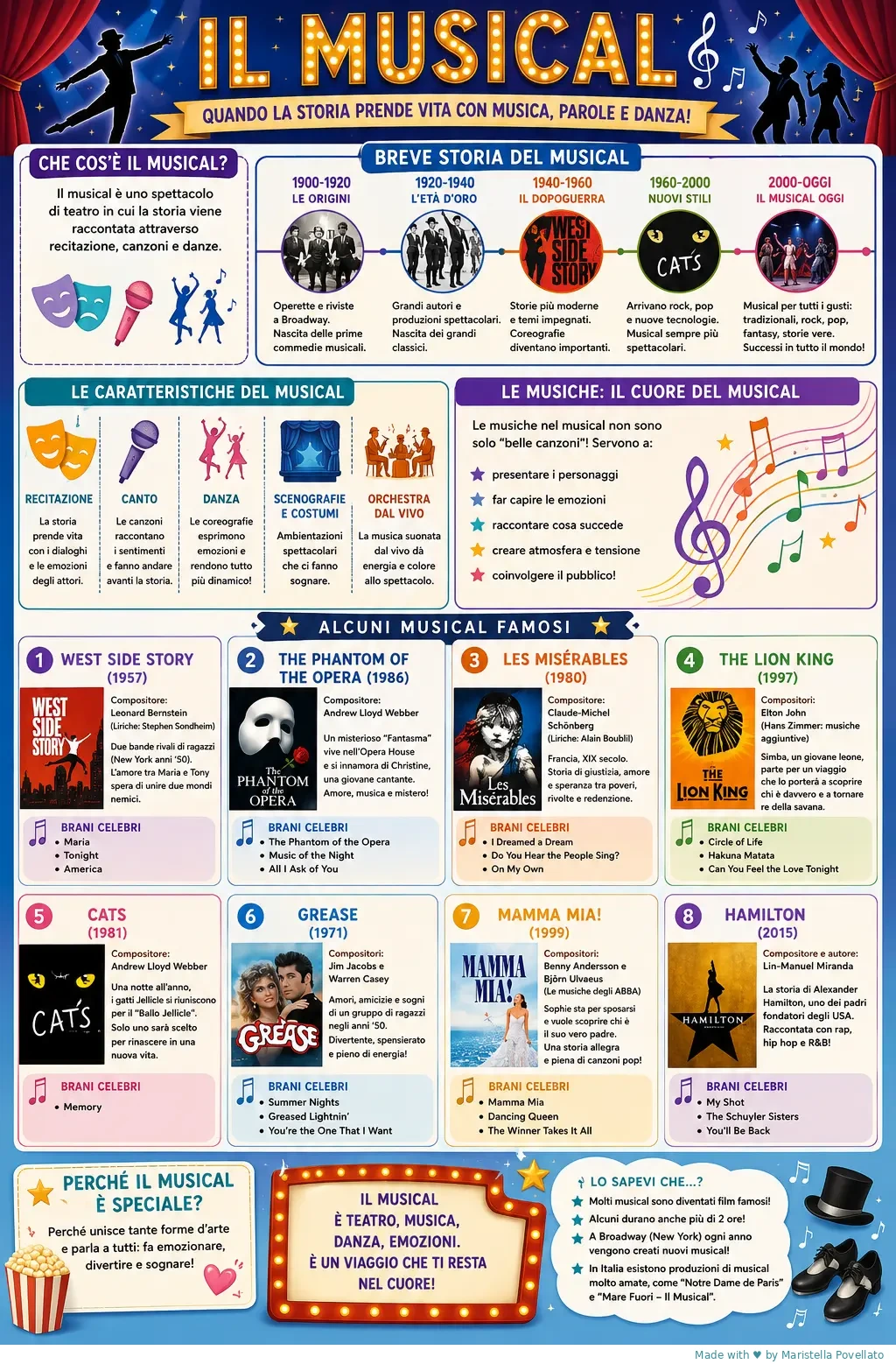
Infographic: the musical Download

Made with ♥ by Maristella Povellato

Listen to the text

THE MUSICAL — A musical (or musical comedy) is a stage show in which acting, singing and dancing come together to tell a story. It began in the United States in the late 19th and early 20th centuries, bringing together European operetta, vaudeville, minstrel shows and jazz; its main home is BROADWAY in New York, along with London's West End. HOW IT WORKS — There are SONGS, DANCE numbers, spoken dialogue and a live orchestra. Each character often has a song that reveals their feelings; the grand finale brings everyone together on stage. Unlike opera, musicals use a 'chest voice' amplified by a microphone, and their musical language is that of popular music (jazz, pop, rock). THE MILESTONES — Show Boat (1927) is considered the first modern musical; it was followed by the golden age, with Oklahoma!, Bernstein's West Side Story (1957, Romeo e Giulietta in New York), My Fair Lady and The Sound of Music. The 1970s–1980s brought rock operas (Jesus Christ Superstar, Hair) and Andrew Lloyd Webber's spectacular productions (Cats, The Phantom of the Opera, Evita). Then came Les Misérables, Rent, Il Re Leone, Mamma Mia!, Wicked, and today Hamilton, which tells American history through rap and hip hop. IN ITALY — The Italian version of Notre-Dame de Paris, with music by Riccardo Cocciante, launched the genre; there is also Aggiungi un posto a tavola by Garinei and Giovannini and many recent productions. AT THE CINEMA — From classic film musicals (Cantando sotto la pioggia, Grease, Mary Poppins) to La La Land and Disney animated films, the musical is one of audiences' favourite genres.

Recommended listening
PieceComposer / ArtistFormLink
West Side Story — America
Musical theatre meets Latin American rhythms.
L. BernsteinCanzone Listen
Cats — Memory
One of the most famous songs in musical theatre.
A. Lloyd WebberCanzone Listen
The Phantom of the Opera
Rock and opera together.
A. Lloyd WebberCanzone Listen
Grease — Summer Nights
The musical set in 1950s America.
Warren CaseyCanzone Listen
Mamma Mia!
The 'jukebox musical' built around famous songs.
ABBACanzone Listen
Hamilton — My Shot
Rap and hip hop tell the story of American history.
L.-M. MirandaCanzone Listen
La La Land — City of Stars
Musicals in today's cinema.
J. HurwitzCanzone Listen
Notre-Dame de Paris — Belle
The celebrated musical in French and Italian.
R. CoccianteCanzone Listen
GO TO QUIZ
11

World music

Infographic: world music Download

Made with ♥ by Maristella Povellato

Listen to the text

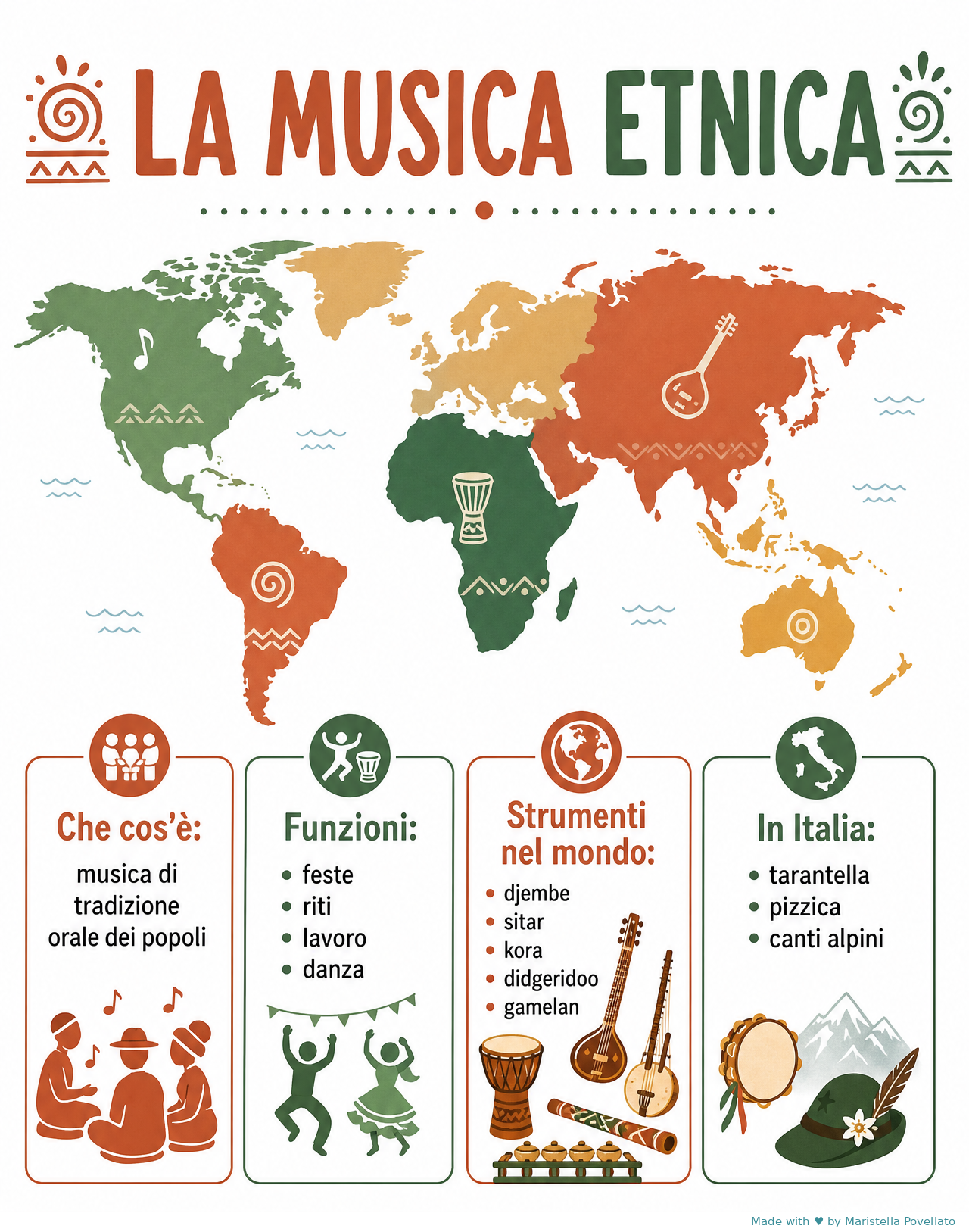
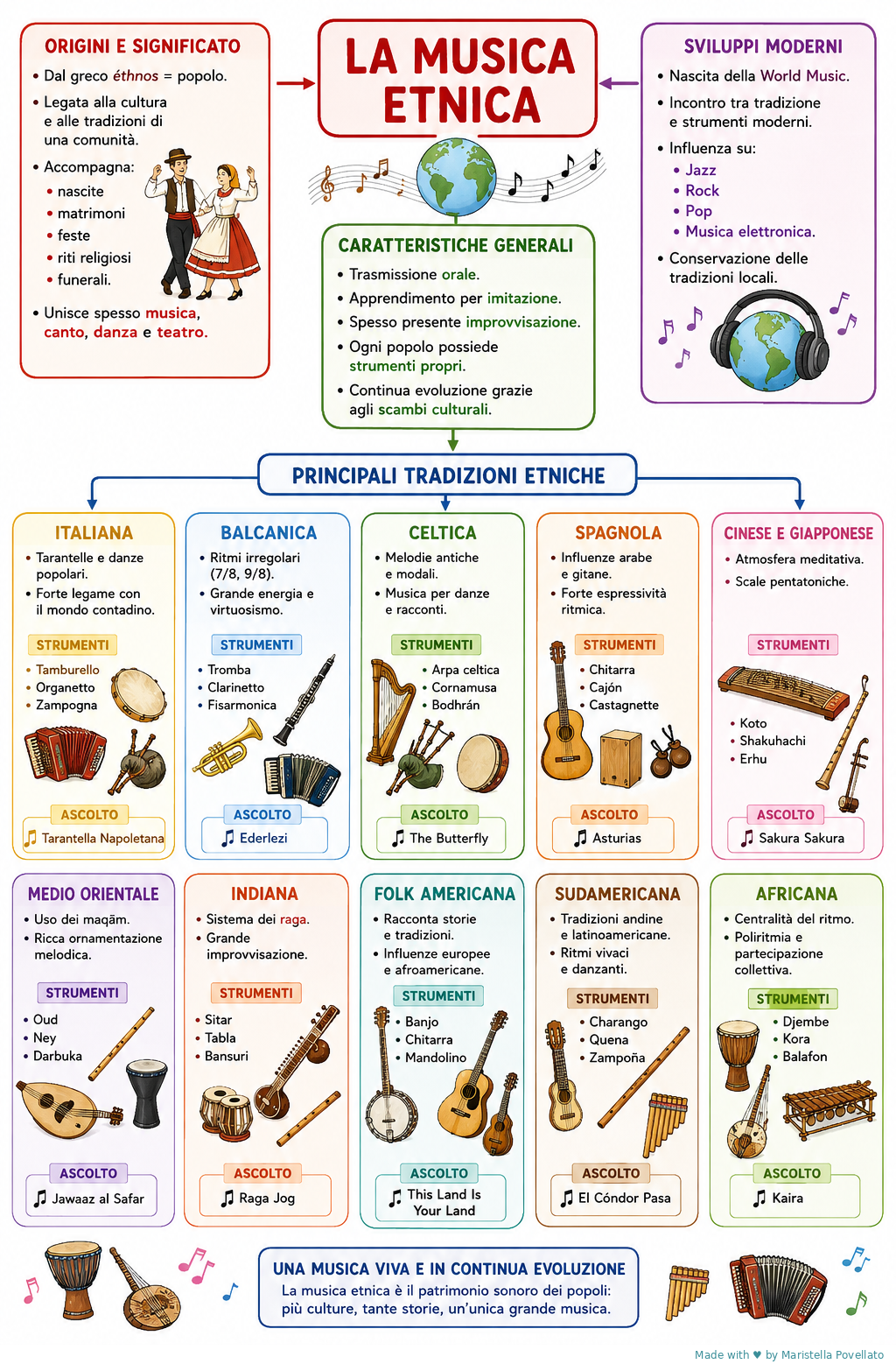
'Ethnic music' or 'world music' refers to the musical traditions of the world's peoples, each with its own instruments, scales, rhythms and purposes (rituals, celebrations, storytelling). AFRICA: vocal polyphony and polyrhythm (several overlapping rhythms), responsorial singing (call & response), instruments such as the djembe, kora (harp-lute), balafon (xylophone) and talking drum. INDIA: classical music based on raga (scales or modes associated with times of day, seasons and feelings) and tala (fixed rhythmic cycles). Instruments: sitar (Ravi Shankar), tabla, tampura, sarod, bansuri. LATIN AMERICA: samba and bossa nova (Brazil), tango (Argentina), salsa, rumba, son (Cuba), mariachi (Mexico), Andean music (Peru, Bolivia) with the quena and charango. THE ARAB WORLD: maqam modal scales with quarter tones, instruments such as the oud (lute), qanun (zither), ney (flute) and darbuka (goblet drum). THE FAR EAST: China (erhu, pipa, pentatonic scale), Japan (koto, shakuhachi, gagaku court music), Indonesia (gamelan: an orchestra of metallophones and gongs from Bali and Java). EUROPEAN FOLK MUSIC: Celtic music (Ireland, Scotland: bagpipes, fiddle), flamenco (Spain: guitar, voice, palmas), klezmer (Eastern Europe), pizzica and tarantella (Southern Italy).

Mappa illustrata della Musica Etnica
Illustrated map of world music Download

Made with ♥ by Maristella Povellato

Recommended listening
PieceComposer / ArtistFormLink
Indian raga (sitar)
Modal music from India.
Ravi ShankarRaga Listen
Balinese gamelan
An orchestra of gongs and metallophones.
Tradizione indonesianaMusica di gamelan Listen
Pata Pata
South Africa, rhythm and voice.
Miriam MakebaCanzone Listen
Kora from Mali
An African harp-lute with 21 strings.
T. DiabatéCanzone Listen
Pizzica from Salento
The tambourine rhythm of Southern Italy.
Tradizione puglieseDanza popolare Listen
Flamenco — Bulerías
Guitar, voice, palmas (rhythmic handclapping) and dance.
Tradizione andalusaDanza (flamenco) Listen
Scotland the Brave
Bagpipes and Celtic tradition.
Tradizione scozzeseCanzone Listen
Mongolian overtone singing
One voice producing two sounds at once.
Tradizione mongolaCanzone Listen
GO TO QUIZ
12

World music

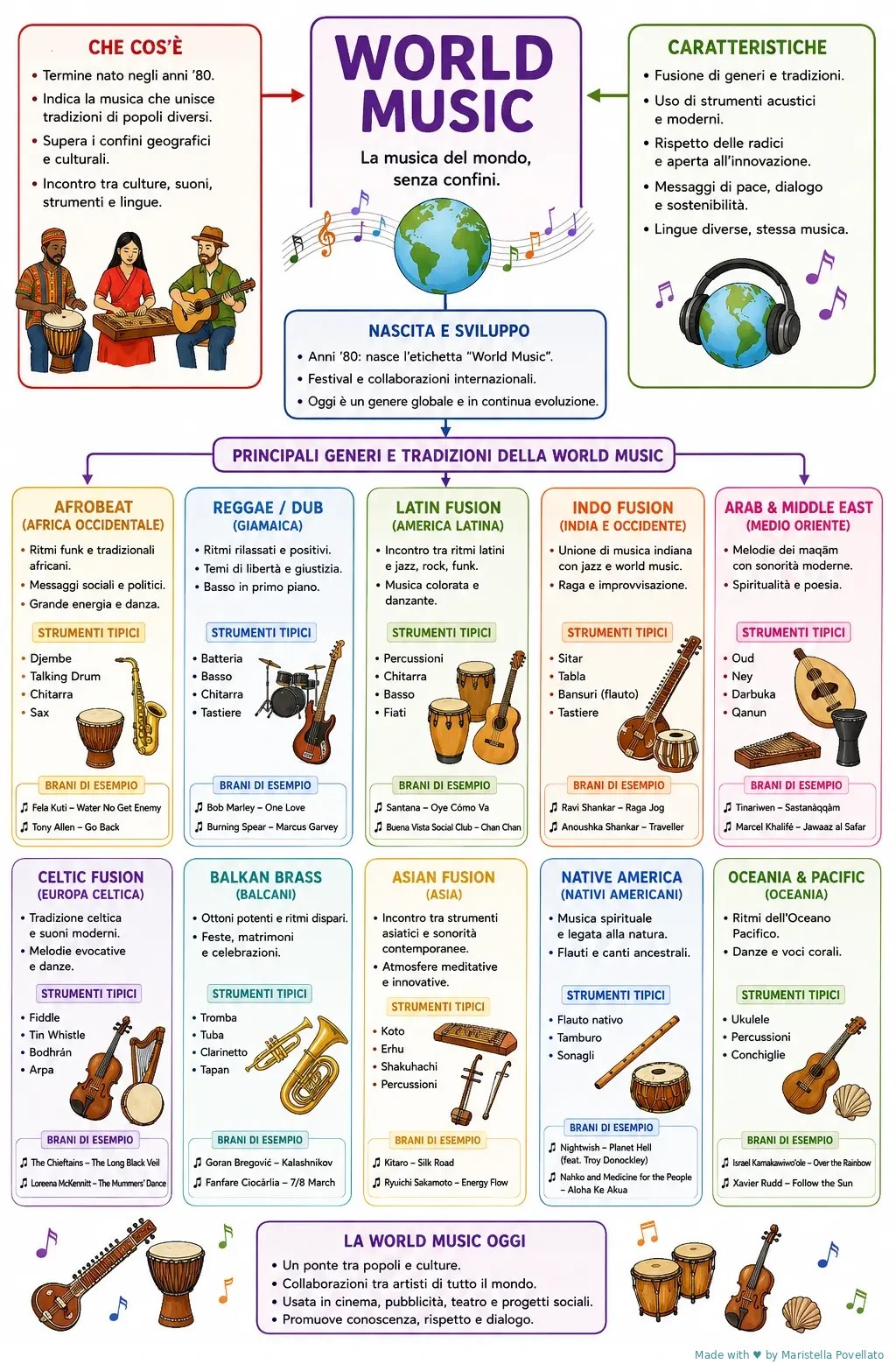
Infographic: World Music around the world Download

Made with ♥ by Maristella Povellato

Listen to the text

WORLD MUSIC — Since the 1980s, world music has meant the meeting of people's musical traditions with modern musical styles (pop, rock, jazz, electronic music). So it is not 'pure' traditional music, but its dialogue with the global world: traditional instruments alongside drums and electric bass, African or Latin languages in pop songs, and international productions. HOW IT BEGAN — The term was launched in 1987 by several London record labels to give music from across the planet a shared shelf in record shops. Some recordings became symbols of this movement: Paul Simon's 'Graceland' (1986), featuring the South African vocal group Ladysmith Black Mambazo, the work of Peter Gabriel, and the WOMAD festival. THE BEST-KNOWN GENRES — AFROBEAT (Fela Kuti, Nigeria: funk, jazz and Yoruba rhythms); REGGAE, ska and dub from Jamaica (Bob Marley); LATIN FUSION: salsa, cumbia, bossa nova and tango reinterpreted in a modern style (Piazzolla, Buena Vista Social Club); Algerian RAÏ (Khaled); BHANGRA and Indian fusion styles; CELTIC FUSION; K-POP and J-pop as global phenomena from Asia. IN ITALY — The 'taranta' of Salento and southern Italian folk music have been revived through the Notte della Taranta; artists such as Eugenio Bennato, i Tarantolati, Vinicio Capossela and Manu Chao (in Europe) mix tradition with singer-songwriter music. WHY IT MATTERS — World music teaches us that there is no single 'right' kind of music: every culture has its own scales, rhythms and instruments, and their meeting creates new things. It also teaches respect, as long as it does not turn into the exploitation of other people's cultures.

Recommended listening
PieceComposer / ArtistFormLink
Libertango
Argentine tango nuevo, bandoneon.
Astor PiazzollaTango Listen
One Love
Jamaican reggae takes the world by storm.
B. MarleyCanzone Listen
Water No Get Enemy
Afrobeat: African funk and political engagement.
F. KutiCanzone Listen
7 Seconds
Africa meets European pop.
Y. N'Dour & N. CherryCanzone Listen
Chan Chan
Cuban son rediscovered.
Buena Vista Social ClubCanzone Listen
Clandestino
Blending musical cultures and exploring migration.
Manu ChaoCanzone Listen
Graceland
American pop and South African choirs.
P. SimonCanzone Listen
Bamboléo
Romani rumba becomes a worldwide hit.
Gipsy KingsCanzone Listen
GO TO QUIZ
13

Film music

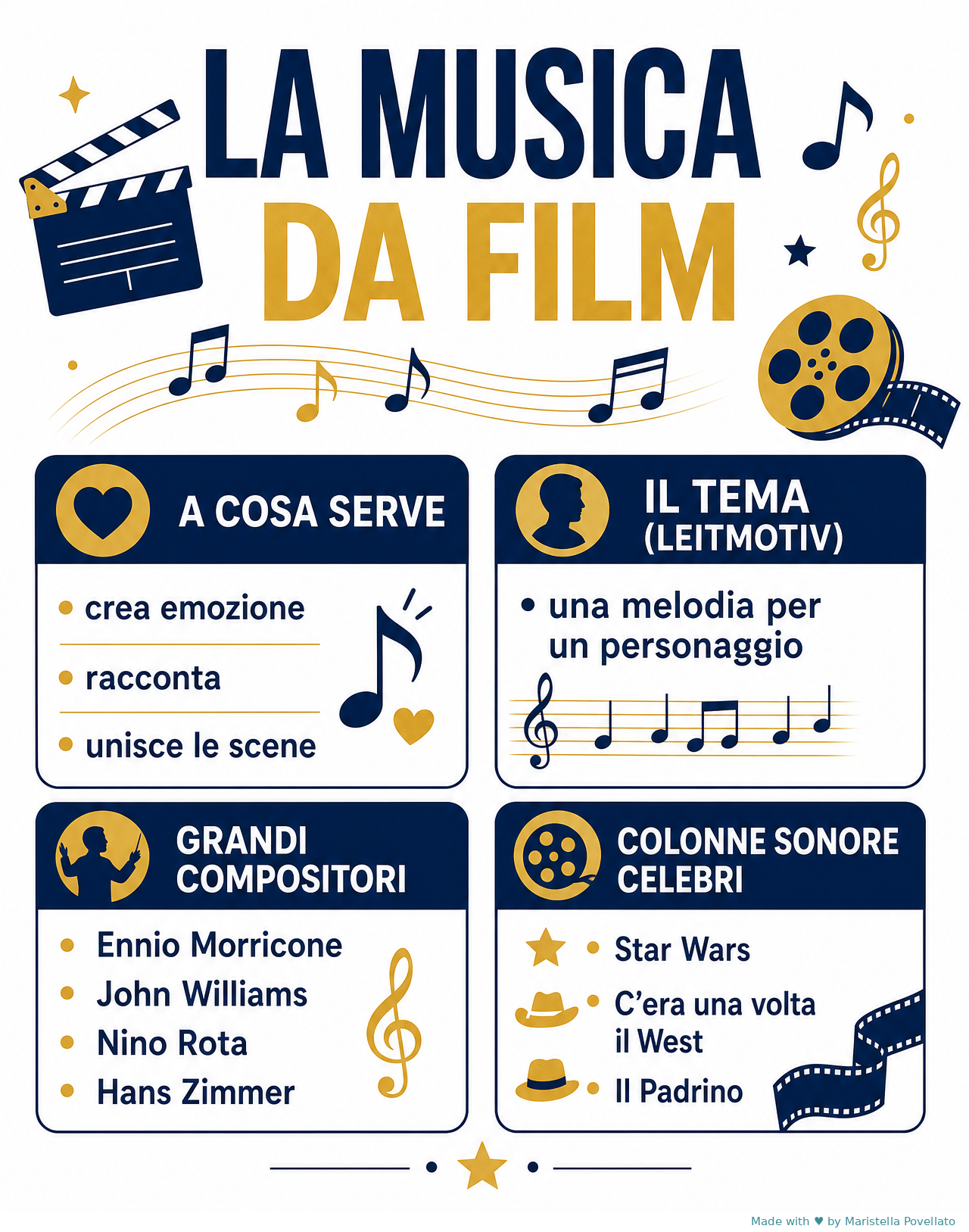
Infographic: film music Download

Made with ♥ by Maristella Povellato

Listen to the text

FILM MUSIC — Cinema began without recorded dialogue, but not without sound: as early as 1895, a pianist or orchestra would accompany the images live. With the arrival of sound films (1927, 'Il cantante di jazz'), the soundtrack became part of the film. WHAT MUSIC DOES IN A FILM — 1) creates the ATMOSPHERE (fear, joy, mystery); 2) highlights the characters' EMOTIONS; 3) uses the LEITMOTIF, a theme that returns whenever a character or idea appears (a technique inherited from Wagner); 4) links scenes and gives the editing a rhythm; 5) places the story in a particular time or place. DIEGETIC AND NON-DIEGETIC MUSIC — DIEGETIC music belongs to the scene: the characters can hear it (a radio, an orchestra in a room). NON-DIEGETIC music is heard only by the audience: it provides musical commentary. THE GREAT COMPOSERS — Ennio Morricone (Westerns, C'era una volta il West, Nuovo Cinema Paradiso), Nino Rota (Fellini, Il Padrino), John Williams (Star Wars, Indiana Jones, Harry Potter, Schindler's List), Hans Zimmer (Il Gladiatore, Interstellar), Howard Shore (Il Signore degli Anelli), Nicola Piovani (La vita è bella), Bernard Herrmann (Hitchcock, Psycho). BEYOND CINEMA — Music for TV series, music videos and VIDEO GAMES, where sound is 'adaptive': it changes according to what the player does. Today, this is one of the most creative and fastest-growing fields.

Recommended listening
PieceComposer / ArtistFormLink
C'era una volta il West
The harmonica as a character's theme.
E. MorriconeCanzone Listen
Star Wars — Main Title
A large orchestra and leitmotifs.
J. WilliamsCanzone Listen
Schindler's List
The violin expresses the suffering of the Holocaust.
J. WilliamsCanzone Listen
Interstellar — Main Theme
Organ and electronic sounds for outer space.
H. ZimmerCanzone Listen
La vita è bella
An Oscar for Best Original Score.
N. PiovaniCanzone Listen
Il Padrino — Amore
The trumpet as a nostalgic voice.
N. RotaCanzone Listen
Il Signore degli Anelli — The Shire
Recurring themes for peoples and places.
H. ShoreCanzone Listen
Frozen — All'alba sorgerò
Songs in contemporary animation.
K. Anderson-LopezCanzone Listen
GO TO QUIZ
14

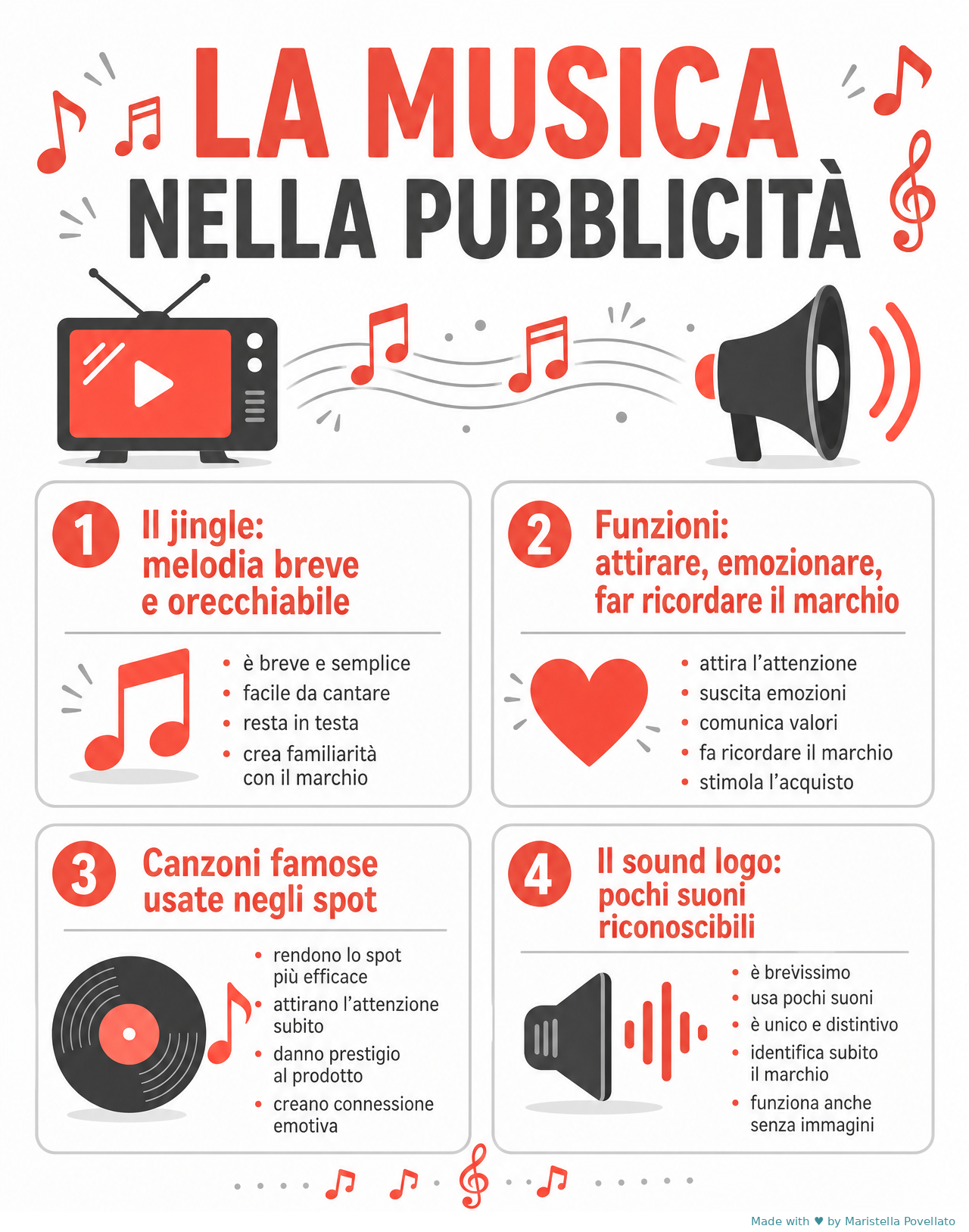
Advertising

Infographic: music in advertising Download

Made with ♥ by Maristella Povellato

Listen to the text

MUSIC IN ADVERTISING — Advertising uses music because sound enters our memory much faster than words. Just a few notes can remind us of a brand, even years later. THE JINGLE — This is a short, catchy, repetitive sung tune, often with the product's name in the lyrics. In Italy, the great testing ground was CAROSELLO (1957-1977): short stories with original music, watched by the whole family. THE SOUND LOGO — Today, many brands have a 2-3-second sound signature: Netflix's 'ta-dum', a computer's startup sound, Intel's five notes, or McDonald's whistle. It is the sound equivalent of a visual logo. THE BORROWED SONG — Many adverts use well-known songs that already exist: the song carries emotions and memories that are transferred to the product. Sometimes the opposite happens: an advert revives an old song, putting it back in the charts. ORIGINAL MUSIC BY NOTED COMPOSERS — Great composers have written for advertising: Ennio Morricone (Barilla), Riz Ortolani, and many pop musicians. HOW IT WORKS — Advertising music carefully chooses its TEMPO (fast = energy, slow = elegance), TIMBRE (strings = sophistication, electric guitar = attitude, electronic sounds = technology) and MODE (major = happiness, minor = nostalgia). Recognising these techniques makes us more aware listeners — and consumers.

Recommended listening
PieceComposer / ArtistFormLink
Sigla di Carosello
Italy's first major television programme built around advertisements.
RAICanzone Listen
Nokia Tune
From a guitar study to everyone's mobile phone.
F. Tárrega (arr.)Canzone Listen
Dove c'è Barilla c'è casa
A great composer working in advertising.
E. MorriconeCanzone Listen
Holidays Are Coming
The most famous Christmas jingle.
Coca-ColaCanzone Listen
I'm Lovin' It
Five notes become a sonic brand.
McDonald'sCanzone Listen
Intel Inside — sound logo
A sound logo lasting just 3 seconds.
IntelCanzone Listen
Netflix — Ta-dum
The sound that announces a brand.
NetflixCanzone Listen
Vieni via con me (advert)
Singer-songwriters' songs used in adverts.
P. ConteCanzone Listen
GO TO QUIZ
15

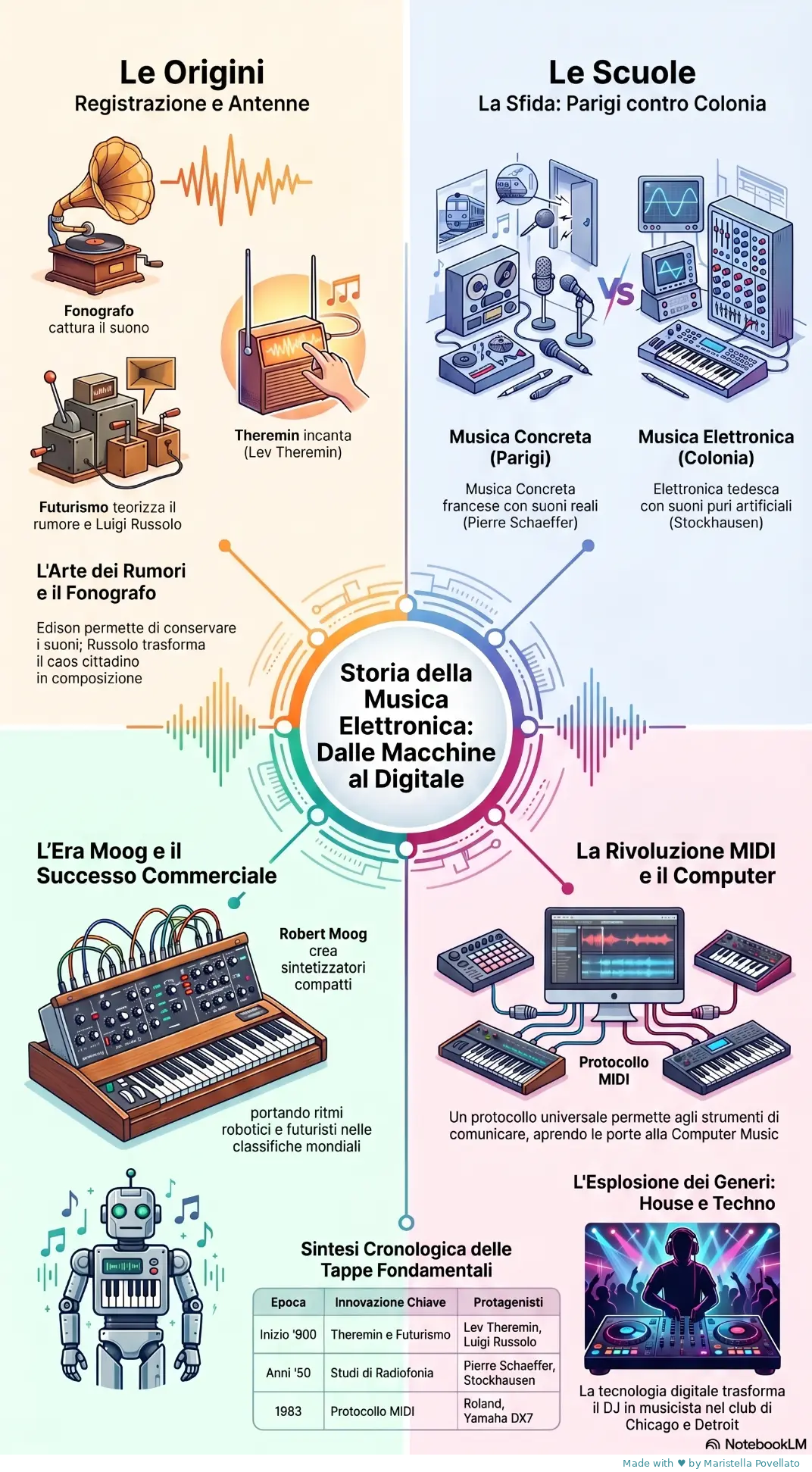
Electronic music

Infographic: the history of electronic music Download

Made with ♥ by Maristella Povellato

Listen to the text

ELECTRONIC MUSIC — This is music produced, transformed or reproduced using electrical and electronic devices: oscillators, synthesizers, recorders and computers. It began when technology first made it possible to PRESERVE sound (Edison's phonograph) and GENERATE IT artificially. THE ORIGINS (early 1900s) — Luigi Russolo's Futurism developed the theory of the ART OF NOISES and built the intonarumori, or noise-making instruments: even the noise of the city could become music. In 1920, Lev Theremin invented the THEREMIN, an instrument played without touching it, by moving the hands between two antennas. The ondes Martenot also appeared, as did radio as a new means of broadcasting. THE TWO SCHOOLS (1950s) — In PARIS, Pierre Schaeffer pioneered MUSIQUE CONCRÈTE: real sounds (trains, voices, objects) are recorded and manipulated by cutting and splicing magnetic tape. In COLOGNE, Karlheinz Stockhausen pioneered pure ELECTRONIC MUSIC: sounds are generated by oscillators, in other words, created from scratch. In Italy, the RAI's Studio di Fonologia in Milan hosted Berio and Maderna. THE MOOG ERA — In the 1960s, Robert Moog built compact synthesizers that could be played as instruments: they reached the charts through Wendy Carlos, Pink Floyd and Kraftwerk, whose robotic rhythms paved the way for all the dance music that followed. MIDI AND COMPUTERS — In 1983, the MIDI protocol allowed keyboards, drum machines and computers to speak the same language: computer music emerged, and anyone could compose at home using a sequencer. HOUSE, TECHNO AND TODAY — From the clubs of Chicago (house) and Detroit (techno), electronic music conquered the world: the DJ became a musician who builds a track live. Today, sampling, loops and software form the basis of pop, rap and soundtracks.

Recommended listening
PieceComposer / ArtistFormLink
Futurist intonarumori
Futurism brings the noises of the city into music.
L. RussoloCanzone Listen
Theremin — Il cigno
The instrument you play without touching it: a continuous, 'space-like' sound.
C. Saint-Saëns / L. ThereminBrano strumentale Listen
Étude aux chemins de fer
Musique concrète: real sounds recorded and manipulated.
P. SchaefferCanzone Listen
Gesang der Jünglinge
A boy's voice and synthesized sounds: the Cologne studio.
K. StockhausenCanzone Listen
Poème électronique
Pure electronic music for the 1958 Brussels Expo.
E. VarèseCanzone Listen
Switched-On Bach
Bach performed entirely on a Moog synthesizer: the hit that brought electronic music into the mainstream.
W. CarlosTrascrizione Listen
Autobahn
A motorway journey told through synthetic sounds and a mechanical rhythm.
KraftwerkCanzone Listen
Oxygène (Part IV)
Melodic electronic music from the 1970s, featuring sequences and layers of synthesizer sound.
J.-M. JarreBrano strumentale Listen
Blue Monday
Drum machines and sequencers: the bridge between pop and club music.
New OrderCanzone Listen
Strings of Life
A Detroit techno classic.
Derrick MayBrano strumentale Listen
Around the World
French house: loops, filters and a robotic voice.
Daft PunkCanzone Listen
GO TO QUIZ
16

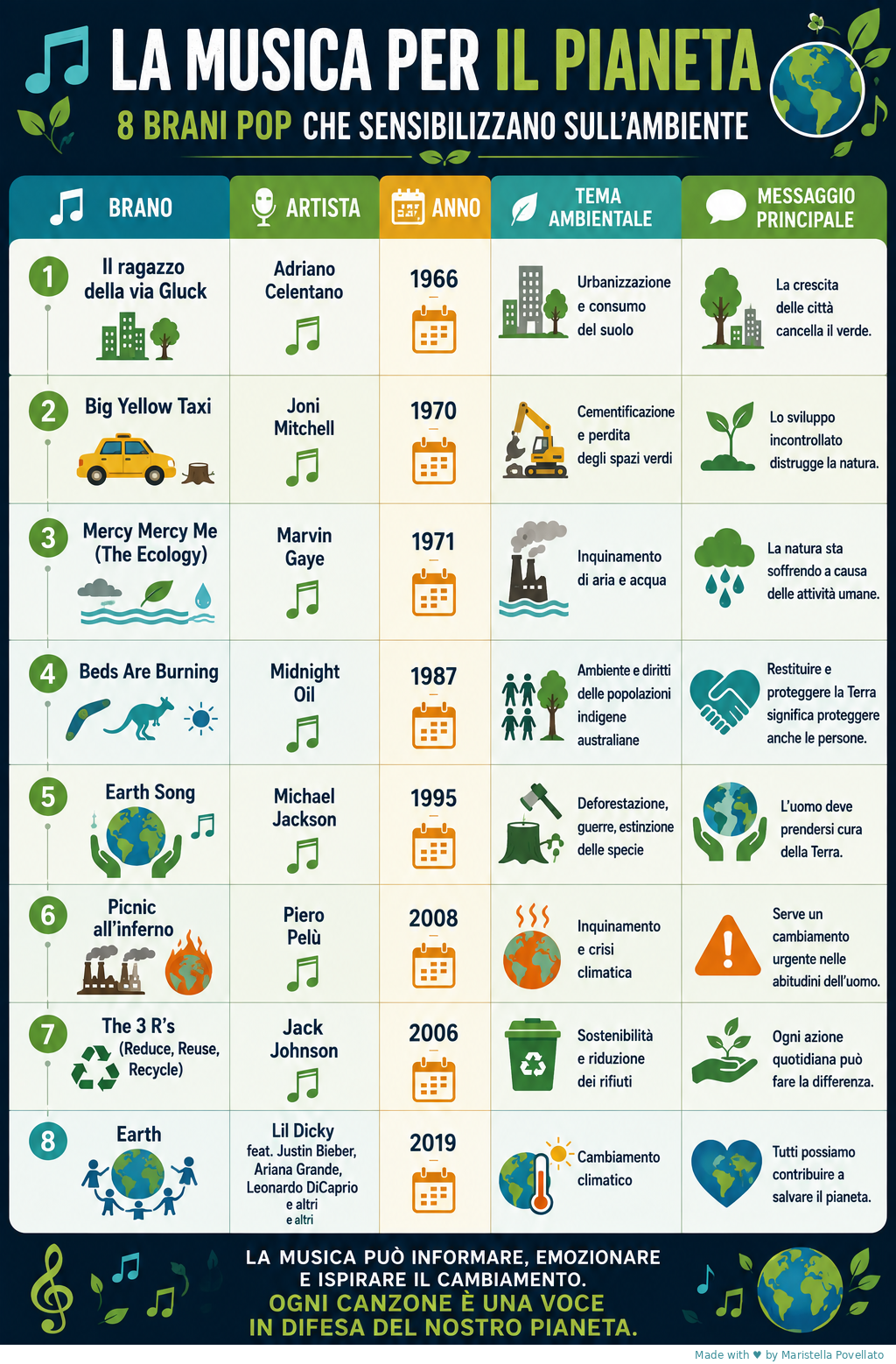
Music and Citizenship Education

Infographic: music for the planet Download

Made with ♥ by Maristella Povellato

Listen to the text

MUSIC, THE RISORGIMENTO AND CITIZENSHIP — Let us return to two nineteenth-century pieces studied in the Romanticism unit in Year Two, to compare belonging, remembrance and participation. VA’, PENSIERO — In Giuseppe Verdi's Nabucco (1842), the exiles remember their homeland: the choral singing expresses shared grief and hope. Listen to the broad melody and the shared phrasing, then reflect on dignity, welcoming others and solidarity, making connections with Articles 2 and 3 of the Constitution. Listen to Va’, pensiero · Va’, pensiero PDF worksheet. INNO DI MAMELI — Il Canto degli Italiani, written by Goffredo Mameli and set to music by Michele Novaro in 1847, is now the national anthem. Follow the march rhythm and sing the refrain as a group, paying attention to your entries and consonants. Compare the words' call for unity with democratic participation, equality and the rejection of war (Articles 1, 3 and 11 of the Constitution): the language of 1847 should be interpreted in its historical context, not as hostility towards other peoples. Listen to Inno di Mameli · Inno di Mameli PDF worksheet. MUSIC AND CITIZENSHIP WORKSHOP — In two groups, compare the beat, tempo and group singing in the pieces. Then discuss: how can we belong to a community without excluding anyone? Choose an activity that welcomes others or encourages participation to carry out at school. Find both complete activities in Special Features. MUSIC AND CITIZENSHIP EDUCATION — Music is not just entertainment: it is a way to speak out about issues that affect everyone. Many songs have told stories of wars, injustice, denied rights and the environmental crisis, reaching people in ways that speeches cannot. MUSIC AND THE ENVIRONMENT — Since the 1960s, artists have spoken out against overdevelopment and pollution: 'Il ragazzo della via Gluck' by Celentano (1966) tells of green spaces disappearing beneath houses; 'Big Yellow Taxi' by Joni Mitchell (1970) and 'Mercy Mercy Me' by Marvin Gaye (1971) describe the destruction of nature and polluted air; 'Beds Are Burning' by Midnight Oil links the environment with the rights of Indigenous peoples; 'Earth Song' by Michael Jackson (1995) and 'Earth' by Lil Dicky (2019) call on us to care for the planet. RIGHTS AND CITIZENSHIP — Music has accompanied major struggles for civil rights: the songs of enslaved African Americans and spirituals, 'Blowin' in the Wind' by Bob Dylan, 'Get Up, Stand Up' by Bob Marley, 'Respect' by Aretha Franklin, and 'Imagine' by John Lennon. In Italy, there are the songs of the Resistance and De André's songs about the disadvantaged and those pushed to the margins of society. THE RULE OF LAW, PEACE AND REMEMBRANCE — Pieces such as 'La guerra di Piero' and 'Il mio nome è mai più' speak about peace; concerts and choirs are used to remember the victims of mafia organisations and the Holocaust. WHAT WE CAN DO — Listen critically to song lyrics, choose legally available music and respect copyright, join choirs and groups to practise working together, and use music to inform our community and raise awareness. Article 9 of the Constitution protects the landscape, cultural heritage and the environment: music is part of this too.

Recommended listening
PieceComposer / ArtistFormLink
Va', pensiero (Nabucco)
1842: the chorus of exiles remembers their homeland; shared phrasing, nostalgia, hope and solidarity.
G. VerdiCoro d'opera Listen
Il Canto degli Italiani (Inno di Mameli)
1847: a marching rhythm and collective singing; unity and participation, to be compared with the constitutional principles of equality and peace.
M. Novaro · testo di G. MameliInno nazionale Listen
Il ragazzo della via Gluck
1966: green spaces disappearing beneath the concrete of cities.
A. CelentanoCanzone Listen
Big Yellow Taxi
1970: 'they paved paradise and put up a parking lot'.
J. MitchellCanzone Listen
Mercy Mercy Me (The Ecology)
1971: soul music speaking out against air and water pollution.
M. GayeCanzone Listen
Beds Are Burning
The environment and the rights of Aboriginal Australian peoples.
Midnight OilCanzone Listen
Earth Song
An environmental song.
M. JacksonCanzone Listen
The 3 R's
Reduce, reuse, recycle: environmental education through song.
J. JohnsonCanzone Listen
Earth
2019: dozens of artists come together for the climate.
Lil DickyCanzone Listen
Imagine
The world's most famous anthem for peace.
J. LennonCanzone Listen
Blowin' in the Wind
Protest song and civil rights.
B. DylanCanzone Listen
Get Up, Stand Up
Reggae and the struggle for rights.
B. MarleyCanzone Listen
La guerra di Piero
An anti-war song.
F. De AndréCanzone Listen
GO TO QUIZ
17

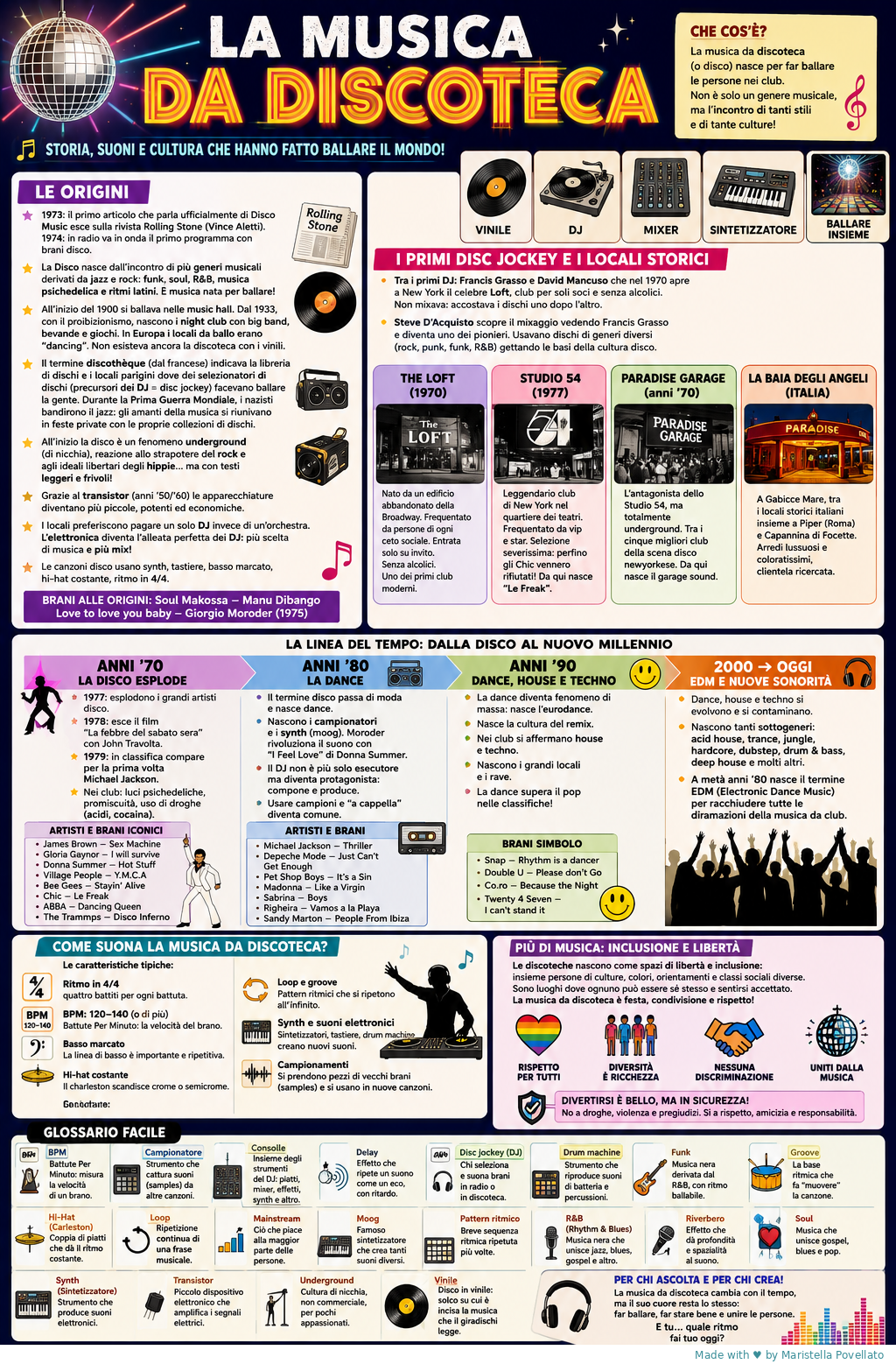
Dance music and nightclubs

Infographic: nightclub music Download

Made with ♥ by Maristella Povellato

Listen to the text

DANCE MUSIC — This is music designed for dancing: it is born in clubs and thrives on the relationship between the DJ and the dance floor. It is not a single genre, but a meeting of many styles and cultures. THE ORIGINS — In the early seventies, DISCO MUSIC emerged in New York from a blend of funk, soul, R&B and Latin rhythms. The French word discothèque referred to venues where people danced to records instead of an orchestra. David Mancuso's Loft, Studio 54 and Paradise Garage became iconic venues; in Italy, these included Baia degli Angeli, Piper and Capannina. WHAT IT SOUNDS LIKE — A 4/4 beat, 120-140 BPM, a strong, repetitive bass line, a steady hi-hat, repeating loops and grooves, synthesizers and samples. The structure is designed for mixing: one track flows into the next without interrupting the dancing. THE TIMELINE — 1970s: disco takes off (Donna Summer, Bee Gees, Chic, Village People), and in 1977 the film 'La febbre del sabato sera' brings it to the world. 1980s: the term DANCE comes into use, and samplers and drum machines arrive (Moog and 'I Feel Love'); the DJ is no longer just a performer, but also a composer. 1990s: HOUSE, TECHNO and EURODANCE emerge, along with remix culture and raves. From 2000 to today: EDM (Electronic Dance Music) brings together trance, dubstep, drum & bass and deep house, and DJs become festival stars. MUSIC AND INCLUSION — Nightclubs also emerged as spaces of freedom where people of different cultures, backgrounds and sexual orientations could meet: dance music is about celebration, sharing and respect. Have fun, but stay safe: say no to drugs, violence and prejudice.

GO TO QUIZ