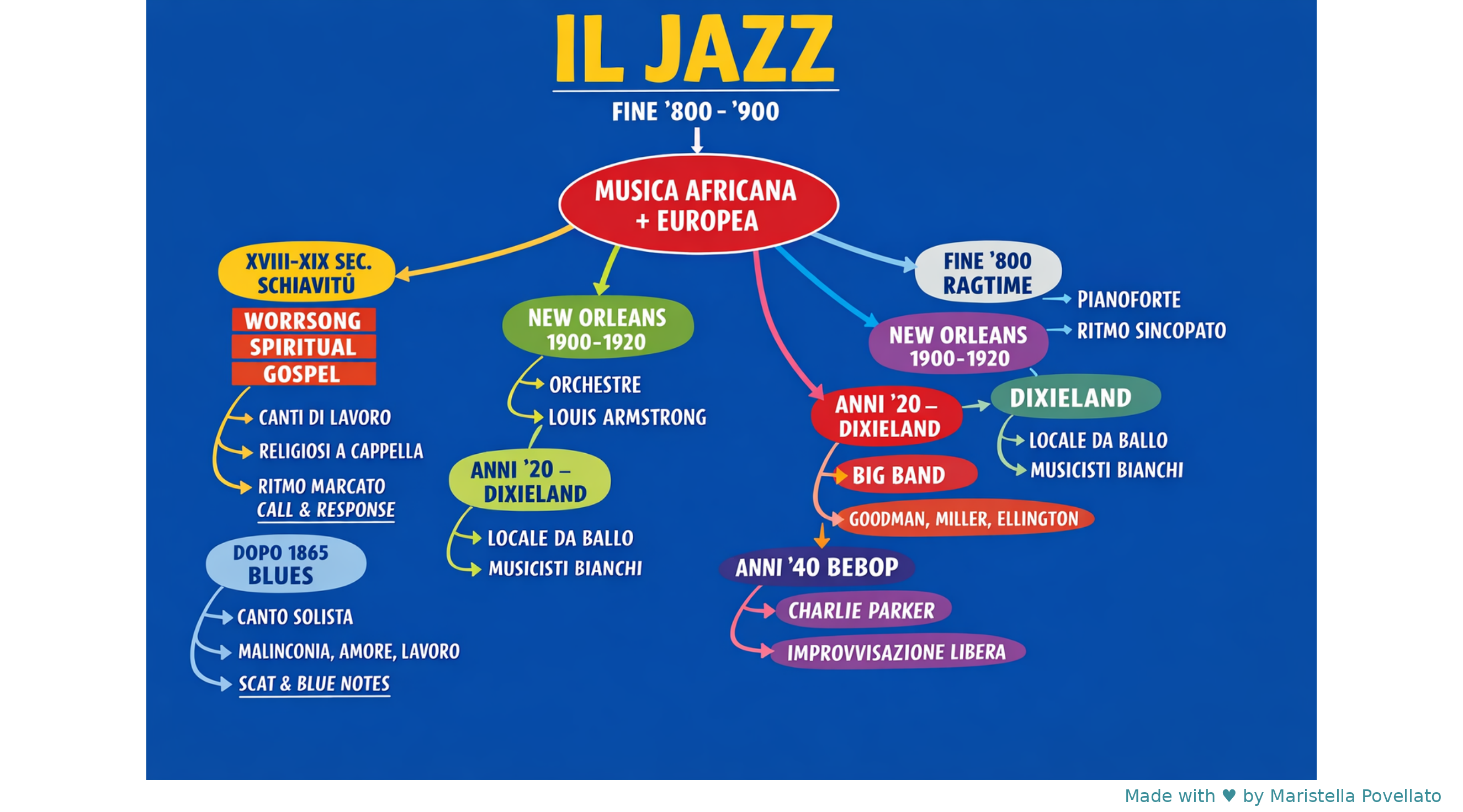
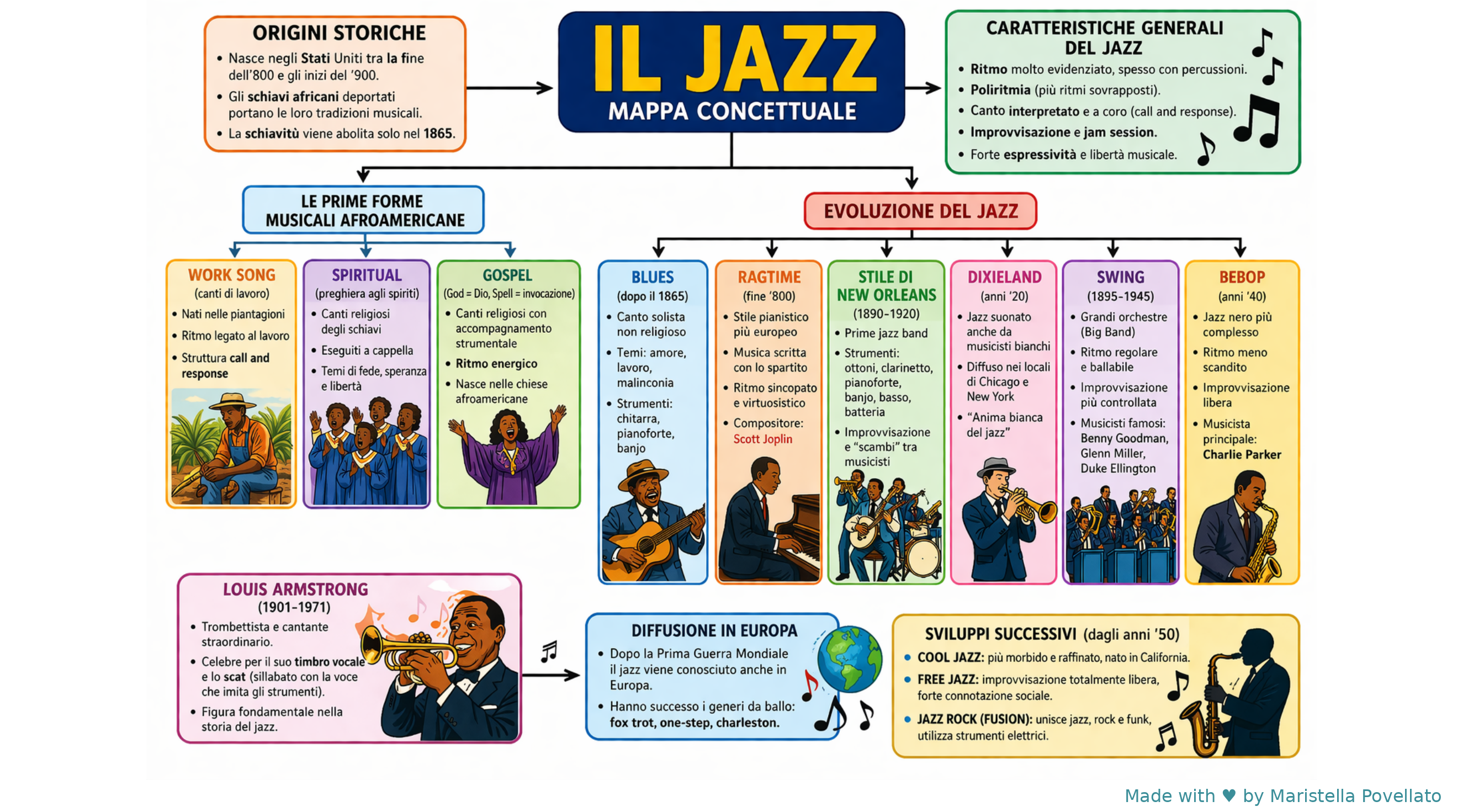
Jazz emerged in the United States between the late nineteenth and early twentieth centuries, from the meeting of African music brought by enslaved people forcibly transported to plantations in the South and the European classical music of the settlers.
Its ROOTS lie in the songs of enslaved people: work songs (songs sung while working in the fields, with a call-and-response structure), spirituals (a cappella religious songs inspired by the Bible) and gospel songs (religious songs accompanied by instruments, with an infectious rhythm).
AFTER THE ABOLITION OF SLAVERY (1865), THE BLUES EMERGED — It is the solo song of someone telling the story of their life: hard work in the fields, poverty, prison and lost love, but also laughter and the desire for freedom. A single voice, free and expressive, in dialogue with the instruments: almost all jazz starts with the blues.
THE STRUCTURE — THE 12-BAR CHORD PROGRESSION — The most traditional Blues is a cycle of 12 bars in 4/4, repeated unchanged from beginning to end, using just three chords: the tonic (I), the subdominant (IV) and the dominant (V).
| Bars | Chord | What happens |
|---|
| 1-4 | I (tonic) | The singer presents their phrase |
| 5-6 | IV (subdominant) | The phrase repeats, moving up a fourth |
| 7-8 | I (tonic) | The phrase returns to the tonic |
| 9 | V (dominant) | The chord that creates tension: the turning point of the progression |
| 10 | IV (subdominant) | The music heads back home |
| 11-12 | I (tonic, with a move to V) | The ending: the progression is complete and can begin again |
WORKSHEET — «ROUTE 66»: THE 12-BAR CHORD PROGRESSION
«Route 66», written by Bobby Troup in 1946 and made famous by Nat King Cole, is a standard based on the blues. Here we provide a simplified accompaniment for learning in Fa, with three seventh chords: Fa7 (F7), Si♭7 (B♭7) and Do7 (C7). This is not an exact transcription of the recording: jazz versions may add passing chords and chord substitutions.
Each bar contains four beats. The progression is divided into three groups of four bars; after the twelfth bar, you return to the first. In the second bar we use the «quick change», an early move to chord IV.
| Bar | Chord | Scale degree and function |
|---|
| 1 | Fa7 — F7 | I7: tonic, start of the progression |
| 2 | Si♭7 — B♭7 | IV7: subdominant, quick change |
| 3 | Fa7 — F7 | I7: return to the tonic |
| 4 | Fa7 — F7 | I7: end of the first phrase |
| 5 | Si♭7 — B♭7 | IV7: start of the second phrase |
| 6 | Si♭7 — B♭7 | IV7: staying on the subdominant |
| 7 | Fa7 — F7 | I7: return to the tonic |
| 8 | Fa7 — F7 | I7: end of the second phrase |
| 9 | Do7 — C7 | V7: dominant, tension |
| 10 | Si♭7 — B♭7 | IV7: moving down towards the tonic |
| 11 | Fa7 — F7 | I7: resolution |
| 12 | Do7 — C7 | V7: leading into the next cycle |
To finish the piece, bar 12 of the final cycle can stay on Fa7 instead of leading into another cycle with Do7.
ACTIVITY — Count «1, 2, 3, 4» aloud for each bar and tap a steady beat along with the progression. Divide the class into three groups: one follows Fa7, one Si♭7 and one Do7; each group raises their hands when their chord comes along. Then compare the chart with the recording: identify where the melody returns and any chords added by the musicians.
Listen to «Route 66» — Nat King Cole
Find out more: blues form and the chords of «Route 66»
WORKSHEET — «SWEET HOME CHICAGO»: THE 12-BAR CHORD PROGRESSION
«Sweet Home Chicago», recorded by Robert Johnson in 1936 with voice and guitar, is one of the best-known blues songs. For practice, we use a simplified learning progression in Mi: Mi7 (E7), La7 (A7) and Si7 (B7). The chart is not an exact transcription of the historical recording: Johnson's phrasing is free, and different performances may vary the accompaniment.
The time signature is 4/4: count four beats per bar, with a shuffle feel. As in the «Route 66» worksheet, the move to chord IV in bar 2 is the «quick change».
| Bar | Chord | Scale degree and function |
|---|
| 1 | Mi7 — E7 | I7: tonic, start of the progression |
| 2 | La7 — A7 | IV7: subdominant, quick change |
| 3 | Mi7 — E7 | I7: return to the tonic |
| 4 | Mi7 — E7 | I7: end of the first phrase |
| 5 | La7 — A7 | IV7: start of the second phrase |
| 6 | La7 — A7 | IV7: staying on the subdominant |
| 7 | Mi7 — E7 | I7: return to the tonic |
| 8 | Mi7 — E7 | I7: end of the second phrase |
| 9 | Si7 — B7 | V7: dominant, tension |
| 10 | La7 — A7 | IV7: moving down towards the tonic |
| 11 | Mi7 — E7 | I7: resolution |
| 12 | Si7 — B7 | V7: leading into the next cycle |
To close the final cycle, bar 12 can stay on Mi7. For an even simpler first practice exercise, you can also keep Mi7 in bar 2, without a quick change.
ACTIVITY — First follow the progression without the recording, counting «1, 2, 3, 4» and pointing to each bar in the table. One group sings a short phrase they have made up, a second group repeats it and a third responds: this lets you explore AAB form. Then listen to Robert Johnson and identify how the guitar answers the voice; compare this stripped-down sound with Nat King Cole's trio in «Route 66».
Listen to «Sweet Home Chicago» — Robert Johnson
THE LYRICS — AAB FORM — Each verse lasts twelve bars and has three four-bar phrases: the first is sung, the second repeats it almost unchanged, and the third ends it differently.
| Part | Where it falls | What it does |
|---|
| A (bars 1-4) | over the first chord | Introduces the idea: «I woke up this morning...» |
| A (bars 5-8) | over the second | Repeats the same phrase to fix it in the memory |
| B (bars 9-12) | over the dominant | Completes or reverses it: this is the moral of the story |
THE ELEMENTS OF THE SOUND —
| Element | What it is |
|---|
| Blue notes | The 3rd, 5th and 7th notes of the scale are lowered or «bent»: they give the blues its sad, tense tone colour |
| Blues scale | Six notes (1, 3b, 4, 5b, 5, 7): the lowered 5th is the typical «blue note» |
| Shuffle rhythm | The quavers are «drawn out», one long and one short: this is the uneven, loping rhythm of the blues |
| Bending and slide | The note is bent with the fingers (bending), or its pitch is changed by sliding a bottleneck along the strings (slide) |
| Call and response | The voice calls and the instrument answers: this is a legacy of work songs |
| Improvisation | The progression stays the same, but the music does not: every performance is different |
THE INSTRUMENTS —
• VOICE — the first instrument: rough, nasal and full of moans, cries and whispers.
• GUITAR — first acoustic in the fields of the South, then electric in the cities; played using slide and bending techniques.
• HARMONICA (mouth organ) — played by «bending» notes with the breath: it becomes a cry.
• PIANO — in saloons and dance halls, with the alternating bass of boogie-woogie.
• BANJO — in the early days, before the guitar was used.
• BASS AND DRUMS — in electric bands: they are the heart of the rhythm.
• BRASS AND CLARINETS — when the blues meets the first jazz bands.
BLUES STYLES —
| Style | Where and when | What it sounds like |
|---|
| Delta / country blues | Southern USA, early 1900s | Voice and acoustic guitar alone, bottleneck slide |
| Classic blues | 1920s, city theatres | A singer with a small jazz band: piano, clarinet and trumpet |
| Chicago blues | 1940s-1950s, the industrial North | Electric guitar, harmonica, bass and drums: an amplified, hard-edged sound |
| Texas blues | 1950s-1980s | Bright electric guitar, soloists with a full, singing tone |
| Rhythm & blues | 1940s-1950s | Fast, danceable blues with shouted vocals: rock 'n' roll would grow out of this |
IN THE LISTENING EXAMPLES — «St. Louis Blues» by Bessie Smith is classic blues; «Hoochie Coochie Man» by Muddy Waters is Chicago blues: compare them and identify the guitar, harmonica and drums.
Piano RAGTIME spread through saloons (Scott Joplin, Jelly Roll Morton). Brass bands and the first jazz bands emerged in New Orleans (King Oliver, Louis Armstrong): this was the NEW ORLEANS / DIXIELAND style, with collective improvisation.
In the 1930s-1940s, big-band SWING was hugely popular (Duke Ellington, Benny Goodman, Glenn Miller): a steady rhythm for dancing. In the 1940s, BEBOP (Charlie Parker, Dizzy Gillespie) brought jazz back to its African American roots: virtuosity, free improvisation and music for listening. This was followed by COOL JAZZ (Miles Davis), FREE JAZZ (Coltrane, Ornette Coleman) and JAZZ ROCK / FUSION with electric instruments.